

Russia revives prewar Nato demands as Trump opens door to wider security talks
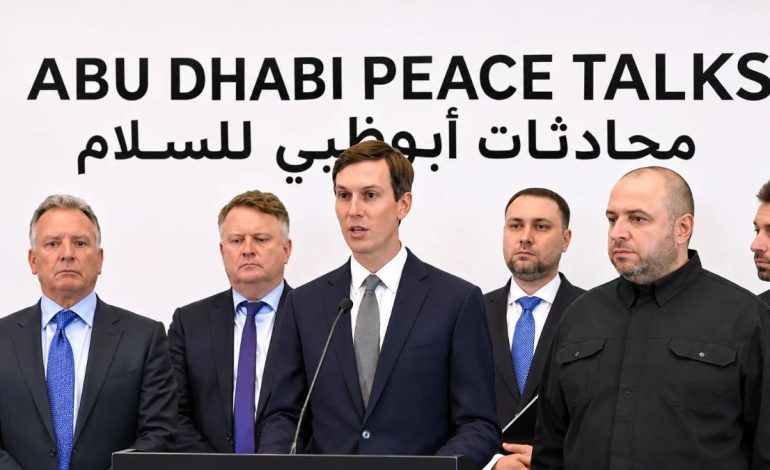
(Image courtesy: Digitaly enhanced screenshot of a video posted by X/@jaredkushner)

New Delhi: Russia has used a US proposal to discuss Europe’s postwar security arrangements to revive demands it made in 2021, before launching its full-scale invasion of Ukraine. The move has raised concerns in Kyiv and among western allies that wider negotiations could weaken Nato and allow Moscow to reshape Europe’s security order.
The proposal to discuss broader security arrangements was floated by the US president, Donald Trump’s, envoys as Washington seeks a path towards ending the war, which is approaching its fifth year. The Kremlin has welcomed the idea, describing a review of Europe’s security framework as important to a settlement, while reiterating that its core demands remain unchanged, according to the Associated Press.
Russia revives its 2021 security demands
In draft agreements submitted to the United States and Nato in December 2021, two months before the invasion, Moscow demanded guarantees that Ukraine, Georgia and other former Soviet republics would not join the alliance. It also sought restrictions on western weapons deployments and military activity in Ukraine and other former soviet states.
Russia further demanded that Nato refrain from stationing troops in areas where they were absent in 1997, before the alliance expanded into former Soviet bloc countries. Its proposals also called for limits on military patrols near each other’s borders, fewer military exercises and greater transparency. Nato allies rejected the demands as unacceptable.
The Russian president, Vladimir Putin, has again criticized the West for dismissing Moscow’s concerns. “They just spat at our opinion,” he said, referring to the response to Russia’s earlier proposals. He also described the European response as “political diarrhea” and “nonsense”, while insisting that “everybody understands that we don’t strive for a war with Europe”.
Putin said it made no sense to discuss Europe’s security without European countries and said Moscow had invited a European delegation to present its position. He maintained that Russia would not abandon its key demands and warned that European troops deployed in postwar Ukraine would be considered legitimate targets.
The Kremlin foreign affairs advisor, Yuri Ushakov, said Putin had reminded Trump’s envoys, Steve Witkoff, and Jared Kushner, of the 2021 proposals during their November 12 meeting in Moscow. Ushakov said Russia would update them with “fresh considerations”.
Analysts see possible room for compromise
Some analysts believe Moscow’s demands could provide an opening for negotiations on arms limits, military deployments and security arrangements. Pro-Kremlin political commentator, Alexei Naumov, argued that Russia’s demands represented an initial bargaining position that could become more flexible during talks.
“Between maintaining the current status quo and the full realization of Russia’s demands, there is a vast space for compromise,” Naumov said, referring to possible agreements on arms limitations, military infrastructure, Ukraine’s future military structure and security guarantees. He added: “Russia is currently negotiating from a position of strength, but that does not at all mean there will be no compromises.”
Tatiana Stanovaya, an expert at the Carnegie Russia Eurasia Center, said Moscow saw an opportunity to discuss what it calls the “root causes” of the war. She said the Kremlin considered the opportunity worth pursuing despite having low expectations for the current round of talks, adding that Russia was prepared to continue fighting if negotiations failed.
Ukraine and Europe warn against talks without a ceasefire
Ukraine and its European allies fear that discussions about a new security framework before a ceasefire could benefit Moscow and sideline Kyiv. The Ukrainian president, Volodymyr Zelenskyy, has warned that such talks could weaken Nato and reshape Europe’s borders without Ukraine’s participation.
The European Union foreign policy chief, Kaja Kallas, has called for a ceasefire before negotiations move to the wider security architecture. “If we start to talk about what Russia is asking regarding the security architecture, we actually walk into the traps that Russia is setting us,” she said.
Kushner said after meeting Zelenskyy and European leaders in Berlin that Trump wanted an agreement with Europe “by his side”, rather than a unilateral settlement. He also said Trump was open to Nato-like security guarantees for postwar Ukraine and that he believed Russia was “comfortable” with such assurances. However, no agreement on the proposed guarantees has been announced.
Stanovaya predicted that the process could deepen divisions within Europe, with little prospect of concrete results.