



India’s antitank firepower gets new boost as Adani tests Bagheera AT1 missiles
Adani tests Bagheera AT1 missiles

New Delhi: In a major development for India’s indigenous defence industry, Adani Defence & Aerospace has successfully test-fired four antitank guided missiles at Rajasthan’s Pokhran Field Firing Ranges. The company’s Bagheera AT1 missile system demonstrated an antitank engagement range of up to 8 kilometre and the ability to fire two missiles in quick succession to overcome a tank’s protection systems.
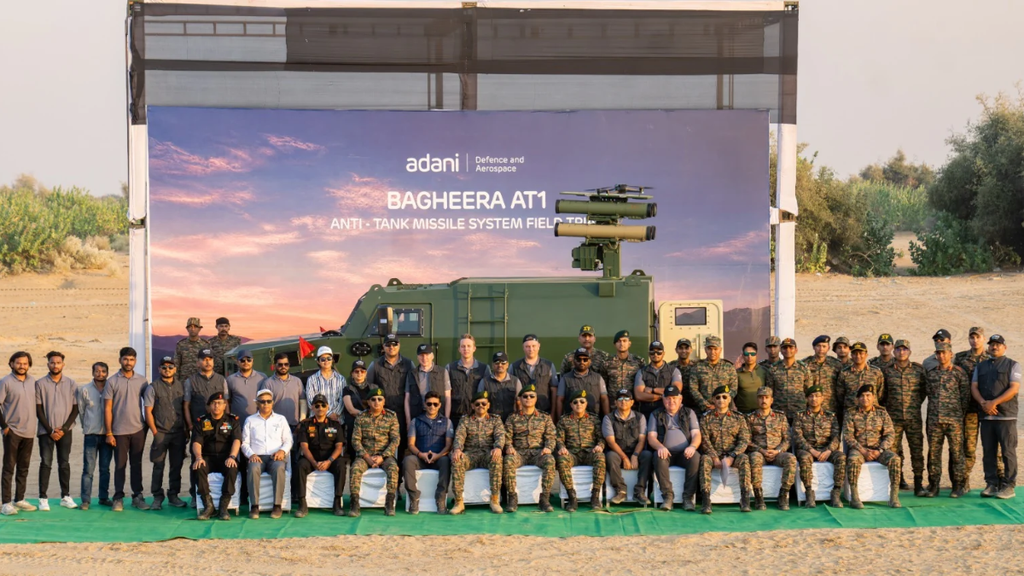
The demonstration was conducted on Friday under the “No Cost, No Commitment” (NCNC) arrangement. According to Adani Defence, senior representatives of the Indian Army, Department of Military Affairs and Ministry of Defence (MoD) witnessed the trials.
The tests covered day and night engagements, a two-missile salvo against a target representing an armoured vehicle and an engagement against an aerial target at extended range. The programme concluded with a static display of the complete missile system.
How does Bagheera AT1 work?
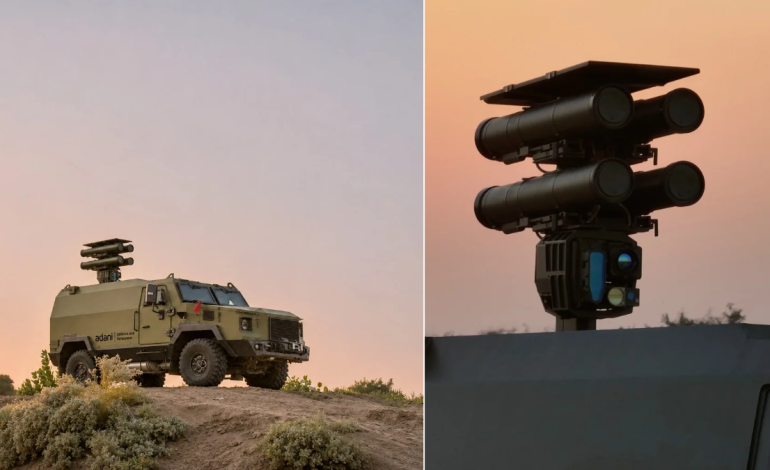
Bagheera AT1 is a vehicle-mounted antitank guided missile system developed and customized by Adani Defence for Indian battlefield conditions. The company said the system underwent 18 months of design and development to meet the Army’s requirements, including India’s terrain and climate.
The missile has an antitank engagement range of up to 8 kilometres, while its wider missile architecture can support guided engagements of up to 10 kilometres. It uses laser beam-riding guidance, meaning the missile follows a laser beam towards its target instead of relying on a radio communication link. According to the company, this makes it highly resistant to electronic jamming.
One of its key features is its two-missile firing capability. Both missiles can be launched in quick succession along the same laser beam against a single target. The first missile is designed to engage a tank’s active protection system (APS), while the second is intended to penetrate its defences.
The complete system includes an automated launcher carrying four ready-to-fire missiles and eight additional reloads onboard. This gives each vehicle a total capacity of 12 missiles. It also has day-vision television cameras, thermal-imaging sights and automated target tracking for operations in different light conditions.
Mounted on an Adani Defence-designed 4×4 high-mobility armoured vehicle, the system allows crews to fire from protected positions and relocate quickly after an engagement. Besides armoured vehicles, it can also engage aerial targets at extended ranges.
India’s antitank missile requirements
The demonstration comes as the Army continues to modernize its antitank capabilities. Its existing inventory includes second-generation Milan-2T and Konkurs-M missiles, while Spike systems have also been inducted to meet immediate operational requirements. India is also progressing with the acquisition of Javelin systems.
Recent conflicts have highlighted the importance of longer-range weapons, mobility and the ability to counter increasingly advanced armoured vehicles. Bagheera AT1 could provide the Army with an additional mobile, long-range ground-based capability alongside its existing man-portable and helicopter-launched antitank missiles.
Adani Defence said the demonstration gives the armed forces a complete system for evaluation. The company has undertaken its development, integration and testing, with the aim of building domestic capabilities in manufacturing, maintenance and long-term support.
Private sector’s growing role in defence production
The development also highlights the expanding role of private companies in India’s defence manufacturing sector. Adani Defence points to figures that say India’s defence production touched a record ₹1.78 lakh crore in FY 2025-26 with the private sector contributing 24 per cent or around ₹42,000 crore. This was an increase from its 22 per cent share in the previous financial year.
India’s defence exports also reached a record ₹38,424 crore during the period.
Adani Defence said the programme would help India develop and manufacture advanced defence equipment locally. It would also support the Atmanirbhar Bharat (self-reliant India) initiative and reduce India’s dependence on imports.