


Indian student jailed for 30 years in UK for grooming 70 girls online; police fear 180 victims. How a complaint blew the lid off
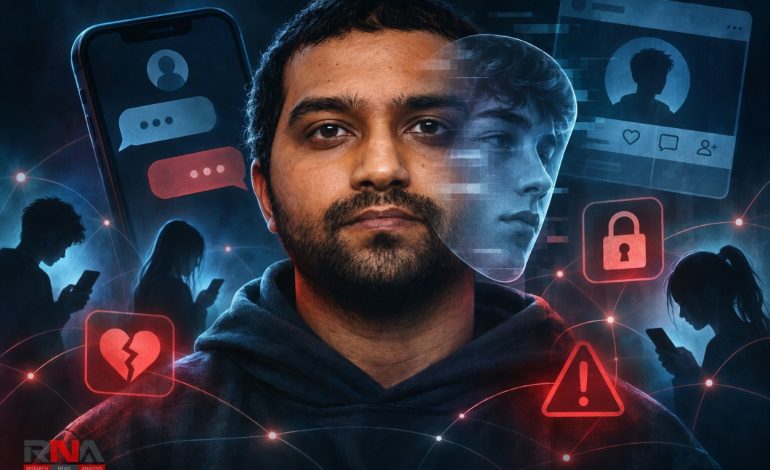
RNA Media illustration featuring Bilal Kazi for representation.

New Delhi: An Indian student who posed as a British teenager to sexually exploit and blackmail dozens of young girls across the United Kingdom has been sentenced to 30 years in prison, following one of the largest online child sexual abuse investigations conducted by Cheshire police. The case, involving at least 70 identified victims and potentially 180 children, has exposed serious vulnerabilities in social media and online gaming platforms that allow sexual predators to approach minors under false identities.
Bilal Kazi, 27, originally from Mumbai, received the sentence at Chester crown court on Friday after admitting multiple child sexual abuse offences committed between 2021 and 2025. The court also imposed an additional eight-year extended licence period, under which he will face supervision and restrictions following his release from prison.
Kazi, who had studied at the University of Chester before moving to Birmingham, used photographs of an unidentified British boy to create an online identity called “Reece”. According to Cheshire constabulary, he contacted girls through Snapchat, Wink and the online gaming platform Roblox, gradually convincing them that they were communicating with a teenage boy interested in a romantic relationship.
Once the girls trusted him, Kazi persuaded them to send intimate photographs and videos, often presenting such exchanges as normal behaviour between romantic partners. When they resisted further demands, he threatened to circulate material already obtained, turning the supposed relationships into a sustained campaign of intimidation and sexual exploitation.
Investigators established that some victims remained in contact with him for more than a year, unaware that the person they believed to be their boyfriend was an adult operating behind a fabricated identity. The identified victims were aged between 11 and 17 when the offences occurred, although prosecutors confirmed that his offending also involved a child younger than 13.
How one complaint uncovered a nationwide abuse network
The investigation began after a 13-year-old girl reported Kazi to Derbyshire Police in November 2021, having initially believed that she was communicating with someone her own age. When she attempted to end the sexual exchanges, he became threatening, and intimate material she had shared was subsequently circulated among her friends after her Snapchat account was compromised.
Cheshire Constabulary assumed responsibility for the investigation in May 2022 after officers established that Kazi had previously lived in Chester but attempts to locate him revealed that he had left Britain. He was eventually arrested at Heathrow Airport in July 2023 on his return to the country, allowing investigators to seize and examine his mobile telephone.
The forensic examination uncovered evidence of a much wider pattern of offending than the initial complaint had suggested, prompting a nationwide effort to identify children associated with usernames and other digital records. Police identified approximately 180 potential victims, eventually tracing 70 girls across 28 of Britain’s 45 police force areas.
Each identified victim was approached by police and offered an opportunity to describe her experiences, making the investigation an unusually extensive exercise in digital evidence recovery and victim identification. The scale of the operation required coordination between Cheshire constabulary, West Midlands police and specialist child abuse investigators.
According to the Crown Prosecution Service, investigators recovered more than 400 indecent images and videos from Kazi’s telephone during the Cheshire investigation, alongside another 500 from devices examined in Birmingham. Prosecutors also revealed that one video he had published online was viewed by 93 people, illustrating how material obtained through coercion could spread beyond its original recipient.
Offences continued despite police intervention
An especially disturbing aspect of the case was Kazi’s continued offending after he had already come under criminal investigation and police supervision. Prosecutors confirmed that he was a registered sex offender and subject to a sexual risk order when some of the offences occurred, raising questions about the effectiveness of existing restrictions in preventing repeat online abuse.
Cheshire police said Kazi admitted 37 of 39 charges brought in its investigation, with two charges left on file, and faced eight additional offences investigated by West Midlands Police. The prosecution service specified that the sentencing covered 33 offences, including 24 counts of causing a child to engage in sexual activity, six counts of blackmail and three counts of making indecent photographs of children.
Sentencing him, Judge Steven Everett described Kazi as a dangerous sexual predator whose conduct had inflicted serious psychological harm on children who believed they were entering genuine relationships. The court heard accounts of lasting emotional distress, with some victims struggling with anxiety, depression and other consequences of the exploitation.
Kazi must serve at least 20 years before becoming eligible for parole, and his release will remain subject to the applicable legal process rather than occurring automatically. He was also placed under a sexual harm prevention order and a restraining order intended to reduce the risk of further offending.
Case raises questions over online child protection
The prosecution has renewed scrutiny of how easily adults can misrepresent their identities on digital platforms frequently used by children, particularly where gaming interactions lead to private conversations on social media. It also demonstrates how offenders can exploit emotional dependence and the threat of public humiliation to maintain control over victims without ever meeting them physically.
Georgia Hughes, a detective constable who worked on the investigation, rejected the misconception that crimes committed online are necessarily less damaging than those involving physical contact. Police said the victims had suffered profound and lasting psychological consequences, with some carrying the fear of further exposure for years.
The case also illustrates the importance of cooperation between police forces and digital forensic specialists, particularly when offenders target children across multiple jurisdictions. British authorities have urged parents to understand the platforms their children use, encourage open communication about online relationships and report suspected grooming before threats escalate.
For victims, the Report Remove service operated through Childline and the Internet Watch Foundation offers assistance in removing sexual images shared online. British prosecutors have emphasized that responsibility for such exploitation rests entirely with offenders, regardless of whether children were manipulated into initially sharing material.