


Myanmar military captures key rebel command centre, 10 bases as resistance suffers fresh setbacks
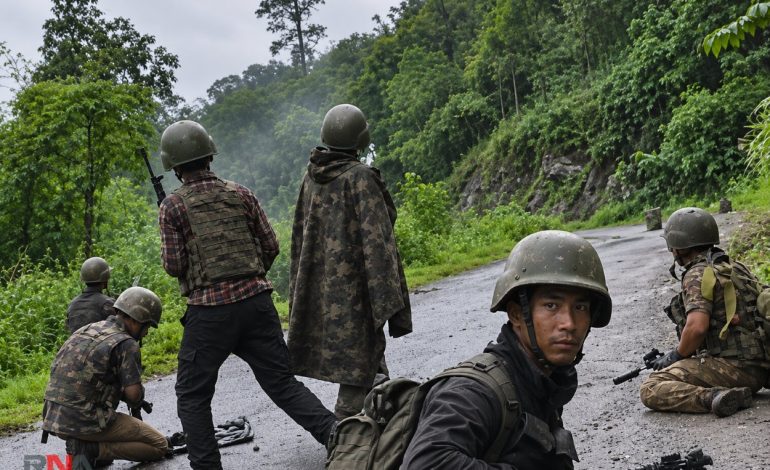
This digitally enhanced screenshot from a widely circulated video on social media purportedly shows the Burmese insurgent group Arakan Army fighting Myanmar government forces in a mountainous and forested region in Rakhine State.

New Delhi: Myanmar’s military has claimed a major battlefield victory after capturing a major command headquarters of the pro-democracy resistance and 10 other fortified positions in the country’s southeast, dealing another setback to armed groups fighting to overthrow military-backed rule. The reported gains come as government forces intensify their counteroffensive across several conflict zones, attempting to reverse territorial losses suffered during more than five years of civil war.
According to Myanmar’s state-run Myanma Alinn newspaper, troops overran the positions during a six-day operation in the forested mountains separating Mon state from the Bago region, approximately 120 kilometres northeast of Yangon. The captured installations reportedly included a special regional military headquarters operated by the opposition National Unity Government (NUG) and a battalion headquarters belonging to the Karen National Liberation Army (KNLA), an established ethnic armed organization.
The operation reportedly began on November 3, with government columns advancing from Theinzayat towards resistance-controlled areas around Kyaikto township in Mon state and Shwegyin township in Bago. According to Eleven Media Group, which carried details of the military’s account, government troops fought four engagements between November 5 and 8 before securing the positions.
Military authorities claimed their forces recovered 97 firearms, more than 12,000 rounds of ammunition, 362 drone-delivered explosives and 139 landmines, besides vehicles, communications equipment and computers. State media published photographs purportedly showing soldiers occupying the captured installations, although neither the extent of the territorial gains nor the quantities of seized equipment could be independently verified.
The NUG and the Karen National Union (KNU), whose armed wing is the KNLA, had not issued an immediate response to the latest claims when the Associated Press reported the developments on Tuesday. Independent verification remains difficult because the military restricts journalists’ access to active combat zones, leaving competing battlefield accounts difficult to establish conclusively.
Why the captured headquarters matters
The reported loss of the NUG’s regional headquarters could have operational consequences extending beyond the immediate fighting, particularly if government forces have disrupted communications and coordination between resistance formations. The command previously claimed responsibility for 12 battalions of the People’s Defence Force (PDF), seven drone units with specialized support capabilities and six additional combat and defence formations operating across Mon, Bago and Kayin states.
The headquarters had already suffered a serious blow in late September when two military fighter aircraft reportedly attacked one of its communications outposts, killing five resistance personnel, including a former government soldier who had defected. The latest operation suggests a sustained military effort to dismantle the resistance’s command infrastructure rather than merely recapture isolated positions.
The developments also reflect a broader shift in the conflict, with government troops recovering strategically important routes and installations previously controlled by opposition forces. An October 29 investigation by Myanmar Now reported that military advances along highways connecting resistance strongholds were disrupting the movement of fighters, weapons and supplies, undermining gains achieved during major rebel offensives in 2023 and 2024.
Further evidence of this changing battlefield emerged on November 8, when the Democratic Voice of Burma reported that the KNU had acknowledged losing two additional outposts in Hpapun township. Karen resistance representatives attributed those reverses to superior government firepower, particularly the extensive use of airstrikes, although fighting continued elsewhere in the region.
Civil war continues despite political transition
Myanmar descended into widespread armed conflict after the military overthrew the elected government of Aung San Suu Kyi on February 1, 2021, triggering mass demonstrations that were violently suppressed. The subsequent emergence of the PDF and its cooperation with long-established ethnic insurgent organizations transformed scattered resistance into a nationwide challenge to military authority.
The military-backed administration assumed office in April this year following elections that excluded major opposition forces and were widely criticized for lacking credibility. The United Nations has questioned whether the political transition represents a genuine return to civilian rule, observing that military influence remains firmly entrenched in the country’s political institutions.
Despite its recent battlefield gains, the military remains engaged in fighting across several regions, and recovering positions does not necessarily guarantee lasting territorial control. Resistance forces retain the ability to conduct dispersed attacks, including increasingly sophisticated drone operations, complicating government efforts to consolidate advances across difficult terrain.
The humanitarian consequences remain severe, with Unicef estimating that 16.2 million people required humanitarian assistance and nearly 3.8 million were internally displaced as of June this year. For India, which shares a 1,643-kilometre border with Myanmar, the continuing instability carries wider implications for frontier security, cross-border movement and connectivity projects linking India’s northeast with Southeast Asia.
The latest territorial reverses underline the growing military pressure on Myanmar’s fragmented resistance, but they do not establish that the government is approaching a decisive victory. Much will depend on whether opposition forces can preserve their command networks, maintain supply lines and reorganize their units before further government offensives threaten their remaining strongholds.