






Earth heating faster than ever as COP31 opens. Scientists warn of unprecedented climate extremes and a hotter 2027
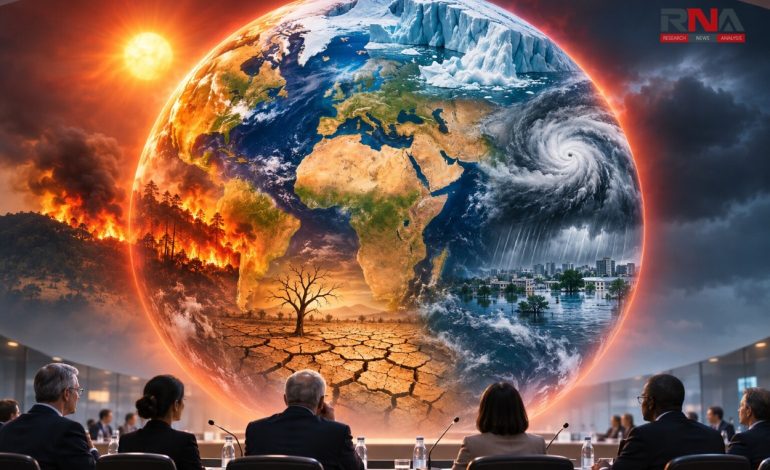
RNA Media illustration for representation.

New Delhi: Earth is accumulating heat at an accelerating rate, disrupting the planet’s natural energy balance and increasing the likelihood of more destructive weather extremes, according to a major United Nations climate assessment released on Monday. The warning comes as world leaders and negotiators gather in Turkey for the COP31 climate summit, with scientists reporting record ocean temperatures, rising sea levels, retreating glaciers and a powerful El Nino threatening to intensify global warming into 2027.
The World Meteorological Organization said the difference between solar energy entering Earth’s climate system and heat escaping into space had reached its highest measured level since monitoring began in 1960. Preliminary observations for the first seven months of 2026 suggest that the imbalance has increased further, indicating that greenhouse gases are trapping additional energy faster than previously observed.
The findings indicate that 2026 will rank among the four warmest years since systematic temperature records began, extending an extraordinary period of global heating. According to the WMO’s State of the Climate Update 2026, average surface temperatures between January and September were approximately 1.47°C above the 1850–1900 pre-industrial baseline, with the final annual figure expected to rise as El Nino strengthens.
The UN secretary general, Antonio Guterres, warned that the combination of human-induced warming and an unusually powerful El Nino was pushing the global climate into increasingly dangerous territory. He said the mounting consequences were falling disproportionately on vulnerable populations, many of which had contributed relatively little to the historical accumulation of greenhouse gases.
Why Earth’s energy imbalance is accelerating
At the centre of the latest assessment is a phenomenon known as Earth’s energy imbalance, which measures the difference between the energy Earth receives from the Sun and the energy it radiates back into space. Under relatively stable climatic conditions, these quantities remain broadly balanced over time, but increasing concentrations of greenhouse gases have progressively disrupted that equilibrium.
Carbon dioxide, methane and other heat-trapping gases absorb outgoing infrared radiation, reducing the rate at which energy escapes into space. The result is a continuing accumulation of heat across the atmosphere, oceans and land, with consequences that extend considerably beyond changes in average air temperature.
The WMO reported that the energy imbalance increased at an estimated rate of 0.3 watts per square metre per decade between 2001 and 2025, compared with 0.13 watts per square metre per decade over the longer 1960–2025 period. This indicates a substantial acceleration in the rate at which the climate system is retaining energy, reinforcing concerns about the long-term effects of greenhouse gas emissions.
The concentration of atmospheric carbon dioxide reached approximately 426.8 parts per million in 2025, representing a 53 per cent increase from the estimated pre-industrial level of 278 parts per million in 1750. Methane concentrations have also increased sharply, adding to the warming influence of carbon dioxide and other greenhouse gases.
These changes are particularly significant because greenhouse gases remain in the climate system for different lengths of time, and some of their effects persist for centuries. Consequently, reducing emissions can limit future warming, but cannot immediately reverse the heat already accumulated in oceans and other components of Earth’s climate system.
Oceans absorb most of the excess heat
The world’s oceans absorb approximately 90 per cent of the excess heat retained by greenhouse gases, making ocean heat content one of the most important indicators of long-term climate change. According to the WMO, ocean heat reached a record level in 2025, with preliminary observations indicating that 2026 is on course to become the tenth consecutive year of record ocean warmth.
The warming of the upper 2,000 metres of the oceans has accelerated particularly sharply over the past two decades, affecting marine ecosystems, fisheries and the capacity of seawater to absorb atmospheric carbon dioxide. Higher ocean temperatures can also provide additional energy and moisture for tropical cyclones, potentially increasing their intensity and rainfall when other atmospheric conditions are favourable.
Global mean sea level reached another record high in 2026, continuing an accelerating trend observed by satellites since 1993. The increase results principally from the thermal expansion of warming seawater and the additional water entering the oceans as glaciers and continental ice sheets melt.
The implications are especially serious for densely populated coastal regions, where even relatively small increases in sea level can worsen storm surges, coastal erosion and saltwater intrusion. The WMO estimates that approximately 900 million people live in low-lying coastal areas exposed to growing risks, making adaptation an increasingly important concern for governments and urban planners.
A powerful El Nino could make 2027 even hotter
Another major concern is the rapid development of an exceptionally strong El Nino, the periodic warming of surface waters across the central and eastern tropical Pacific Ocean. The phenomenon influences atmospheric circulation and rainfall patterns worldwide, often producing droughts in some regions and unusually heavy precipitation in others.
El Nino conditions began strengthening in August and could reach record intensity by December, according to the WMO’s latest assessment. The agency expects the phenomenon to continue into early 2027, with its influence on global average temperatures potentially becoming more pronounced next year.
The WMO’s secretary-general, Celeste Saulo, explained that El Nino does not introduce additional heat into Earth’s climate system but redistributes energy already stored in the oceans. Because ocean temperatures are already at record levels, the developing event could amplify the effects of human-induced warming and increase the risks associated with heatwaves, tropical cyclones and extreme rainfall.
El Nino typically raises annual global average temperatures by approximately 0.1°C–0.2°C, although its precise influence varies between events. The WMO cautioned that the interaction between natural climate variability and persistent greenhouse gas-driven warming could produce another exceptionally hot year in 2027.
For India, the development warrants attention because El Nino has historically been associated with an increased probability of deficient southwest monsoon rainfall. However, the relationship is not uniform, and other influences, including the Indian Ocean Dipole and regional atmospheric circulation, can significantly affect seasonal rainfall.
Glaciers retreat as climate disasters intensify
The deterioration of Earth’s frozen regions provides further evidence of the scale of warming, with glaciers worldwide losing more than 400 billion tonnes of ice during 2025. According to the WMO, this was the fourth consecutive year in which all 19 monitored glacierized regions experienced net ice loss, underscoring the widespread nature of the retreat.
Antarctic sea ice reached its third-lowest annual maximum in the satellite record during 2026, while the Arctic winter maximum was either the lowest or second lowest observed. The decline in reflective ice surfaces can reinforce warming by exposing darker ocean waters and land surfaces that absorb more solar energy.
The human consequences have become increasingly visible, with extreme weather causing widespread disruption across several continents during 2026. Preliminary assessments cited by the WMO suggest that heatwaves, droughts and wildfires contributed to more than 30,000 excess deaths in Europe, alongside substantial losses to agriculture, transport and energy infrastructure.
In the Himalayas, the catastrophic collapse of ice and rock followed by flash flooding in Nepal during August killed more than 1,300 people, according to the WMO. The disaster highlighted the dangers confronting mountain communities, where retreating glaciers, unstable slopes and extreme precipitation can combine to produce devastating downstream consequences.
Scientists caution that no individual disaster can automatically be attributed entirely to climate change without a dedicated assessment of its causes. Nevertheless, the increasing frequency and intensity of several categories of extreme weather are consistent with the broader physical consequences of a warming climate.
What the findings mean for India
India faces a particularly complex climate challenge because its large population, dependence on seasonal rainfall and extensive coastline create exposure to several overlapping risks. The WMO estimated that approximately 146.5 million people in India experienced extreme heat during an April 2026 heatwave, illustrating the growing public-health implications of rising temperatures.
Prolonged heatwaves can increase electricity demand, affect agricultural productivity and threaten the health of outdoor workers, particularly in densely populated urban areas. At the same time, intense rainfall can overwhelm drainage systems, damage infrastructure and disrupt economic activity even when total seasonal precipitation remains close to normal.
The Himalayan region presents additional concerns because glacier retreat and changing precipitation patterns can affect river systems, hydropower infrastructure and downstream water security. These developments are especially significant for northern and northeastern India, where infrastructure development and settlements increasingly intersect with environmentally fragile mountain terrain.
India is expected to emphasize climate finance, technology transfer and equitable adaptation measures during COP31, arguing that developing economies require greater international assistance to address risks they did relatively little to create. The environment minister, Bhupender Yadav, said in a November 3 statement that New Delhi would seek predictable, largely public and concessional financial support without imposing additional debt burdens on developing countries.
India has also maintained that emissions-reduction commitments must recognize national circumstances, historical responsibilities and the development requirements of poorer countries. Its negotiating position emphasizes that the transition towards cleaner energy must remain compatible with affordable energy access, economic growth and climate justice.
COP31 faces mounting pressure to deliver
The scientific warnings have intensified scrutiny of COP31, which opened in Antalya on November 9 and will continue until November 20 under an unusual arrangement in which Turkey holds the conference presidency and Australia leads the formal negotiations. The meeting comes against a difficult geopolitical backdrop, with governments divided over financing, fossil-fuel dependence and the distribution of responsibility for reducing emissions.
The United States is absent from the negotiations following the Trump administration’s withdrawal from international climate cooperation, complicating efforts to secure commitments from major emitting economies. Developing countries, meanwhile, are pressing wealthier nations to provide greater financial support for climate adaptation and recovery from increasingly destructive disasters.
The latest UN Environment Programme Emissions Gap Report 2026 has reinforced concerns that existing national commitments remain insufficient to meet the Paris Agreement’s temperature objectives. It estimates that global greenhouse gas emissions must fall by 18 per cent by 2030, 45 per cent by 2035 and 69 per cent by 2040, compared with 2025 levels, to follow a pathway that limits the overshoot of 1.5°C and enables temperatures to return towards that threshold later this century.
The distinction between temporarily exceeding 1.5°C in an individual year and crossing the Paris Agreement’s long-term warming threshold remains important. Nevertheless, the succession of exceptionally hot years indicates that the window for limiting sustained warming is narrowing, making rapid emissions reductions and stronger adaptation measures increasingly urgent.
The WMO also stressed that better forecasting and early-warning systems can substantially reduce the human and economic costs of extreme weather. The number of countries reporting multi-hazard early-warning capabilities increased from 56 in 2015 to 136 in 2025, demonstrating that investments in monitoring, forecasting and public preparedness can produce measurable improvements.
The central issue confronting COP31 is therefore not simply whether governments can agree on more ambitious climate commitments, but whether those commitments can be translated into sufficiently rapid and sustained action. With Earth retaining heat at an accelerating rate and a powerful El Nino threatening further disruption, the scientific evidence suggests that delays in reducing emissions will make the task of protecting communities, economies and ecosystems progressively more difficult.


