AI misuse and nuclear war among 17 threats to humanity’s future, Lancet warns
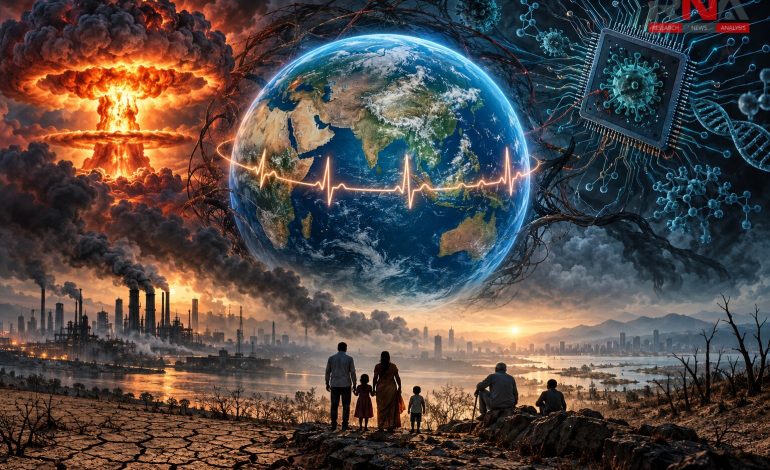
RNA Media illustration for representation.

New Delhi: The malicious use of artificial intelligence and nuclear conflict could threaten humanity’s survival this century, a Lancet commission has warned in an assessment identifying 17 interconnected dangers to global health. Its findings also highlight the enormous harm that preventable disease, environmental damage and social inequality could cause between 2025 and 2100 unless governments strengthen prevention and preparedness.
The Lancet Commission on 21st century global threats to health, launched at the World Health Summit in Berlin on October 11, 2026, examines risks extending well beyond hospitals and infectious diseases. Drawing on projections covering 204 countries and territories, it brings gradual health deterioration and sudden catastrophic events into a common assessment of future harm.
The findings distinguish between threats capable of causing human extinction and those expected to inflict exceptionally large losses of healthy life. They do not predict that humanity will disappear by 2100; instead, they identify dangers whose consequences warrant preventive action, including events considered unlikely.
AI misuse and nuclear conflict fall into the first category because their worst outcomes could extend far beyond the immediate victims. The pathways examined include AI-assisted development of biological weapons and a nuclear conflict that sends particles into the upper atmosphere, reduces sunlight and disrupts food production sufficiently to cause widespread famine.
The uncertainty surrounding these risks is substantial, according to the Norwegian Institute of Public Health, whose researchers contributed to the commission. Unlike familiar diseases, their probabilities cannot be calculated reliably from historical experience and therefore depend on expert assessments.
The other 15 threats encompass air pollution, antimicrobial resistance, childhood malnutrition, climate change and conventional armed conflict. They also include declining international development assistance for health, high alcohol consumption, high blood pressure, income inequality and low educational attainment.
Naturally occurring pandemics, obesity, poor mental health, smoking and unhealthy ageing complete the list. Their inclusion reflects the commission’s broad definition of a health threat, covering diseases and behavioural risks alongside economic, environmental and security conditions that shape people’s chances of living healthy lives.
To compare such different dangers, the researchers used disability-adjusted life years, or DALYs, a measure combining years lost to premature death with years lived in reduced health. One DALY represents one lost year of healthy life, allowing long periods of illness and disability to be considered alongside mortality.
For each threat, the commission compared plausible better and worse futures to estimate how much health loss policy interventions could avert. Its criteria for identifying a catastrophic threat included a potential burden of at least one billion DALYs by 2100, sufficient evidence for modelling and meaningful scope for action.
Obesity and associated dietary and lifestyle risks emerged as the largest preventable burden, while low educational attainment and income inequality were also major drivers. Improving education could avert an estimated 16.1 billion lost healthy life years, while reducing income inequality could avert about 13.8 billion, according to Medical Xpress’s account of the findings.
Climate change illustrates both the scale of the projected damage and the limits of what researchers can quantify. The commission estimated that restricting warming to around 1.8°C rather than 4.4°C could avert 1.89 billion lost healthy life years, while acknowledging that harder-to-measure consequences, including displacement and mental health effects, could make the actual burden greater.
The assessment’s central argument is that these dangers interact, making isolated responses inadequate. Its framework consequently places health planning alongside decisions on finance, defence, climate and technology, rather than assigning responsibility solely to health ministries.
The commission’s recommendations centre on stronger health systems, investment in breakthrough technologies and regular monitoring of emerging threats. Proposed priorities include sustained preparedness funding, new vaccines and antibiotics, better obesity treatments and climate technologies, with attention to access for disadvantaged populations.
It also proposes dedicated government capacity for anticipating risks and an independent mechanism to update assessments annually and bring findings to finance and national security decision-makers. The purpose is to make prevention a continuing function of government, reducing dependence on emergency responses after a crisis has already begun.
The findings are intended to evolve as evidence and circumstances change, rather than serve as a permanent ranking of dangers. The commission’s broader message is that substantial future harm remains avoidable, but protecting health will require coordinated decisions across sectors and national borders.