

Army major faces termination over alleged affairs, Armed Forces Tribunal refuses to halt proceedings
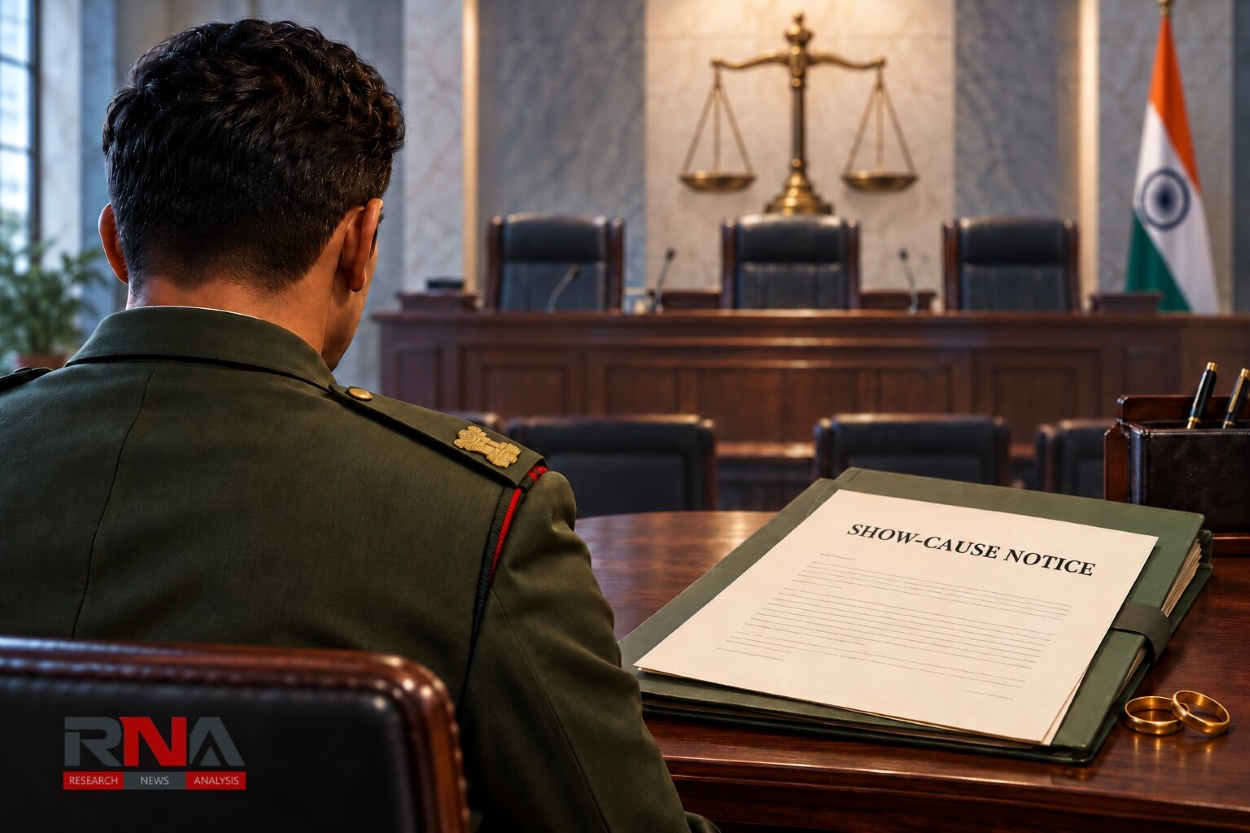
RNA Media illustration for representation.

New Delhi: An Indian Army major facing allegations of extramarital relationships with four women, including the wives of two fellow officers, faces possible termination of service after the Armed Forces Tribunal declined to halt administrative proceedings against him. The tribunal directed him to answer the Army’s show-cause notice while requiring the authorities to provide documents he had sought for his defence.
The officer belongs to 11 Armoured Regiment and is currently attached to 23 Grenadiers, according to the Indian Express. A notice issued by the chief of the Army staff on August 10 this year sought his explanation against administrative termination, stating that the circumstances made a court-martial inexpedient.
The tribunal’s principal bench in New Delhi, comprising Justice Rajendra Menon and Lieutenant General CP Mohanty, disposed of his application on October 14. It told him to present his objections in his response to the notice and directed the Army to supply the court of inquiry findings and hearing-of-charge proceedings.
The decision allows the administrative process to continue; it does not itself terminate the officer’s service or establish the allegations against him. His challenge concerns both the proposed action and whether the investigations afforded him a proper opportunity to defend himself.
The case originated in an August 2023 complaint by his then-wife to the additional directorate general of discipline and vigilance at Army Headquarters, alleging adultery, substance abuse and neglect. Headquarters 55 Independent Mechanised Brigade convened a court of inquiry in October 2023, with further inquiries following.
A tentative chargesheet under sections 45 and 63 of the Army Act was framed in March 2025, followed by the recording of a summary of evidence and additional evidence. The Army subsequently pursued administrative termination instead of proceeding to a court martial.
According to NDTV, the major alleges that the women concerned and their husbands were not examined despite repeated requests, violating safeguards under Army Rule 180. He also contests the procedures used to seize his electronic devices and search his married accommodation.
The officer further submitted that his marriage ended by mutual divorce on March 30, 2026, and that his former wife withdrew her complaint under their settlement. He argues that the withdrawal, together with the alleged procedural defects, undermines the proposed action against him.
The administrative route has a distinct legal basis under Army Rule 14, which governs termination for misconduct under section 19 of the Army Act. It permits such proceedings where the central government or the chief of the Army staff considers a court-martial inexpedient or impracticable but believes the officer’s continued retention is undesirable.
Under that procedure, the officer is ordinarily entitled to receive adverse reports and submit a written explanation and defence, subject to a security-related exception on disclosure. If the explanation is considered unsatisfactory, the case can be placed before the central government with the Army chief’s recommendation for a decision.
The case also illustrates the distinction between the decriminalization of adultery under ordinary criminal law and accountability under military legislation. Section 45 addresses conduct unbecoming an officer’s position, while section 63 concerns acts or omissions prejudicial to good order and military discipline.
In its January 31, 2023, clarification in the Joseph Shine case, the Supreme Court said its earlier judgment striking down the Indian Penal Code’s adultery provision had not examined the operation of these military provisions. Decriminalization therefore does not, by itself, prevent military authorities from pursuing proceedings under the applicable service law, although the merits depend on the facts of each case.
For the major, the immediate requirement is to submit his defence through the show-cause process, supported by the documents the tribunal has ordered the Army to provide. The reported ruling leaves the final administrative decision open rather than resolving the disputed allegations.