




Israeli settlers attack Palestinians, burn olive groves, beat and injure US journalist as attacks engulf West Bank harvest
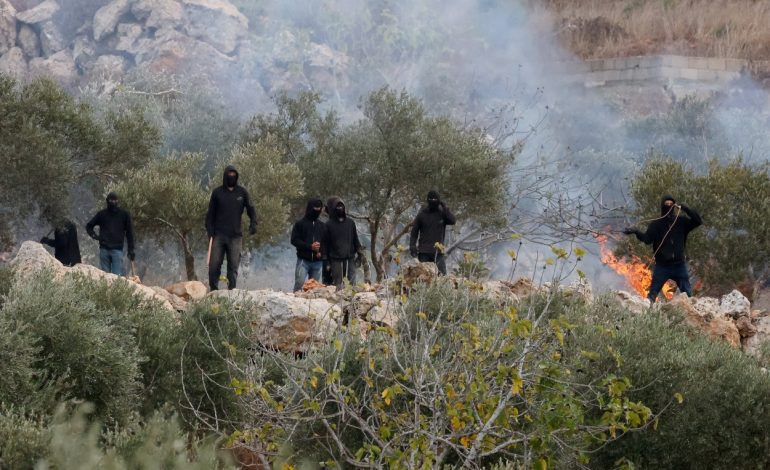
Masked Israeli settlers seen burning olive trees belonging to Palestinian farmers near Ramallah in occupied West Bank during the current ongoing harvest season. (Photo: X/@frontisHQ)

New Delhi: Masked Israeli settlers attacked Palestinian olive harvesters and journalists in the occupied West Bank on Friday, burning trees and vehicles and injuring several people, including an American photojournalist working for the Washington Post. The violence around villages northeast of Ramallah came as restrictions on agricultural access and repeated attacks placed further pressure on Palestinians gathering their annual olive crop.
The most extensively documented assault unfolded near Abu Falah, where dozens of settlers descended towards Palestinian families harvesting terraced olive groves. A Reuters eyewitness account described roughly 80 attackers, some carrying gas canisters, setting trees alight and using slings to throw stones as villagers retreated and then threw stones back.
Among those assaulted was Heidi Levine, a veteran American photojournalist who was wearing protective equipment identifying her as a member of the press. Her media organization reported that she was knocked down, repeatedly kicked and robbed of her cameras and phone before other journalists and Palestinians helped her reach safety.
Speaking after receiving treatment, Levine credited her helmet and protective vest with preventing more serious injuries. She was initially taken to a clinic in Abu Falah and subsequently transferred to a hospital in Ramallah, according to the Times of Israel.
The Palestinian Red Crescent Society reported six people injured in two attacks it attended in Abu Falah, including a 63-year-old woman and a 40-year-old man who required hospital treatment after being beaten. Separately, settlers attacked harvesters near Turmus Ayya and burned three Palestinian-owned vehicles, extending the violence beyond a single village.
Witnesses also raised questions about the conduct of Israeli troops at Abu Falah. Reuters reported that the assault continued after military vehicles arrived, soldiers fired tear gas towards Palestinians, and its photographer saw an armed settler discharge a weapon.
The Israeli military and police subsequently announced investigations into the violence, saying investigators would enter the area under military escort to collect evidence and testimony. They said violence was treated seriously, particularly attacks on journalists carrying out their work, while police also opened an investigation into the burning of vehicles near Turmus Ayya.
Agricultural restrictions across Area C
The attacks coincided with restrictions that the Associated Press reported prohibit Palestinians from harvesting in Area C this year. The region encompasses most of the West Bank’s agricultural land, making access restrictions consequential for both the current harvest and rural household incomes.
Area C is an administrative designation established under the Oslo framework and covers more than 60 per cent of the West Bank. According to the UN humanitarian affairs office, OCHA, Israel retains near-exclusive control there, including over law enforcement, planning and construction.
The restrictions operate alongside localized permissions that can leave farmers with too little time or access to gather their crop. In an October 15 assessment, the humanitarian analysis organization ACAPS said farmers in Faqqu’a had received permission to harvest approximately 20 of 2,500 dunums in Wadi Masus, with access limited to a single day for work normally requiring five or six days.
ACAPS also reported that about 35 per cent of olive-growing land in Bethlehem governorate was inaccessible to farmers by October 4. Across the West Bank, it estimated that restrictions and settler attacks threatened the livelihoods of between 80,000 and 100,000 families dependent on olives and olive oil.
For those households, being prevented from reaching a grove can mean losing income even when the trees themselves survive. Burning or cutting down trees compounds that immediate loss by damaging the productive assets on which subsequent harvests depend.
International reaction
The Washington Post condemned the assault on Levine and urged the authorities to conduct a thorough investigation and pursue accountability. Its executive editor, Matt Murray, expressed outrage that a journalist had been attacked while doing her job, while welcoming the fact that she had received medical care and was safe.
The wider international response to settler violence predates Friday’s attacks and includes diplomatic condemnation and sanctions. A European Union report published in July reiterated demands that Israel protect Palestinians, hold perpetrators accountable and halt settlement activity, which the EU considers illegal under international law.
Canada has also used sanctions against extremist settler violence, with amended regulations published in June. Its official explanation described the sustained escalation in attacks on Palestinians and their property as a threat to international peace and security.
Britain previously sanctioned outposts and organizations supporting extremist settlers, explicitly highlighting the vulnerability of Palestinians during the olive harvest. Those measures, announced in October 2024, form part of the international response to the broader pattern of violence rather than a new response to the Abu Falah assault.
The scale of that pattern is documented in the EU’s July report, which cited OCHA figures recording 1,828 settler attacks causing casualties or property damage during 2025. The report warned that violence, restricted access to land and inadequate accountability were contributing to Palestinian displacement and expanding settlers’ territorial control.
Friday’s announcement of investigations therefore places renewed attention on whether evidence will lead to prosecutions and effective protection for harvesters and journalists. The same EU assessment, citing the Israeli rights organization Yesh Din, noted that 93 per cent of police investigations into settler attacks between 2005 and 2022 had closed without indictments.



