




Houthi attack on Yemen’s presidential palace in Aden kills five; Saudi Arabia says it intercepted missile over Medina
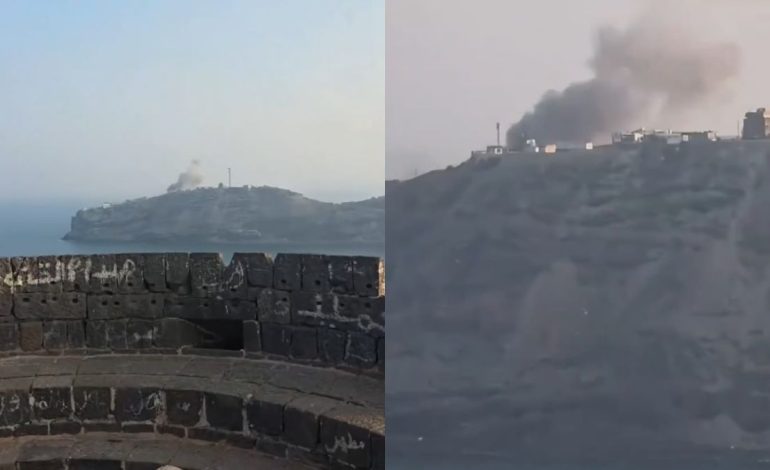
Smoke rises after reported strikes in Yemen. (Image courtesy: Screen Shorts via X/@cym27s)

New Delhi: Yemen’s Iran-aligned Houthi movement struck the al-Maashiq presidential palace complex in Aden with missiles and drones on Thursday, killing five people and injuring 16. The attack hit the seat of the internationally recognized government, although the prime minister and other cabinet members were reported safe.
Separately, Saudi Arabia’s military coalition said it intercepted and destroyed a cruise missile over Medina province the same day. Its initial announcement did not identify the launcher or intended target, and Houthi military spokesman, Yahya Saree denied the group’s involvement.
Yemen’s information minister, Moammar al-Eryani, said five ballistic missiles had been fired at the palace. Health minister, Qasim Buhaibeh said the casualties included guards and civilian employees, revising initial reports of two deaths and six injuries. The government also reported that drones were involved.
The Houthis claimed they had attacked a Saudi military operations headquarters in Aden. Houthi-run media said Saudi officers operated the facility and stored weapons there, but those claims have not been independently verified.
Yemen’s prime minister, Shaya al-Zindani, condemned the attack as “cowardly” and a continuation of the Houthis’ criminal behaviour. He said the government would continue functioning despite the strike and vowed that its forces would press ahead with military operations against the Houthis along Yemen’s southwestern Red Sea coast and other front lines.
Saudi coalition reports further missile and drone interceptions
The Medina incident drew particular attention because the province includes the Prophet’s Mosque, one of Islam’s holiest sites. There was no independently established link between the intercepted missile and the assault on Aden.
The coalition separately reported intercepting drones over the oil-producing eastern province and near Khamis Mushait, close to a military airbase. It also reported destroying another drone heading towards southern Saudi Arabia, without linking all the interceptions to a single attack.
At a briefing, coalition spokesman, major general Turki al-Maliki said the Houthis had carried out 20 attacks on Riyadh’s King Khalid International Airport in October, killing 17 people and injuring 333. He also reported deaths and injuries at Abha airport and said coalition strikes had destroyed 127 weapons storage facilities and launch platforms in Yemen. These figures are the coalition’s assessments.
Saudi Arabia also accused Iran of encouraging the latest Houthi attacks and continuing to provide military assistance to the group. “We think that the escalation by the Houthis at this latest stage of the conflict is encouraged by Iran,” the kingdom’s deputy foreign minister, Rayed Krimly, said. Tehran has previously denied supplying weapons to the Houthis, while its foreign minister, Abbas Araghchi, has offered to facilitate talks between Saudi Arabia and the group.
The governing council of the UN’s International Civil Aviation Organization condemned attacks on Saudi civilian aviation infrastructure, while the UN security council condemned the continuing strikes against the kingdom. Flight disruptions have spread across Saudi Arabia amid repeated attacks on airports and energy facilities.
The renewed attacks follow an earlier strike on Saudi Aramco’s headquarters complex in Dhahran, which triggered a fire without causing casualties. Saudi-led coalition operations around Yemen’s Houthi-controlled capital, Sanaa, have also intensified, while both sides continue to issue warnings over attacks on military and civilian infrastructure.
Aden attack deepens Yemen’s renewed conflict
Aden has housed Yemen’s internationally recognized government since the Houthis seized Sanaa in 2014, prompting a Saudi-led intervention the following year. The latest strike brought the fighting to a complex associated with the country’s leadership, although the Houthis described their intended target as a military headquarters.
The informal ceasefire that followed the 2022 truce began unravelling in July, when the Houthis announced a maritime embargo against Saudi Arabia and intensified attacks on its infrastructure. Fighting escalated in September after the group captured territory along Yemen’s south-western Red Sea coast near the strategically important Bab al-Mandab Strait. Saudi-backed government forces subsequently launched a counter-offensive and reported recapturing positions overlooking the vital shipping passage.
In Taiz, the World Food Programme says it cannot reach more than 600,000 people dependent on food assistance as fighting and restrictions worsen the humanitarian situation.
Yemen’s presidential leadership council chairman, Rashad al-Alimi, spoke to the prime minister, Shaya al-Zindani and other officials after the strike. He ordered investigations, assistance for victims’ families and additional security for state institutions, according to his office.
The coalition has urged the Houthis to stop attacking civilian infrastructure, while the group has warned airlines that Saudi airspace is unsafe, excluding the holy cities of Mecca and Medina. No evidence has established that the missile intercepted over Medina was part of the Aden operation.