


China, North Korea open New Yalu River Bridge after 12-year wait to boost trade
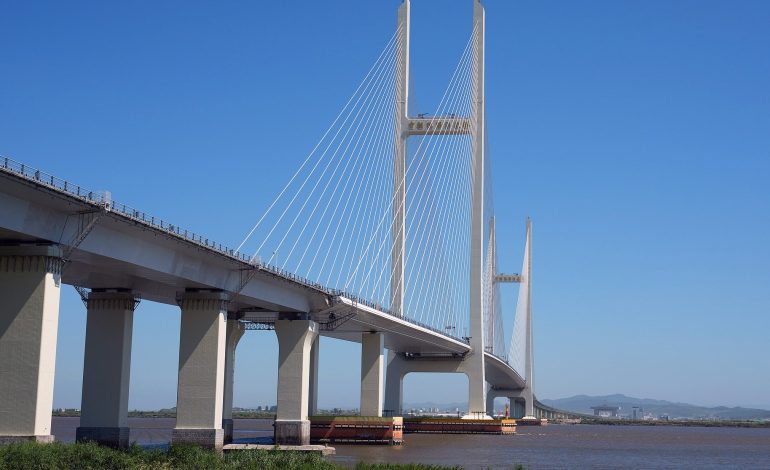
The China-North Korea New Yalu River Bridge. (Photo: X/@BridgingNews_)

New Delhi: China and North Korea opened the New Yalu River Bridge on Thursday, bringing a long-delayed border crossing into service 12 years after its construction was completed. The four-lane road link connects Dandong in China’s northeastern Liaoning province with Sinuiju in North Korea, creating a larger gateway for commerce between Pyongyang and its most important trading partner.
Lorries travelled in both directions during the inauguration, with Chinese and North Korean flags lining the crossing and spectators gathering on the Dandong side. NK News reported that the opening ceremony began at 10am local time, marking the end of years in which the completed bridge stood unused across the border river.
The prime minister of China, Li Qiang, and his North Korean counterpart, Pak Thae-song, delivered video addresses at the ceremony, according to South Korea’s SBS. Li described the crossing as an important infrastructure project supported by the president of China, Xi Jinping, and the North Korean leader, Kim Jong-un.
In his address, Li urged the two countries to use the opening to improve customs clearance, strengthen transport connections and develop cooperation between their border regions. His emphasis on clearance procedures underscored that the bridge’s commercial value will depend on how efficiently goods can move through the facilities at either end.
The 3,026-metre crossing provides two lanes in each direction, offering substantially more road capacity than the ageing Sino-Korean Friendship Bridge nearby. According to Xinhua’s report of the opening, the older combined road-and-rail bridge accommodated one-way road traffic and restricted lorries to a maximum weight of 20 tonnes.
The new cable-stayed bridge has a deck measuring 28.5 metres across, with navigation clearance designed for vessels in the 3,000-tonne class. China and North Korea agreed in 2010 to build the road crossing downstream from the existing bridge, seeking to improve transport through their principal border trading hub.
Although the structure was completed in 2014, the connecting roads and customs infrastructure on the North Korean side remained unfinished for years. The delay left a major Chinese investment without an operational connection to North Korea’s road network, preventing the crossing from fulfilling its intended role in bilateral trade.
The infrastructure shortfall unfolded against a difficult political backdrop, including tensions over Pyongyang’s nuclear tests and subsequent international sanctions. Pandemic border restrictions later compounded the disruption, further postponing the prospect of normal commercial activity across the new crossing.
Its opening is expected to make the transport of bulky freight easier, particularly industrial machinery, raw materials and construction supplies. Lim Eul-chul, a North Korea specialist at Kyungnam University, told AFP that safety concerns surrounding the narrow older bridge had complicated heavy shipments, while the new route would improve their movement and efficiency.
The inauguration also provides a tangible sign of renewed engagement between Beijing and Pyongyang as North Korea strengthens its connections with neighbouring powers. It follows the opening of a road bridge with Russia in September, giving the country another overland route alongside its established dependence on Chinese trade.
China remains central to North Korea’s civilian economy, even as Pyongyang’s military and political relationship with Moscow has expanded. Chinese exports to North Korea reached $2.3 billion in 2025, rising 25 per cent from the previous year, although they remained below levels recorded before the tightening of UN sanctions in 2017.
Beijing has presented the bridge as a means of expanding both trade and exchanges between people, but the opening does not itself establish unrestricted passenger access. At an October 14 foreign ministry briefing, the spokesperson, Mao Ning, confirmed the inauguration without directly answering a question about whether initial operations would be limited to freight.
Nor does additional transport capacity remove the sanctions and administrative restrictions governing commerce with North Korea. The immediate achievement is a functioning road connection; the scale of its economic impact will become clearer as regular freight movements establish how extensively the two governments intend to use it.



