Veer Guardian 2026: IAF chief calls Japan ‘friend in need’ as Japanese fighters make India debut
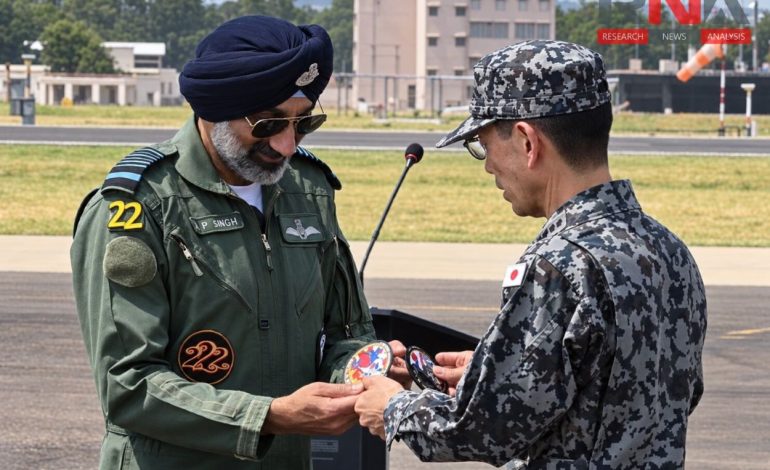
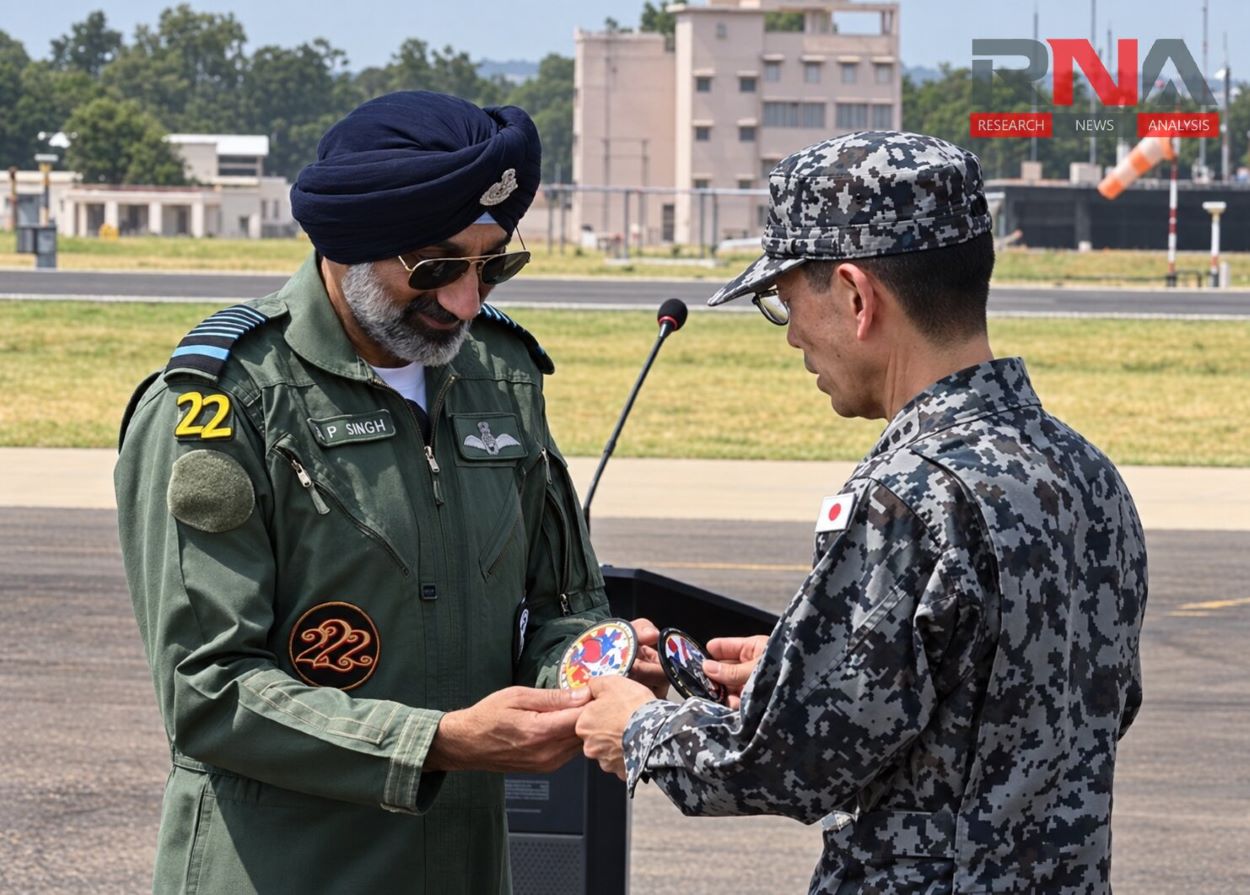
IAF chief Air Chief Marshal Amar Preet Singh (L) and JASDF chief General Takehiro Morita exchange their original squadron patches at Jodhpur airbase.

New Delhi: The Indian Air Force chief, Air Chief Marshal Amar Preet Singh, has described Japan as an “Apatsu Mitram” – a friend in times of difficulty – as Japanese fighters operated from Indian soil for the first time during Exercise Veer Guardian 2026. He said the landmark deployment reflected growing trust between the two air forces and the expanding strategic partnership between New Delhi and Tokyo.
Singh made the remarks at Air Force Station Jodhpur on Sunday alongside the chief of staff of the Japan Air Self-Defense Force (JASDF), General Takehiro Morita. As RNA Media reported earlier on Sunday, the two commanders also flew in Tejas light combat aircraft during the exercise, providing a visible demonstration of the increasingly close operational relationship between the services.
“There is a Sanskrit expression which says ‘Apatsu Mitram’ – ‘a friend in time of need,’” Singh said. He added that the phrase captured the spirit of a partnership built on professional trust, mutual respect and a shared commitment to peace and stability.
The exercise marks the first deployment of Japanese fighter aircraft to India for bilateral combat training. Three JASDF F-2A fighters and about 110 Japanese personnel were expected to participate in the drills.
The Indian Air Force has fielded the indigenous Tejas, Rafale and Su-30MKI fighters, while Japan is participating with the Mitsubishi F-2A – a much bigger variant of the US F-16 made with significant Japanese content for long-range marine roles. It is made by Mitsubishi Heavy Industries and Lockheed Martin and incorporates a larger wing, extensive use of composite materials and Japanese electronic systems.
The training includes complex operational missions, coordinated air-combat manoeuvres, mission planning and extensive professional interaction between pilots, engineers and other specialists.
ACM Singh called the operation of Japanese fighters from an Indian base a major milestone in the history of bilateral military cooperation. Their arrival also completed an exchange that could not take place during the Indian Air Force’s multinational Exercise Tarang Shakti in 2024, when adverse weather over Southeast Asia prevented Japanese aircraft from reaching India, although a JASDF ground contingent participated.
The Indian air chief said the latest exercise showed that defence engagement between the two countries had advanced beyond visits and subject-matter expert exchanges to tactical-level training in a demanding operational environment. Flying and training together allowed personnel to understand each other’s procedures, exchange operational experience and improve their respective capabilities, he added.
ACM Singh described the resulting synergy using the Japanese word “kizuna”, meaning an enduring bond or connection strengthened through shared experience and mutual respect. He said this relationship had developed steadily through activities ranging from Exercise Shinyuu Maitri, which focuses principally on airlift and humanitarian operations, to advanced fighter training under Veer Guardian.
Gen Morita, meanwhile, praised the Tejas as an embodiment of India’s indigenous defence and aerospace capabilities. He said flying in the aircraft had given him a first-hand appreciation of the Indian Air Force’s training environment and the work undertaken by Indian military and industrial teams to develop the fighter.
Gen Morita described his Tejas sortie as both a valuable professional experience and a symbol of the confidence built between the two services over several years. The aircraft, designed by the Aeronautical Development Agency and manufactured by Hindustan Aeronautics Limited, forms an important part of India’s effort to replace ageing fighter fleets with domestically produced platforms.
The appearance of the two air chiefs in Tejas aircraft also carried diplomatic and industrial significance beyond the immediate training value of the sortie. It placed India’s indigenous fighter programme before a senior representative of one of Asia’s most technologically advanced air forces while underlining Japan’s willingness to expand operational engagement with India.
Veer Guardian 2026, being held in Jodhpur until September 22, is the second edition of the bilateral fighter exercise. The inaugural edition took place at Japan’s Hyakuri Air Base and Iruma Air Base in January 2023, with the Indian Air Force deploying Su-30MKI fighters supported by transport and aerial-refuelling aircraft.
The reciprocal edition in India allows Japanese pilots to train against and alongside a wider combination of Indian fighters. For both sides, such exposure is valuable because interoperability depends not only on compatible communications but also on familiarity with mission-planning methods, command procedures, flight-safety practices and tactical decision-making.
Japan’s F-2A, operating it alongside the Tejas, Rafale and Su-30MKI gives the exercise a diverse mix of aircraft with substantially different aerodynamic, sensor and combat characteristics.
The exercise is taking place as India and Japan strengthen security cooperation under their special strategic and global partnership. Their defence relationship now covers bilateral and multilateral exercises, maritime security, military technology, logistics cooperation and consultations over developments in the Indo-Pacific.
The two countries are also members of the Quad with Australia and the United States and support a free, open and rules-based Indo-Pacific. Although Veer Guardian is a bilateral training engagement and is not directed against a declared adversary, its growing complexity reflects shared concern over regional military developments and the importance both governments attach to credible deterrence.
The defence minister, Rajnath Singh, earlier described the maiden arrival of JASDF fighters in India as a significant milestone demonstrating growing trust between the countries. He said such exchanges reinforced their shared commitment to peace and stability across the Indo-Pacific.
For the Indian Air Force and the JASDF, however, the immediate value lies in converting political convergence into practical operational familiarity. Veer Guardian 2026 shows that the relationship is moving from periodic engagement towards sustained and increasingly sophisticated air-power cooperation.