


US paid a heavy price in Iran war, weapons stocks, bases took major hit, Pentagon report reveals
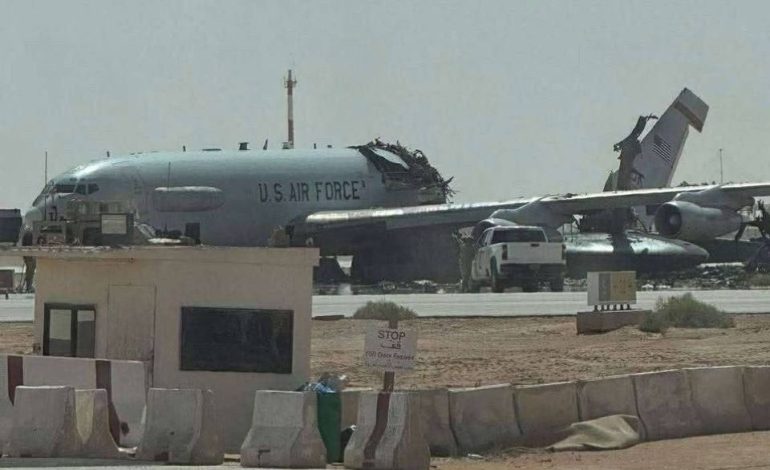
An AEW&C aircraft destroyed by an Iranian missile strike at Prince Sultan air base in Saudi Arabia. (Photo via Facebook)

New Delhi: The United States has suffered significant financial, equipment and logistical costs during its war with Iran, with a new US government watchdog report acknowledging shortfalls in advanced weapons inventories and disruptions to the military supply network. The assessment provides the most comprehensive official accounting so far of the damage inflicted on American forces and facilities during Operation Epic Fury, including losses of aircraft, damage to bases and pressure on stocks of high-end munitions.
The report by the United States defence department inspector general, covering the period through June 30, said the campaign had created “strategic inventory shortfalls” and exposed bottlenecks in the industrial base responsible for replenishing advanced munitions. The assessment is significant because it shifts the discussion from the immediate battlefield performance of US forces to the longer-term question of how quickly Washington can restore the inventories consumed during the conflict.
According to figures cited in the wider reporting, Operation Epic Fury had incurred an estimated $33.4 billion in costs by June 29, including $22.3 billion for expended munitions, $7.4 billion in incremental obligations and $3.7 billion in equipment losses. The figure did not fully capture infrastructure repair requirements, meaning the eventual financial burden of the campaign is likely to be higher.
The findings also underline the unusually high consumption rate of advanced weapons during the conflict. While the Pentagon has disputed suggestions that the United States lacks sufficient weapons for ongoing operations, the inspector general’s reference to inventory shortfalls and industrial bottlenecks indicates that the issue is less about an immediate inability to fight and more about the time and capacity required to rebuild stocks.
The physical losses have been substantial as well. The report said Iranian attacks destroyed as many as 30 MQ-9 Reaper drones and damaged or destroyed seven KC-135 refuelling aircraft, five of which were struck while on the ground in Saudi Arabia.
US bases across the region also came under sustained attack, with hundreds of buildings and other structures damaged or destroyed in Kuwait, Bahrain, Qatar, the United Arab Emirates, Saudi Arabia, Iraq, Oman and Jordan. The damage to Bahrain was particularly consequential because the country’s US naval facility serves as a major regional logistics hub.
The disruption forced US Central Command to rely more heavily on alternative supply routes, including facilities farther from the Middle East. The inspector general said the shift to alternative hubs such as Diego Garcia resulted in logistics cycles of 14 to 18 days, illustrating how attacks on fixed infrastructure can affect military operations well beyond the immediate site of the strike.
The campaign also imposed a human cost. The watchdog’s accounting listed 11 US service members as killed in action in Kuwait, Iraq, Jordan and Saudi Arabia, while other deaths occurred in incidents classified as non-hostile, including a KC-135 crash in Iraq following a collision.
The broader financial picture is larger than the inspector general’s June accounting. The US defence secretary, Pete Hegseth, told Congress in late July that the war had already cost $37.5 billion, suggesting that expenditure continued to rise substantially after the period covered by the watchdog’s assessment.
The conflict also damaged American diplomatic infrastructure. US diplomatic facilities in Iraq, Kuwait, Saudi Arabia and the United Arab Emirates suffered an estimated $184 million in physical damage, while the State Department separately reported $113 million in other conflict-related costs, including contingency and evacuation expenses.
Washington also evacuated about 9,000 American citizens from countries affected by the conflict, with the evacuation operation costing more than $11 million by late June. The scale of the evacuation underscores how the conflict expanded beyond a conventional military campaign into a wider protection and crisis-management operation for the US government.
There is a further economic dimension. The state department reported more than $44 billion in emergency and non-emergency military sales during the period, with Saudi Arabia accounting for the largest share as regional states sought to reinforce their security capabilities in response to the conflict.
For Washington, however, the more consequential issue may be the industrial capacity required to replenish what the war consumed. Reporting based on the inspector general’s assessment has indicated that some advanced missiles and defensive interceptors could take years to return to pre-war inventory levels, turning a battlefield expenditure into a longer-term readiness problem.
The lesson extends beyond the Iran conflict itself. A major-power military can possess overwhelming technological and operational advantages and still face strategic pressure if a high-intensity campaign consumes precision weapons, air-defence interceptors, aircraft and logistics capacity faster than industry can replace them.
That has implications for any future contingency involving a technologically capable adversary. The Iran war has therefore become not only a test of American strike power, but also a real-world test of the resilience of the US defence-industrial base, its overseas logistics architecture and its ability to sustain a prolonged high-tempo campaign.
For India and other Indo-Pacific powers, the episode offers a broader strategic signal: modern warfare is increasingly a contest not simply of platforms and battlefield effectiveness, but of inventories, industrial throughput, repair capacity and the ability to sustain operations over time. The US experience in Iran demonstrates how even a technologically superior military can face difficult trade-offs when the consumption rate of sophisticated weapons begins to outpace replenishment.