
Israeli rights group B’Tselem accuses Israel of running a systematic ‘elimination project’ in West Bank
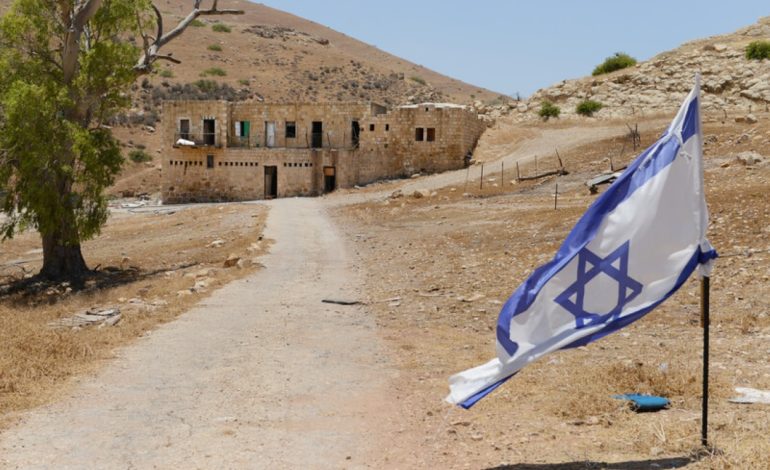
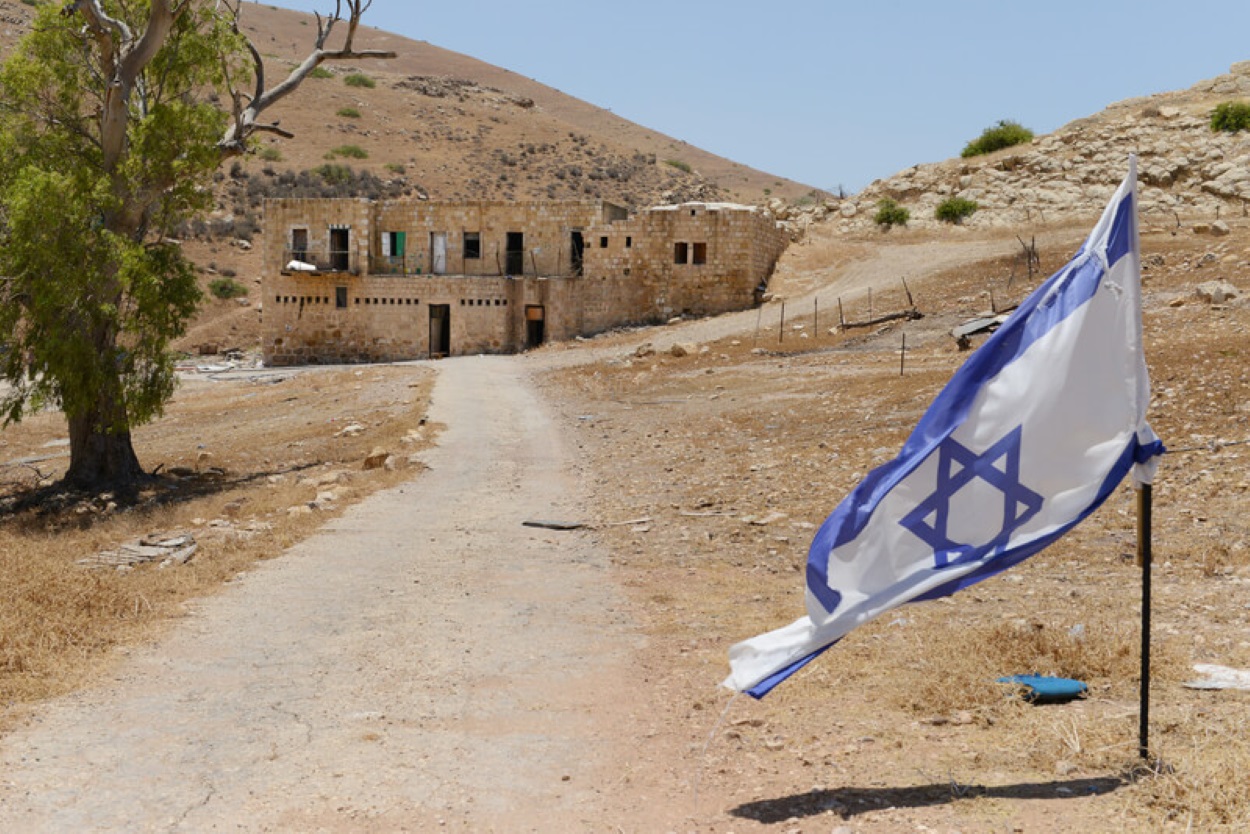
An Israeli flag planted near a road leading to the emptied Palestinian village in West Bank’s Jordan Valley, which Israeli agricultural setters have taken over and named it Bitron. (Photo: X/@TheCradleMedia)

New Delhi: An Israeli human rights organization has accused its own government of waging a coordinated campaign to strip Palestinians of the very conditions needed to sustain life in the occupied West Bank. The group, B’Tselem, says the effort is not a series of disconnected abuses but a deliberate state project with a clear internal logic.
The report, titled “The Elimination Project” (link to full report/link to YouTube video), was released at a news conference in Jerusalem on Monday. It runs to 249 pages and draws on more than 2,000 sworn testimonies gathered since October 2023, alongside three decades of the organization’s own archival material.
It is worth emphasizing who is making this charge. B’Tselem is not a foreign advocacy body or a Palestinian institution – it is an Israeli organization, staffed largely by Israelis, founded in Jerusalem in 1989 to monitor Israel’s own conduct in the occupied territories. That an Israeli group, working from inside Israeli society, has produced the most severe indictment yet of its government’s West Bank policy lends the report a weight that outside criticism rarely carries in Israeli domestic debate.
According to B’Tselem, the assault on Palestinian life is organized around five interlocking domains. These are violence and intimidation, restrictions on movement, economic strangulation, the destruction of social and political institutions, and ethnic cleansing paired with territorial takeover.
The report describes routine activities – commuting to work, taking children to school, reaching a hospital, visiting relatives, tending land – as having become acts of endurance for many Palestinians. It says these are precisely the “conditions that enable Palestinians to exist as a people with land, institutions and language”, and that they are being systematically dismantled rather than merely neglected.
B’Tselem’s executive director, Yuli Novak, told reporters that the pattern was not new but had entered a distinct phase. She said the process began accelerating at the end of 2022, when a far-right coalition took office, and intensified sharply after the events of October 2023.
Novak was careful to distinguish the current government’s role from the origins of the policy itself. “This government didn’t create the project,” she said, adding that it had “inherited a violent political system that successive Israeli governments built over decades” but had made it “faster, more violent and institutionalized than ever.”
The report identifies a 2017 document known as the “Decisive Plan”, authored by the current finance minister, Bezalel Smotrich, before he entered government, as the ideological blueprint for the policy. Smotrich now holds broad authority over civilian affairs in the West Bank. B’Tselem argues his plan effectively left Palestinians three choices: accept subordinate status under Jewish rule while abandoning national claims, leave the territory altogether, or face forcible suppression if they resisted.
B’Tselem’s field director, Kareem Jubran, pointed to the practical machinery enforcing this reality. He cited more than 900 military checkpoints and gates now controlling entry to Palestinian towns and villages, a network that governs the daily rhythm of movement across the territory.
The economic picture painted by the report is stark. Unemployment in the West Bank has more than doubled in two years, driven by the destruction of agricultural and industrial infrastructure, tightened control over the financial system and the withdrawal of Palestinian work permits inside Israel. B’Tselem estimates that roughly 700,000 Palestinians in the West Bank now depend on humanitarian aid simply to eat.
Schooling has not been spared either. Between 8 and 20 per cent of West Bank schools were forced to close during the 2023–24 academic year, a consequence of the financial squeeze on the Palestinian Authority after Netanyahu’s government suspended the transfer of tax revenues it collects on the authority’s behalf.
On casualties, B’Tselem’s findings sit close to independent tallies. Several international media organizations citing Palestinian health ministry data, has put the West Bank death toll since October 7, 2023, at more than 1,100 Palestinians, both civilians and militants. Separate B’Tselem figures cited elsewhere put the number of rural communities fully displaced since 2023 at over sixty, with several more partially emptied.
This is not the first assessment by a credible organization to reach similar conclusions. The UN human rights chief, Volcker Turk, released a report in January this year warning of the “systematic asphyxiation” of Palestinian rights and calling for illegal settlements to be dismantled. Human Rights Watch’s own 2026 world report separately documented the displacement of roughly 32,000 people from three northern West Bank refugee camps earlier that year, describing it as the largest such displacement since 1967.
The timing of the B’Tselem report is unlikely to be accidental. It lands roughly six weeks before Israel’s legislative elections, scheduled for October 27, in which Netanyahu’s political future is far from assured. Novak, however, played down any electoral effect on the underlying policy, arguing that a change of government would be unlikely to reverse a system she says predates the current coalition by decades.
Israeli authorities had not issued a formal response to the report at the time of its release. B’Tselem’s critics inside Israel have previously dismissed similar findings as politically motivated rather than legally grounded, though the organization maintains that the practices it documents – even if “elimination” itself is not a recognised legal term – amount to violations already prohibited under international law.