




Five baby orangutans found in Odisha, news and images go viral; sparks wildlife-trafficking concerns
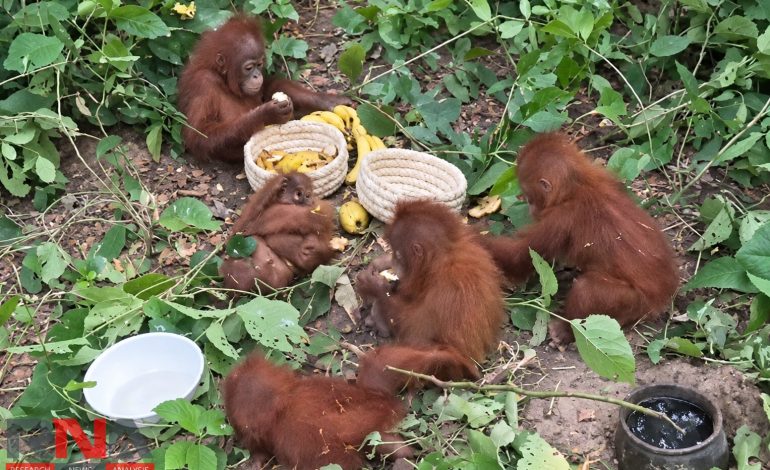

New Delhi: Five baby orangutans found in a forest in Odisha’s Balasore district have become an internet sensation, with footage of the unusual discovery circulating across Indian social media. Their appearance thousands of kilometres from their natural habitat has also prompted a suspected wildlife trafficking investigation, raising questions about how the young apes reached India and who brought them here.
Residents spotted the animals near Badapai village in the district’s Bhograi area on Tuesday, at around 6am, drawing a crowd before forest personnel intervened. The orangutans were rescued and initially examined by veterinarians, with the authorities reporting that four were healthy and accepting food and oral rehydration solution.
The discovery rapidly moved from a local spectacle to a national talking point as news organizations and other accounts circulated footage on X, Instagram and Facebook. Reports and posts repeatedly highlighted the same extraordinary detail: these were young orangutans, animals associated with Southeast Asian rainforests, appearing unexpectedly in an Indian village’s surroundings.
Their small size and distinctive appearance, combined with the mystery of their arrival, appear to explain much of the clips’ appeal. Local television coverage also framed the discovery around questions about the unfamiliar animals and their origins, helping turn a striking visual into a story that invited both curiosity and concern.
By Thursday, all five were being cared for at Nandankanan Zoological Park near Bhubaneswar, where they had been placed in quarantine under veterinary supervision. The zoo has arranged a temperature-controlled space, round-the-clock monitoring and a feeding programme that includes fruit at frequent intervals, alongside toys and slings to support their comfort and activity.
Their transfer provides immediate shelter, but their longer-term placement remains unresolved. Odisha has sought approval from the central authorities to retain the animals in the state, while investigators work to establish how they arrived.
Why discovery raises concerns
Orangutans occur naturally only on the islands of Borneo and Sumatra, with no natural migration corridor connecting their habitat to Odisha. Their presence therefore points to human transport, although the circumstances of that movement remain under investigation.
A team from Odisha Police’s special task force has been examining CCTV footage and questioning residents, with the Wildlife Crime Control Bureau also involved in the inquiry. The state’s forest and environment minister, Ganesh Ram Singh Khuntia, has said investigators are examining possible transport routes, but the authorities have not established the animals’ journey or intended destination.
The task force officer overseeing the inquiry, KV Singh, has cautioned against speculation while investigators examine records and compare similar cases. That distinction matters: suspicions of an international trafficking operation are serious, but identifying its organizers, transporters and buyers requires evidence.
Conservationists nevertheless regard the discovery as a warning about the demand for exotic animals in India. The wildlife researcher and conservationist, Uttara Mendiratta, told ThePrint that the case pointed to a wider-trafficking problem, while the wildlife projects manager at World Animal Protection, Shubhobroto Ghosh, linked such trade to demand from people seeking unusual pets.
The director of wildlife protection at Humane World for Animals India, Sumanth Bindumadhav, also highlighted an earlier case involving a juvenile orangutan found during a Mumbai flat raid in November 2024. He argued that the Odisha discovery exposed weaknesses in the safeguards governing private possession of animals whose needs make them unsuitable for domestic captivity.
The conservation stakes are particularly high because all three orangutan species – Bornean, Sumatran and Tapanuli – are classified as critically endangered. International commercial trade in orangutans is prohibited under the Convention on International Trade in Endangered Species of Wild Fauna and Flora, or Cites.
Capturing an infant can also involve losses beyond the animal that eventually reaches a buyer. WWF warns that hunters commonly kill mothers when taking their young for the illegal pet trade, although the fate of the mothers of the five animals rescued in Odisha has not been established.
Orangutans reproduce slowly, making populations especially vulnerable to the removal of breeding females and their offspring. Trafficking compounds the damage caused by forest clearance, logging and agricultural expansion, while also depriving forests of animals that help disperse seeds.
Some conservationists have consequently called for the rescued youngsters to be repatriated, with their future guided by their origins and prospects for rehabilitation. Mendiratta said returning them could offer a chance of eventual life in the wild or a contribution to conservation in their native range.
For now, the immediate priority is their care, alongside an investigation that can establish responsibility for their arrival in Odisha. The public attention surrounding the five infants has brought that investigation into view; its significance will depend on whether it uncovers the people and demand behind their journey.