


US says it struck Iranian missile launchers poised to sow mines in Hormuz. Can rockets really lay sea mines?
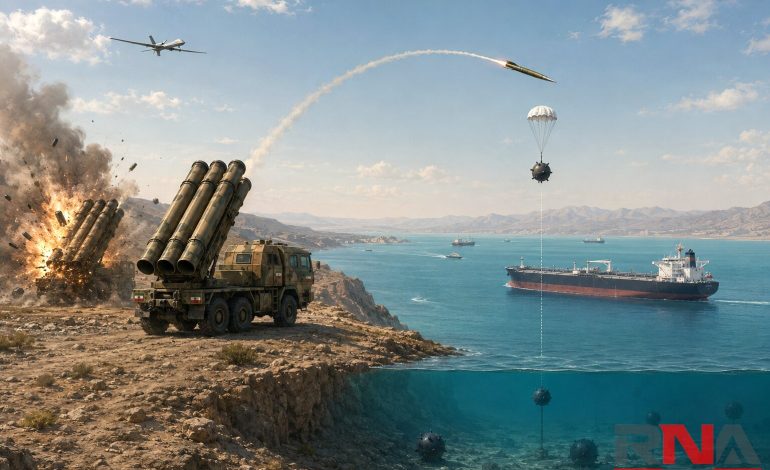
RNA Media for illustration.

The United States says its forces struck two Iranian rocket launchers on Larak island in the early hours of August 31 (India time) after detecting Islamic Revolutionary Guard Corps personnel preparing to fire rockets carrying sea mines into the Strait of Hormuz. A US official described the operation as a limited action against an imminent threat, although Washington has released neither imagery of the purported mine-carrying rockets nor a detailed assessment confirming that the launchers were destroyed.
Iran condemned the attack, with the IRGC-linked semi-official Tasnim news agency reporting that a US drone strike killed two people and wounded two others, while the IRGC promised retaliation and subsequently fired ballistic missiles towards US bases in Jordan. The incident marked the first known American strike inside Iran since late July and came days after the US military said it had cleared mines from the strait’s principal shipping lane − a claim Tehran has disputed.
Now, can rockets really lay sea mines?
The short answer is yes. A rocket can deliver a sea mine if the projectile, payload and release mechanism have been designed for that purpose. The more difficult questions are whether Iran has converted such a concept into a reliable operational weapon, what type of mine it can carry and whether the launchers attacked on August 31 were actually preparing to use it.
The US account initially drew scepticism because rockets are ordinarily designed to carry explosive warheads that detonate at or near their targets, rather than deposit intact weapons in the water. Harlan Ullman, a retired US naval officer, told Al Jazeera that the claim appeared “implausible”, arguing that an unprotected mine striking the sea at high velocity could be damaged or destroyed.
That objection would be valid if a conventional rocket simply plunged into the water with a mine fixed inside its nose, but that is not how a properly engineered dispenser weapon would work. The carrier would have to release its payload before impact, after which a parachute, aerodynamic brake or another retardation device could slow the mine sufficiently for controlled entry into the water.
Iran has previously advertised precisely this broad concept, although publicly available footage is insufficient to establish how mature or reliable it is. During the IRGC navy’s Great Prophet-19 exercise in the Persian Gulf in January 2025, Iranian military media reported the employment of “projectile mines” and the launching of mobile mines from rocket launchers, presenting the method as a new minelaying technique.
Open-source analysts identified the system shown during that exercise as a modified Fajr-5 multiple-launch rocket system, but the Pentagon has not publicly identified the launchers targeted on Larak island. The Critical Threats Project assessed that the August 31 episode was the first observed Iranian attempt during the present conflict to deploy mines from shore, rather than from the fast boats traditionally associated with IRGC minelaying.
The standard Fajr-5 is a 333mm, solid-propellant artillery rocket developed primarily for attacking land targets and normally fired from a mobile four-tube launcher. Its commonly cited variant has a range of about 75 kilometres, a launch weight of roughly 915kg and a conventional warhead containing about 90kg of high explosive, giving engineers enough payload allowance to substitute a specially designed compact mine and its release equipment.
A mine-carrying version would not require the rocket to perform the mine’s function or strike a ship directly. It would serve only as the transport vehicle, flying to a predetermined area before ejecting a mine that would descend separately, enter the water, arm itself after a programmed delay and wait for a vessel.
Several safety stages would be essential because a naval mine must remain inert during storage, handling, launch acceleration and descent. A workable design could use acceleration sensors, a timer, water-pressure switches and an arming delay so that the fuze becomes active only after the mine has entered the water and settled or begun drifting.
The concept is unconventional, but the underlying engineering is not revolutionary. Aircraft have dropped naval mines for decades, and modern US Quickstrike-ER weapons combine existing mine components with guidance and wing kits so that aircraft can release them from considerable standoff distances before they make a controlled water entry.
An aircraft-delivered mine must also tolerate vibration, acceleration, separation and impact with the sea without exploding prematurely or damaging its sensors. Replacing the aircraft with a rocket therefore creates demanding integration problems, but none that violates basic physics or lies beyond the capabilities of a country with an established missile, rocket and naval-mine industry.
Surface ships, submarines, aircraft and small boats remain the usual minelaying platforms because they can place large weapons relatively accurately and configure a minefield according to water depth and seabed conditions. The US National Academies’ study of naval mine warfare lists aircraft and submarines among established American delivery methods, illustrating that the mine and the platform carrying it need not be developed as a single weapon from the outset.
There is also an important distinction between a rocket-delivered mine and what naval specialists call a rocket-propelled or rising mine. The former is carried into the deployment area by a rocket, whereas the latter waits underwater and, after detecting a vessel, releases a rocket-propelled warhead or similar effector upwards towards the target.
Iran has long been reported to possess more conventional contact, moored, bottom and influence mines, as well as possible Chinese-origin EM-52 rising mines. These weapons should not be confused with the suspected Fajr-5 payload, whose distinguishing feature is its method of delivery from land.
Even among analysts who accept Iran’s rocket-mining capability, the exact payload remains disputed. Naval-warfare analyst HI Sutton assesses that the Fajr-5 may carry a bottom influence mine suited to water shallower than about 30 metres, while Maritime Executive has interpreted the 2025 demonstration as involving one comparatively small, free-floating mine in each rocket.
A bottom mine would sink to the seabed and use magnetic, acoustic or pressure sensors to recognize a vessel passing above it, making accurate placement and suitable water depth important. A drifting contact mine would be simpler to disperse but less controllable, as currents could carry it away from the intended channel, towards neutral shipping or eventually on to a coastline.
Drifting mines would also raise serious legal and humanitarian concerns because their movement becomes difficult to predict after release. The 1907 Hague Convention VIII prohibits unanchored automatic contact mines unless they become harmless within an hour after the person who laid them ceases to control them, while also requiring precautions for peaceful shipping and warnings when minefields are no longer under surveillance.
Accuracy would be another limitation, especially if the mine carrier were based on an unguided Fajr-5 rather than the guided Fajr-5C. Wind, ballistic dispersion, separation errors and sea currents could all move the weapon away from its intended position, although a narrow shipping corridor is an area target and Iran might value disruption more than geometrically precise minefield construction.
Claims that one Fajr-5 rocket could scatter dozens or hundreds of credible sea mines should be treated cautiously because its 333mm diameter and limited payload impose clear physical restrictions. The Iranian exercise was more plausibly demonstrating one compact mine per rocket, or at most a small number of much lighter devices, rather than a large cluster of weapons capable of seriously damaging major ships.
A small rocket-delivered mine would probably carry substantially less explosive than Iran’s full-sized moored or bottom mines, some of which weigh several hundred kilograms. It might be unlikely to sink a modern double-hulled supertanker outright, but it could damage propulsion equipment, puncture a smaller vessel, injure personnel or force every suspected transit lane to be searched again.
The real attraction lies in the delivery method rather than the destructive power of an individual mine. A truck-mounted launcher concealed on Iran’s mountainous coastline could fire from a standoff position and relocate, allowing the IRGC to threaten a monitored waterway without exposing a minelaying vessel and its crew to US aircraft, drones or warships.
Rocket delivery nevertheless has important disadvantages: it carries fewer mines than a ship, provides less control over their final positions and produces a visible launch signature that can expose the firing unit. The August 30 attack itself demonstrates this vulnerability because US surveillance apparently detected the preparations early enough for American forces to engage the launchers before they fired.
Iran may consider those shortcomings acceptable after losing or being denied the use of more conventional minelaying platforms. The method would represent an adaptation under pressure – an inefficient but survivable alternative for rapidly restoring uncertainty after US forces claimed to have cleared the internationally recognized traffic separation scheme.
That uncertainty is strategically valuable because mines do not necessarily have to sink ships to influence maritime traffic. Even an unconfirmed report of a few newly laid weapons can delay sailings, increase insurance premiums, compel naval escorts and restart a slow mine-countermeasure operation in waters still exposed to Iranian missiles and drones.
Stakes high for India, Asian energy importers
The stakes are particularly high for India and other Asian energy importers because Hormuz is one of the world’s most important maritime chokepoints. Before the present disruption, about 20 per cent of global petroleum-liquid consumption and a similar share of liquefied natural gas trade passed through the strait, with India, China, Japan and South Korea among the leading destinations for its crude flows.
The most defensible conclusion, therefore, lies between outright dismissal and unquestioning acceptance of Washington’s account. Rockets can indeed deliver purpose-built naval mines, and Iran has demonstrated the concept, but the US has yet to provide public evidence establishing what the two Larak Island launchers carried, whether their mines were operational or whether the strike destroyed the systems as claimed.