Modi’s SCO visit doubles as diplomatic test before India’s BRICS summit and crucial UNSC race
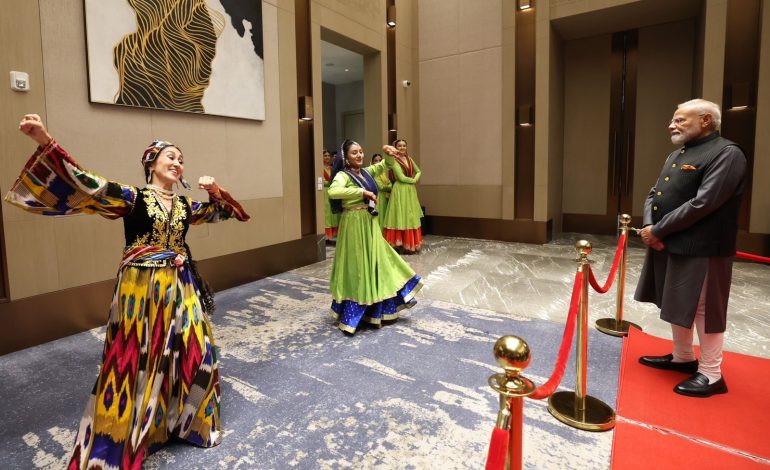
Narendra Modi watching a performance by the Bollywood Battle Group in Tashkent, on August 30, 2026. (Photo: X/@narendramodi)

New Delhi: The prime minister, Narendra Modi, has begun a four-day Central Asian visit carrying an agenda that extends well beyond the Shanghai Cooperation Organization summit in Bishkek. His meetings in Uzbekistan and the Kyrgyz Republic could influence India’s preparations for the September BRICS summit, its contest for a UNSC seat and its effort to regain economic ground in Central Asia.
Modi arrived in Tashkent on August 29 for a two-day state visit before travelling to Bishkek for the 26th SCO summit on August 31 and September 1. The gathering marks the organization’s 25th anniversary and will bring him together with leaders from China, Russia, Iran, Pakistan and the five Central Asian republics.
The visit began with talks with the president of Uzbekistan, Shavkat Mirziyoyev, on expanding cooperation in trade, investment, defence, energy and digital connectivity. According to the Prime Minister’s Office, the two sides were also expected to examine how India’s Viksit Bharat programme could complement Uzbekistan’s development strategy, Yangi Uzbekistan.
It is Modi’s fourth visit to Uzbekistan, a country that has emerged as one of India’s principal political and commercial partners in Central Asia. His programme also includes visits to the Shastri Memorial and the Mahatma Gandhi Centre at the Tashkent State University of Oriental Studies, underscoring the historical and educational links underpinning the relationship.
The economic imbalance nevertheless remains substantial, with different datasets placing India’s trade with the five Central Asian states at between $2 billion and $2.5 billion in 2025. China’s merchandise trade with the same region reached a record $106.3 billion that year, illustrating the scale of the challenge confronting New Delhi.
SCO summit offers several diplomatic openings
In Bishkek, Modi is expected to restate India’s approach to the SCO around three themes – security, connectivity and opportunity. He has said India will work with other members to build a region free from terrorism, separatism and extremism, issues that New Delhi considers inseparable from stability in Afghanistan and Pakistan’s continued support for cross-border terrorist groups.
The SCO includes India, China, Russia, Pakistan, Iran, Kazakhstan, Kyrgyzstan, Tajikistan, Uzbekistan and Belarus, making it one of the few forums where New Delhi engages its principal continental partners and adversaries simultaneously. The prime minister is expected to hold several bilateral meetings on the sidelines, although the government had not announced a complete schedule before the summit.
A meeting with the president of Russia, Vladimir Putin, would allow the two leaders to review energy and defence cooperation following the external affairs minister, S Jaishankar’s, recent visit to Moscow. It would also provide an opportunity to discuss Putin’s participation in the BRICS summit that India will host in New Delhi on September 12 and 13.
The presence of the president of China, Xi Jinping, will be watched particularly closely because he is also expected to travel to New Delhi for the BRICS gathering. Reuters reported that preparations were under way for Xi to arrive with a delegation of about 400 officials, although Beijing had not formally confirmed his visit.
Such a visit would be Xi’s first to India in seven years and would give both governments another opportunity to stabilize a relationship still constrained by the boundary dispute and strategic mistrust. Recent contacts, including talks in Beijing between India’s national security advisor, Ajit Doval, and the Chinese foreign minister, Wang Yi, suggest that both sides want to prevent border tensions from derailing wider diplomatic engagement.
The Bishkek meeting also carries a difficult Pakistan dimension because Islamabad will assume the rotating SCO chairmanship at the conclusion of the summit and host the organization’s leaders in 2027. India has remained non-committal on its level of participation, with the Ministry of External Affairs maintaining that any decision must be considered closer to the event and against New Delhi’s policy of zero tolerance towards terrorism.
BRICS consensus remains immediate challenge
The more urgent diplomatic test concerns India’s BRICS chairmanship and its ability to secure a substantive leaders’ declaration in New Delhi. Preparatory discussions have been complicated by divisions between Iran and the United Arab Emirates over the West Asia conflict and the disruption of shipping through the Strait of Hormuz.
Those differences prevented BRICS foreign ministers from issuing a joint statement after their meeting in New Delhi in May, forcing India to publish a chair’s statement instead. Reuters reported that Iran wanted an explicit condemnation of the US-Israeli attacks, while the UAE rejected Tehran’s allegations of involvement in the military campaign and accused Iran of attacking Emirati infrastructure.
The attendance of the president of Iran, Masoud Pezeshkian, in Bishkek gives Modi an opening to assess Tehran’s position before the BRICS leaders assemble in India. However, any suggestion that an SCO-side meeting will resolve the Iran-UAE dispute would be premature, as the disagreement encompasses military attacks, maritime navigation and competing interpretations of the war.
For India, a consensus BRICS declaration would demonstrate that the enlarged grouping can still act collectively despite including states engaged in direct confrontation. Failure would not invalidate the organization, but it would weaken New Delhi’s attempt to present its chairmanship as a platform for reformed multilateralism and a stronger Global South voice.
Tajikistan complicates India’s UNSC campaign
The Central Asian visit also coincides with India’s campaign for a non-permanent seat on the United Nations Security Council for 2028–29. The election will be held in the UN General Assembly in June 2027, with India competing against Tajikistan for the single seat available to the Asia-Pacific Group.
Unlike India’s successful and uncontested campaign for the 2021–22 term, the coming election could require sustained lobbying across the 193-member General Assembly. A candidate must secure a two-thirds majority of the members present and voting, making regional endorsements and reciprocal diplomatic arrangements particularly important.
Tajikistan has never served on the Security Council and has received the backing of the Organization of Islamic Cooperation, giving Dushanbe a credible platform from which to pursue its candidature. India, by contrast, has served eight terms and is presenting its record in peacekeeping, counter-terrorism and development partnerships as evidence that it can contribute effectively to the Council.
Modi’s presence alongside the president of Tajikistan, Emomali Rahmon, is therefore diplomatically significant, even though New Delhi has not publicly indicated that it will ask Dushanbe to withdraw. Any compromise would have to accommodate Tajikistan’s ambition to become only the third Central Asian country, after Kazakhstan and Kyrgyzstan, to serve on the Council.
There is precedent for negotiating a clean regional slate: Kazakhstan withdrew from the contest for the 2011–12 Asian seat in January 2010, leaving India to run unopposed. That outcome, however, resulted from sustained diplomacy and does not mean Tajikistan will automatically accept a similar arrangement.
India seeks to revive its Central Asia engagement
Modi’s visit may also help advance plans for a second India–Central Asia summit, more than four years after he hosted the inaugural meeting virtually on January 27, 2022. The Delhi Declaration envisaged regular leaders’ meetings, but a follow-up summit has yet to take place despite continuing exchanges among foreign ministers, national security officials and other senior representatives.
India’s engagement has been constrained primarily by geography, as Pakistan denies it overland access to Afghanistan and the Central Asian republics. New Delhi consequently depends on Iran’s Chabahar port and the International North-South Transport Corridor, both of which remain vulnerable to instability in West Asia, sanctions and incomplete transport infrastructure.
The Bishkek summit will not by itself eliminate those structural obstacles, but it provides India with a concentrated opportunity to engage every Central Asian leader. Its success will be measured less by the summit declaration than by whether New Delhi can build consensus for the BRICS meeting, improve its position in the UNSC contest and restore momentum to an underdeveloped but strategically important regional partnership.