




What triggered Nepal floods? Deadly flash floods leave hundreds missing along China border
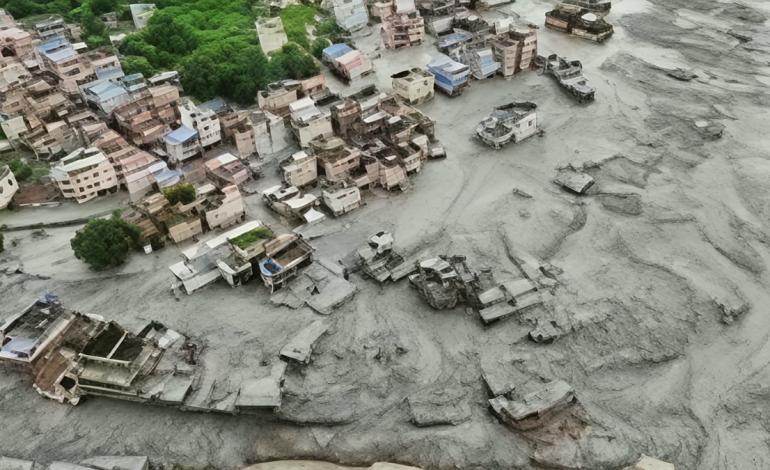
Flood along Nepal’s China border. (Image courtesy: X/@ShashiTharoor)

New Delhi: A sudden torrent of water, ice, rock and mud tore through Nepal’s Rasuwa district near the Tibetan frontier on Wednesday morning, sweeping away homes, roads and bridges and leaving hundreds of people missing, as RNA Media reported on Wednesday. The disaster struck the Bhote Koshi river system shortly after 8.30am near the Rasuwagadhi border crossing, with the surge travelling downstream towards Nuwakot and Dhading.
The event was initially reported as a magnitude 4.4 earthquake, but the US Geological Survey (USGS) later determined that no earthquake had occurred. Instead, the agency said the seismic signal, recorded as a 5.2-magnitude event near the Nepal-China border, was generated by a glacial collapse and the debris flow that followed.
The collapse sent ice and rock into the river system, triggering a powerful downstream surge. Experts at the International Centre for Integrated Mountain Development (ICIMOD) said the Trishuli river rose by as much as nine metres within 30 minutes, with the Lhende Khola tributary among the worst affected.
Glacier section plunged 1.2km, satellite analysis shows
Daniel Shugar, a geomorphologist at the University of Calgary, wrote on social media platform Bluesky that the source of the flooding in Nepal was a collapsed glacier. The Guardian, citing Shugar’s initial analysis of Planet Labs satellite imagery, reported that a section of ice covering around 0.2 square kilometres had collapsed by roughly 1.2km vertically, with the lower part of the glacier breaking away at about 5,200 metres and crashing onto the valley floor around 1,200 metres below.
Shugar also pointed to extensive snowmelt visible in satellite imagery in the 24 hours before the disaster, suggesting that warm conditions may have prevailed in the area. However, he said weather station data was still needed to determine what role those conditions played in the collapse.
The exact sequence of events remains unclear. An international group of glacier researchers said that while a glacial collapse was certainly involved, it was unlikely to have been the sole cause of the disaster.
Hundreds remain missing
The floods left hundreds of people unaccounted for in Nepal, with authorities continuing efforts to trace those missing and establish contact with stranded travellers. Nepal Tourism Board list showed 384 travellers unaccounted for, including 291 foreigners and 93 Nepali citizens, among them 105 Indian tourists and 37 people identified as non-resident Indians.
The latest update from the external ministry, said 21 Indian nationals, who were travelling for the Kailash Manasarovar Yatra, had been rescued from Timure in Rasuwa. According to RNA Media, 288 Indian nationals in Nepal remained uncontactable, including people working at a hydropower project and groups travelling through different tour operators.
China steps up emergency response
Meanwhile, China has stepped up its emergency response after the mudslide affected Gyirong Port in Xizang Autonomous Region. The China Meteorological Administration raised its emergency response for major meteorological disasters from Level III to Level II, while authorities began combining satellite imagery with meteorological data to assess the risk of further disasters, China Daily reported.
The National Satellite Meteorological Center also set up a special response team and a joint emergency support group with the Xizang regional meteorological observatory. Authorities used imagery from the HJ-2 satellite and the Mazu weather-warning platform to monitor the affected area and support ongoing rescue and relief efforts.
Climate change raises concerns
The disaster has renewed concerns over the growing instability of the Himalayan region, although scientists have cautioned that it is too early to directly attribute this particular collapse to climate change. Andrew Mackintosh, a glaciologist at Monash University, said scientists have strong evidence linking warming to glacier retreat and the degradation of mountain permafrost, while the relationship between individual glacier collapses and climate change remains difficult to establish.
An ICIMOD assessment found that glaciers in the Hindu Kush Himalaya disappeared 65 per cent faster between 2011 and 2020 than in the previous decade. The latest disaster has further highlighted the risks posed by rapidly changing mountain conditions to communities and infrastructure downstream.





1 Comment
[…] Trending August 27, 2026 […]