


Ladakh leaders demand elected assembly and real powers from Centre. What are the region’s core demands?
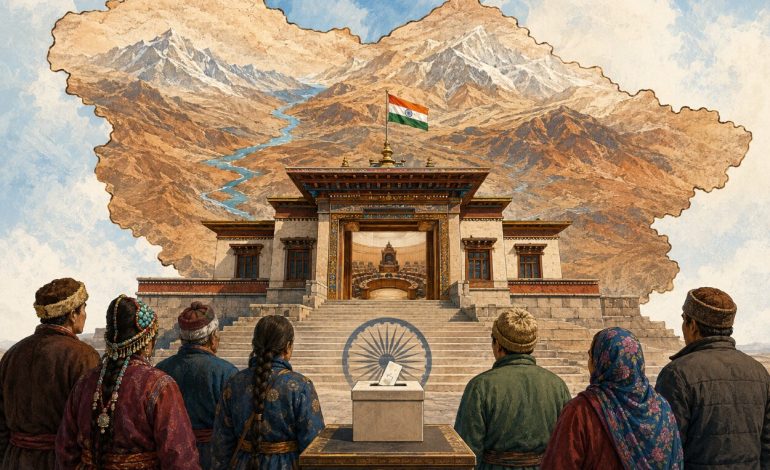
RNA Media illustration for representation.

New Delhi: Ladakh’s principal civil-society coalitions have presented the Centre with a charter of “non-negotiable” conditions for establishing an elected government in the Union territory, insisting that any new institution must possess substantive constitutional authority. The demands extend far beyond an advisory council and include control over legislation, public finances, the bureaucracy and, to a significant degree, policing.
Representatives of the Leh Apex Body and the Kargil Democratic Alliance submitted the document during talks with senior Ministry of Home Affairs officials and Ladakh’s chief secretary, Ashish Kundra, in Leh on Wednesday. The Ladakh MP, Mohmad Haneefa Jan, climate activist Sonam Wangchuk and senior representatives from Leh and Kargil also attended the discussions.
The meeting produced no immediate breakthrough, although the visiting officials indicated that another round could be held in New Delhi during the first week of September. The home ministry has yet to announce whether that engagement will involve the smaller subcommittee or the high-powered committee headed by the minister of state for home affairs, Nityanand Rai.
The latest submission builds on an understanding reached during negotiations in New Delhi on May 22 when the two sides discussed a customized democratic structure for Ladakh. That arrangement was envisaged as an elected Union territory-level body with legislative, executive and financial powers, even as full statehood remained the region’s long-term objective.
The Ladakhi organizations now want the proposed body formally designated as the Ladakh legislative assembly and headed by a chief minister and council of ministers. Its members should be directly elected from constituencies created through a constitutionally recognized delimitation process, according to the charter reported by various media outlets.
The assembly’s authority, the groups contend, should draw substantially from the state and concurrent lists in the Seventh Schedule of the Constitution. The lieutenant governor should ordinarily act on the aid and advice of the elected government, thereby reducing the risk of recurring disputes between the administrator and elected representatives.
The charter also demands constitutionally protected control over taxation, budgeting, expenditure, borrowing and public funds, including separate consolidated and contingency funds for Ladakh. Provisions governing money bills, grants and annual financial statements should be adapted from Articles 198 to 209 of the Constitution.
A particularly consequential demand concerns home affairs, public order and police, which the organizations want placed substantially under the elected government. If accepted, this would give Ladakh’s proposed administration greater authority than arrangements in which the Centre or lieutenant governor retains decisive control over security-related subjects.
The groups have additionally sought a separate Ladakh Public Service Commission, Ladakh Administrative and Police Services and locally structured cadres. Such an arrangement would require amendments to the Jammu and Kashmir Reorganisation Act, 2019, and possibly relevant constitutional provisions governing public service commissions.
Leaders also pressed for the unconditional withdrawal of cases arising from the violence in Leh on September 24 last year, and “dignified and adequate” compensation for those killed, injured or otherwise affected. Four people were killed and scores were injured after a protest over statehood and job protections descended into violence and police opened fire.
What are the core demands of Ladakhis?
The present charter is the detailed constitutional version of a four-point campaign pursued jointly by the Leh Apex Body and the Kargil Democratic Alliance: statehood, Sixth Schedule protection, a separate public service commission and two Lok Sabha seats. These demands emerged after Ladakh became a Union territory without a legislature on October 31, 2019, leaving most territorial authority with the lieutenant governor and bureaucracy.
Statehood remains the ultimate political objective because it would provide Ladakh with an elected legislature, a council of ministers and powers normally available to states. However, the Centre has cited Ladakh’s limited capacity to generate enough revenue to finance its recurring expenditure, prompting discussion of a distinctive interim model that would function much like a Union territory with a legislature.
The second demand has traditionally been Ladakh’s inclusion in the Sixth Schedule, which permits autonomous councils in tribal areas to legislate on specified matters, including land, forests, local customs and village administration. The Sixth Schedule presently applies under Article 244(2) to tribal areas in Assam, Meghalaya, Tripura and Mizoram, meaning its extension to Ladakh would require constitutional action by Parliament, as the Constitution makes clear [pdf].
The Centre and Ladakhi representatives have consequently explored special safeguards modelled on Articles 371A, 371F and 371G, which provide differentiated constitutional arrangements for Nagaland, Sikkim and Mizoram. For Ladakhis, the label is less important than the outcome: enforceable protection for land, employment, culture, language, tribal identity and a fragile high-altitude environment.
The demand for a separate public service commission is similarly tied to employment and administrative representation. Ladakhi organizations argue that locally anchored recruitment institutions and cadres are necessary to prevent residents from being marginalized in government employment and to ensure that officials understand the territory’s geography, languages and social composition.
Their fourth original demand seeks two Lok Sabha constituencies, one each for Leh and Kargil, instead of the territory’s single parliamentary seat. Supporters say the vast distances, distinct political identities and differing demographic profiles of the two regions justify separate representation, although the matter would have to pass through Parliament and a formal delimitation process.
Pending a final settlement, the organizations want interim restrictions requiring a valid Ladakh Residence Certificate for registering businesses, conducting specified commercial activities and obtaining or renewing trade licences. They have also sought a pause on the allotment or transfer of land to people who do not satisfy Ladakh’s residence requirements, preventing changes that may become difficult to reverse before constitutional protections are finalized.
The central question, therefore, is no longer merely whether Ladakh will receive another council. It is whether the Centre is prepared to create an elected institution with genuine lawmaking, financial and executive authority – and constitutional safeguards strong enough to protect local interests without compromising the governance and security requirements of India’s strategically sensitive frontier.