


‘Sense better, understand faster’: Air Marshal Tejpal Singh on shortening Ooda loop. What is it?
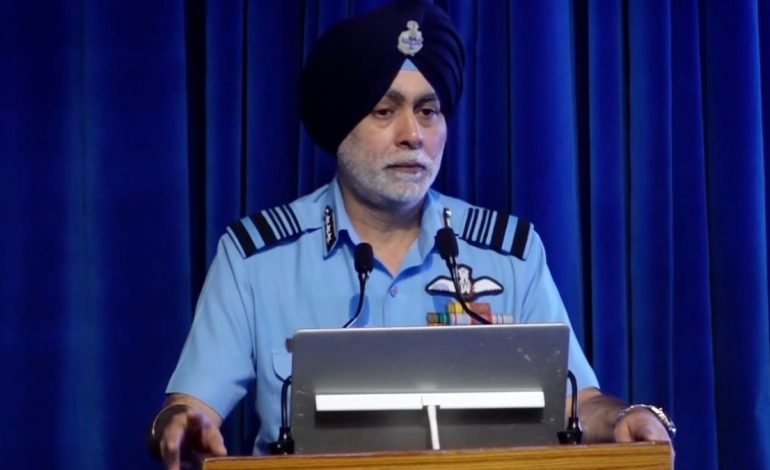
Air Marshal Tejpal Singh seminar on surveillance, C4I2 and electro-optics in New Delhi. Screengrab from a widely circulated video on social media.

New Delhi: The deputy chief of the air staff, Air Marshal Tejpal Singh, on Tuesday said information superiority, network-centric operations and rapid decision-making are becoming central to modern warfare, with military success increasingly depending on how quickly forces can turn information into action. Speaking at a seminar on surveillance, C4I2 (Command, Control, Communications, Computers, Intelligence and Information) and electro-optics in New Delhi, AM Singh said the armed forces need to shorten their Ooda loop so they can make decisions and act faster than an adversary.
AM Singh stressed that this does not mean weapons and combat platforms are becoming less important. Instead, their effectiveness increasingly depends on the information available to commanders and the speed with which that information can move from sensors to decision-makers and, ultimately, to the systems that act on those decisions.
He said surveillance, C4I2 and electro-optical capabilities should therefore be integrated rather than developed or operated as separate systems.
He described this integration as a “system of systems” and pointed to the integrated air command and control system (IACCS) as an example of sensors, communications and weapon systems being brought together. He also called for standardized protocols, interoperability and self-reliance in communications so that military platforms and intelligence, surveillance and reconnaissance assets can operate across a common digital architecture.
The emphasis on information and connectivity is at the heart of the idea of network-centric warfare, a concept that emerged with the growing use of information technology in military operations.
What is Ooda loop in network-centric warfare?
Ooda is an acronym for “observe, orient, decide and act”. The concept is associated with a retired US Air Force pilot, Colonel John Boyd, who describes Ooda as a continuous command-and-control and decision-making cycle. In simple terms, a military first gathers information, makes sense of it, decides how to respond and then takes action. The process then begins again as the situation changes.
The importance of the Ooda loop becomes clearer when viewed alongside network-centric warfare.
Traditional military operations were often organized around individual platforms and hierarchical command structures. A tank, aircraft or artillery unit would collect information through its own sensors and pass reports through established channels before decisions were made.
Network-centric warfare changes the emphasis by connecting sensors, commanders and combat platforms so information can be shared more quickly across the force.
A US Naval War College study on network-centric warfare describes this as a shift in focus from the individual platform to the network. The underlying idea is that military units should not be treated simply as independent actors but as parts of a continuously connected operational environment.
The Army War College paper on the principles of network-centric warfare similarly describes it as an operational concept that uses networks to connect sensors, leaders and shooters. The purpose is to create shared situational awareness, improve the speed of decision-making and increase the tempo and effectiveness of operations.
This makes information the link between the different parts of the force.
A sensor may detect an aircraft, vehicle or other object. Another sensor may provide additional information about its location or characteristics. A communications network can carry those inputs to a command system, where they can be combined and presented to a commander. The commander can then decide what action is required and direct an appropriate platform to respond.
The objective is not simply to collect more information. It is to make useful information available to the right people quickly enough for it to improve a decision.
This distinction is important because information superiority does not mean having an unlimited amount of data. The US Naval War College research describes the value of networked operations in terms of the quality, relevance, accuracy and timeliness of information moving through the network.
That is where the OODA loop comes in.
The first stage, “observe”, is about gathering information about the environment. In modern warfare, this can involve surveillance systems, radars, aircraft, unmanned systems, satellites and other sensors operating across different domains.
The second stage, “orient”, is about interpreting that information. A sensor may tell a commander that something is present, but that alone does not establish what it is, whether it represents a threat or what it may do next. The information needs to be understood in context.
The Army War College paper describes the orientation stage as involving the information and knowledge used to interpret new inputs, including an individual’s understanding, experience, training and mental models.
The third stage, “decide”, follows from that understanding. A commander or decision-maker determines what response is appropriate.
The fourth stage, “act”, is where the decision is translated into action through military forces and their capabilities.
But the cycle does not end there. The results of the action create new information, which is observed and fed back into the next cycle.
This is why the OODA loop is a loop rather than a straight line.
For a military force, the advantage comes from being able to move through these stages effectively while preventing an adversary from doing the same. A networked force can potentially reduce delays between detecting a development, understanding it, deciding on a response and acting on that decision.
This also explains why network-centric warfare is not simply about installing better communications equipment.
A network is useful only when the information moving through it can be understood and used. The Army War College paper divides the network-centric environment into physical, information and cognitive domains. The physical domain is where forces and platforms operate; the information domain is where information is created, processed and shared; and the cognitive domain is where perception, understanding and decisions take place.
The three are closely connected.
A better sensor improves what a force can observe. A stronger information network allows that information to be moved and shared. Better processing and shared situational awareness can improve understanding. The commander can then make a decision and direct the appropriate response.
This is also why interoperability becomes important.
If different military systems cannot exchange information effectively, a force may have advanced sensors and weapons but still lose time moving information between separate networks. Network-centric warfare therefore places emphasis on connecting different systems and organisations so that information can be shared across the force.
AM Singh’s call for common digital standards reflects this requirement. He said communications systems, ground sensors, combat platforms and aerial intelligence, surveillance and reconnaissance assets should operate on common networks and standardised protocols, with interoperability built into systems from the design stage.
There is also a vulnerability built into this model. As more military functions depend on interconnected networks, those networks themselves become important targets.
AM Singh warned that cyberattacks, electronic warfare and spoofing could disrupt the systems on which networked operations depend. He therefore stressed the need for resilient communications and networks capable of functioning in contested electromagnetic environments.
The evolution towards network-centric warfare does not remove the importance of firepower. Rather, it changes how firepower is connected to the wider force.
A fighter aircraft may carry powerful weapons, but its effectiveness can also depend on information received from other sensors, communications systems and command networks. The same principle applies to ships, ground forces, air-defence systems and unmanned platforms.
The underlying shift is therefore from individual platforms working with limited information to connected forces operating with shared information and a common understanding of the battlefield.
This is also why AM Singh’s remarks on the Ooda loop go beyond simply asking the military to make faster decisions. His argument is that faster decisions require the systems that support those decisions to work together.
Surveillance provides the information. Communications move it. C4I2 helps connect and process it. Electro-optical systems can support detection and identification. Commanders use the resulting information to understand the situation and decide on a response. Combat platforms then act, generating new information for the next cycle.
In that sense, network-centric warfare provides much of the architecture through which information moves, while the Ooda loop describes how that information is converted into decisions and action.
For modern militaries, the challenge is therefore not simply to acquire more platforms or collect more data. It is to connect the different parts of the force well enough for information to become timely understanding, understanding to become a decision and the decision to become action.
That is the basis of AM Singh’s argument that future warfare will continue to depend on weapons and platforms, but that information, integration and faster decision-making will increasingly determine how effectively those capabilities are used.