Mecca Pact: Saudi Arabia, Pakistan and Türkiye sign trilateral defence agreement; India says it is studying the fallout
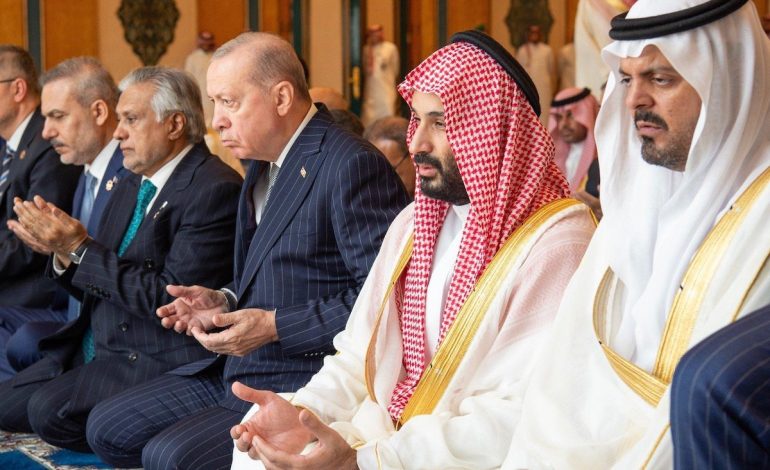
Saudi Arabia’s Mohammed bin Salman (2R), Türkiye’s Recep Tayyip Erdogan (3R), and Pakistan’s Shehbaz Sharif (4R) pray with other high-ranking officials of the three countries at Mecca’s Grand Mosque after signing the mutual defence pact. (Photo: X/@TabzLIVE)

New Delhi: Saudi Arabia, Pakistan and Türkiye signed a trilateral mutual defence agreement in Mecca on Friday, binding the three states to treat an attack on any one of them as an attack on all. The signing, which formalizes months of speculation about a broader Muslim-majority security bloc, comes as the wider Middle East remains gripped by the fallout of the Iran conflict.
The accord, called the Mecca Joint Defence Agreement, was signed at the Makkah Al-Mukarramah summit by the crown prince of Saudi Arabia, Mohammed bin Salman, the president of Türkiye, Recep Tayyip Erdogan, and the prime minister of Pakistan, Shehbaz Sharif. A joint statement said the pact is meant to strengthen collective deterrence against aggression and to deepen defence cooperation across all three states.
In a joint statement issued after signing of the agreement, the three countries issued a joint statement, which said: “The agreement is intended to strengthen collective deterrence against any act of aggression, and stipulates that any armed attack against any one of the three states shall be regarded as an attack against them all. It further provides for the enhancement of all aspects of defence cooperation among the three states.”
The Mecca Pact
As RNA Media reporter earlier on Friday, the core clause is straightforward, which says any armed attack on Saudi Arabia, Pakistan or Türkiye will be regarded as an attack on all three, obliging a collective response. Pakistan’s foreign office described the agreement as an effort to institutionalize deterrence at a moment when several Gulf states feel increasingly exposed.
The pact does not spell out the precise military mechanics of that commitment, and officials involved have been careful not to frame it as directed against any particular country. Mansoor Ahmed of the Australian National University’s Strategic and Defence Studies Centre told Reuters that Pakistan and Türkiye bring established defence industries to the arrangement, while Saudi Arabia is expected to contribute largely through financing.
Friday’s agreement extends the bilateral Pakistan-Saudi Arabia Strategic Mutual Defence Agreement that the two countries signed in Riyadh in September last year, during a state visit by Sharif at the invitation of bin Salman. That earlier pact similarly held that aggression against either country would be treated as aggression against both, and was widely read as a signal of Riyadh’s growing unease with the reliability of its traditional western security guarantees.
Türkiye’s interest in joining a wider arrangement is not new either. The Turkish foreign minister, Hakan Fidan, had already indicated in January of Ankara’s preference for a broader regional security platform built around cooperation among Muslim-majority states.
The timing is not incidental. The pact arrives against the backdrop of sustained hostilities involving Iran, which have unsettled several Gulf capitals and fed talk in strategic circles of an emerging “Islamic Nato”.
Türkiye’s own relations with Israel have also deteriorated sharply over the war in Gaza, adding a further layer of urgency to Ankara’s push for a collective security umbrella. Analysts caution, however, that the agreement is unlikely to carry an explicit nuclear dimension – Pakistan’s nuclear arsenal, they note, remains oriented primarily towards deterring India rather than extending cover to new partners.
India’s response
Reacting to the development, the Ministry of External Affairs, during its biweekly media briefing on Friday, said it was closely following the signing and would examine its implications for national security as well as for regional and global stability. The response echoes the language New Delhi used after last year’s bilateral Saudi-Pakistan pact, when the spokesperson for the ministry, Randhir Jaiswal, said the government remained committed to protecting India’s national interests and ensuring comprehensive national security.
New Delhi’s caution is not without cause. Pakistan is the only nuclear-armed Muslim-majority state, which makes any expansion of its formal security partnerships a matter of direct interest to Indian planners, irrespective of how the pact’s authors choose to frame it.
Türkiye’s inclusion is arguably the more consequential shift from an Indian standpoint. Ankara has, in recent years, deepened defence-industrial ties with Islamabad – supplying drones and naval platforms, and voicing public support for Pakistan during last year’s Operation Sindoor. Therefore, its formal entry into a mutual defence framework with Islamabad adds a layer India’s security establishment will want to track closely, even if the pact’s stated purpose is regional deterrence rather than confrontation with any specific country.
For Saudi Arabia, the scenario looks different. Riyadh has simultaneously built a substantial defence relationship with India, and its embrace of Pakistan and Türkiye is more plausibly a hedge against uncertain American commitment in the Gulf than a repudiation of ties with New Delhi. How India calibrates its response – diplomatically and in its own defence partnerships across the Gulf – will be worth watching in the weeks ahead.