

Trump orders leak probe as reports expose Pentagon’s depleted munitions stockpile
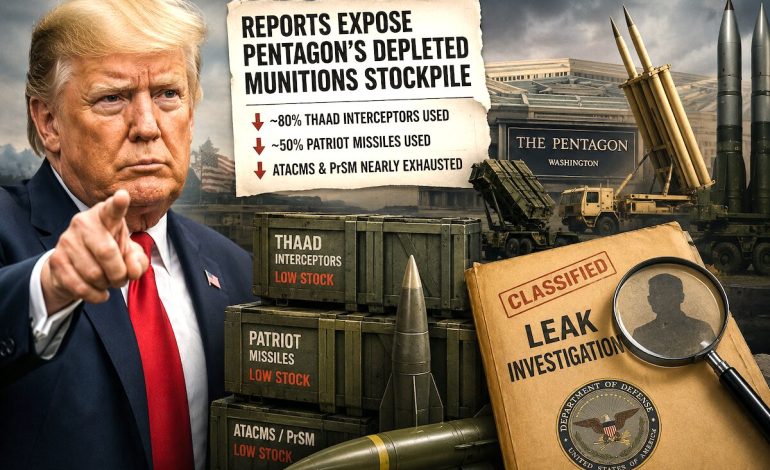
RNA Media illustration for representation.

New Delhi: The US president, Donald Trump, has ordered fresh investigations into who disclosed classified details of the Pentagon’s dwindling munitions stockpile, the Wall Street Journal reported on Thursday, citing administration officials. The directive marks a sharp escalation in Trump’s campaign against a string of media reports that have laid bare how heavily American weapons reserves were drawn down during the war with Iran.
According to the WSJ report, the matter had been weighing on Trump since a cabinet meeting at Camp David the previous week. He is understood to have telephoned the deputy war secretary, Stephen Feinberg, who has spent the past year overseeing efforts to expand munitions production, to discuss the state of American arsenals.
That call reportedly triggered a hastily arranged meeting of senior defence officials the same night, convened to work out ways of accelerating output of critical munitions. Trump is said to have been particularly irritated that details of the shortfall reached the press at a moment he was trying to project strength toward Tehran.
The frustration follows weeks of reporting on the toll taken by the conflict. CNN reported that the US military had used up nearly 80% of its terminal high altitude area defence (Thaad) interceptor stock and around half its Patriot air-defence missiles since the fighting with Iran began.
Reuters and CBS News separately reported that the military had exhausted nearly all its offensive army tactical missile systems (Atacms) and precision strike missiles (PrSM). Analysts cited by these outlets warned this could force a reliance on shorter-range and aerial strike options should hostilities resume.
The Centre for Strategic and International Studies estimated in late July that the US had expended more than 1,500 Patriot missiles and some 200 Thaad interceptors during the campaign. The war, which began on February 28, has now run past the five-month mark, and replenishing pre-war stockpile levels is expected to take years.
Trump directs blame at ‘leakers’
Trump did not mince words in response. “The ‘leakers’ of these treasonous statements are being hunted down,” he wrote on Truth Social, insisting the country held “massive amounts of ‘munitions’, especially of certain types”.
He added that fresh supplies were “being manufactured and shipped to the US as needed” and claimed defence contractors were building “the largest number of plants and factories in our country’s history.” Speaking to reporters separately on Thursday, Trump conceded that stocks of some munitions were tighter than others, but maintained the US remained “in very good shape” with “literally massive amounts of ammunition.”
The White House press secretary, Karoline Leavitt, told reporters the US had “more than enough firepower” to carry out any operation the president might order. She also pushed back on a separate Washington Post account alleging a clash between Trump and the defence secretary, Pete Hegseth, over the stockpile issue at Camp David.
Leavitt warned that anyone found to have leaked classified military information should face prosecution under federal law. The administration has treated the coverage as both a security breach and a political embarrassment, given its repeated public assurances of readiness.
Pressure over Iran talks
Trump has privately complained that the coverage could embolden Tehran and weaken Washington’s leverage as it presses Iran over its nuclear programme, the Journal reported. Officials familiar with his thinking said he views the stockpile reports as undercutting months of effort to project unwavering strength in the region.
That anxiety appears to have shaped the administration’s swift response, from the Camp David phone call to the emergency Pentagon huddle that followed. It also explains the unusually personal tone of Trump’s public remarks, in contrast to the more measured line taken by Leavitt.
The administration has separately asked Congress for substantial new funding to rebuild depleted stocks and expand production capacity. Reports citing the request put the figure at $87.6 billion, of which $67.15 billion would go toward the Pentagon, most of it tied to costs from the military campaign against Iran.
Much of this funding remains pending before lawmakers. The scale of the ask underlines how significant the drawdown has been, even as the White House continues to insist publicly that shortages pose no strategic risk.
The episode highlights a familiar tension in wartime Washington: the instinct to control the narrative around military readiness against a press corps intent on documenting it. For a White House already navigating a prolonged Iran conflict, the leak probe signals that this fight over information is now being fought almost as hard as the one in the Gulf.