


Exiled Bangladeshi author Taslima Nasreen returns to Kolkata after nearly two decades
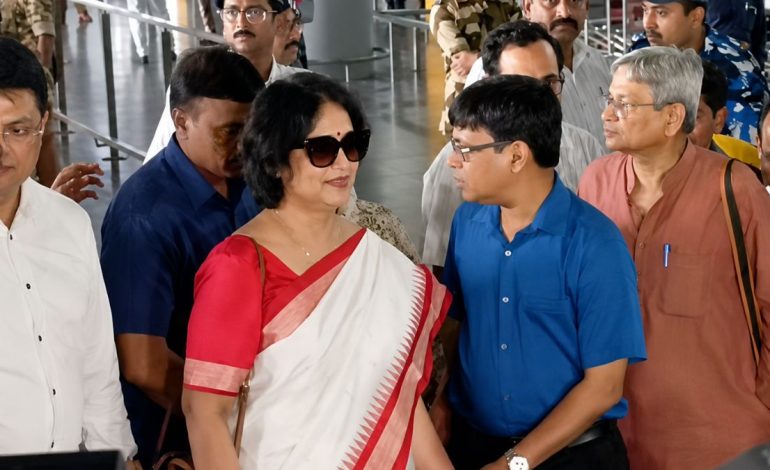
Taslima Nasreen arrives in Kolkata nearly two decades after being forced to leave the city. Image Credit: X/@JournoShabana

New Delhi: Exiled Bangladeshi author Taslima Nasreen returned to Kolkata on Friday, nearly two decades after she was forced to leave the city in 2007 following violent protests over her memoir Dwikhandito. She is in the city to attend a literary programme on August 1 at Rabindra Sadan, organized by Secular Mission, Paschimbonger Jonno and Human Rights Beyond Frontiers.
Her visit marks her first public appearance in Kolkata since 2007 and has quickly turned into a politically charged event in West Bengal.
‘A homecoming’
Ahead of her arrival, Nasreen described the trip as an emotional homecoming. She said returning to Kolkata felt like returning to “my own country”, adding that she had never left the city willingly. She called her return a symbol of the resilience of free expression. The programme is expected to include a civic reception, poetry recitation and an audience discussion.
Organizers said the event is likely to be attended by the West Bengal chief minister, Suvendu Adhikari; the finance minister, Swapan Dasgupta; and author Shirshendu Mukhopadhyay.
Political reactions
The visit has drawn sharp responses from opposition parties. Trinamool Congress MLA Akhruzzaman criticized the invitation, alleging Nasreen had made statements against Muslims, and accused the BJP government of honouring her for political reasons.
Indian Secular Front MLA Naushad Siddiqui said the BJP was using her visit to divert attention from governance issues and provoke communal tensions. The BJP welcomed her return, with the minister, Agnimitra Paul, saying it reflected a changed political environment in Bengal and criticizing previous governments for failing to protect Nasreen.
Why she left Kolkata
Nasreen fled Bangladesh in the 1990s after receiving death threats from Islamist groups over her writing, including her 1993 novel Lajja. She later settled in Kolkata but was forced to leave in 2007 after protests over Dwikhandito, her memoir that had already been banned in West Bengal in 2003 for allegedly hurting Muslim religious sentiments.
The Calcutta high court struck down that ban in 2005, allowing the book’s republication. But unrest resurfaced in 2007, leading to curfews in parts of the city. She was later moved out of Kolkata and relocated to Delhi under central government protection before briefly living in Europe.
The memoir behind row
Dwikhandito is the third volume of Nasreen’s multi-part autobiography, following Amar Meyebela and Uttal Hawa. It has now been published in English as Split: A Life by Penguin Random House India, translated by Maharghya Chakraborty.
The memoir combines personal recollections with criticism of religious orthodoxy, and includes portrayals of public figures that some objected to. Nasreen has said she was forced to remove certain passages from the book and faced a $4 million defamation lawsuit over it.
Nasreen has received international recognition for her work, including the Sakharov Prize for Freedom of Thought in 1994 and the Simone de Beauvoir Prize in 2008. Her return to Kolkata after 19 years has reopened a long-running debate in India over free expression and how the state responds to religious protests against writers.
While the BJP has framed her visit as a restoration of that freedom, opposition parties have accused the party of using the event to score political points ahead of scrutiny over governance in the state.