

China moves J-20 stealth fighters closer to Indian frontier, satellite imagery shows
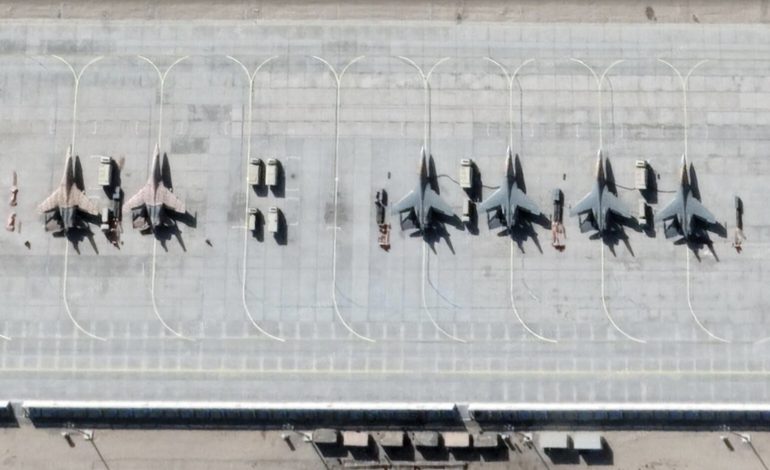
Six J-20s seen parked at the Hotan airbase in China’s Xinjiang region. (Google Earth image)

New Delhi: Fresh satellite imagery has revealed that China has stationed several Chengdu J-20 “Mighty Dragon” stealth fighters at two airbases facing India. Analysts are describing this as one of the largest concentrations of Beijing’s most advanced combat aircraft yet observed opposite the line of actual control (LAC).
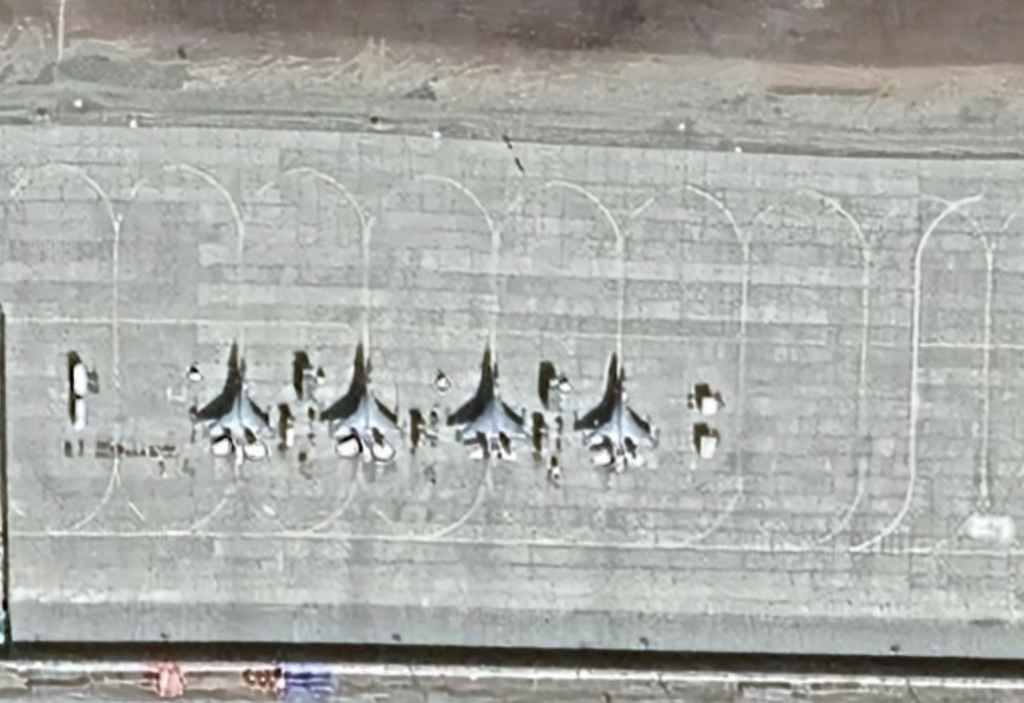
The images, captured by the geospatial intelligence firm Vantor between late June and early July 2026 and confirmed by RNA Media from Google Earth on Tuesday, show six J-20s parked at Hotan airbase in China’s Xinjiang region and four more at Damxung airbase in Tibet’s Lhasa prefecture. Some reports place the combined total as high as 12, the discrepancy likely owing to aircraft moving in and out of frame between successive satellite passes.
Hotan, a dual-use military and civilian facility, lies approximately 245 kilometres from India’s Daulat Beg Oldie advanced landing ground in eastern Ladakh and roughly 389 kilometres northeast of Leh – placing China’s most capable low-observable fighter within striking distance of India’s northernmost military infrastructure. Damxung, meanwhile, sits about 344 kilometres northwest of Tawang, extending the pattern of deployment towards India’s eastern sector in Arunachal Pradesh.
Neither the Indian Air Force nor the defence ministry has issued an official comment on the specific imagery. Beijing, too, has made no public statement, in keeping with its longstanding practice of neither confirming nor denying such deployments.
Long pattern now more visible
The J-20 has featured in a series of earlier sightings near the India border stretching back a decade – a single aircraft was reported at the high-altitude Daocheng Yading airport in 2016, followed by limited appearances at Hotan during the 2020 Galwan valley crisis, and a build-up of six J-20s at Shigatse airbase in Tibet, roughly 150 kilometres from Sikkim, reported by several media outlets in May 2024. The current concentration at Hotan and Damxung is the most substantial documented to date and appears to represent an incremental but sustained forward posture rather than an isolated exercise.
China does not publish an official inventory of its J-20 fleet. Independent estimates put the number of airframes delivered anywhere between roughly 300 and 500, a range that reflects the difficulty of separating frontline fighters from training aircraft, test platforms and jets awaiting formal induction. Western analysts, including those at the Royal United Services Institute and the Mitchell Institute for Aerospace [YouTube video] Studies in the US, estimate China’s Chengdu plant is now producing more than 100 J-20s a year, with satellite imagery reportedly showing factory expansion exceeding the footprint of Lockheed Martin’s F-35 production complex in Fort Worth, Texas.
What the deployment really means
Defence analysts caution against reading the imagery as evidence of imminent hostile intent. There is no reported crossing of the LAC associated with the deployment, and a single satellite pass cannot establish how long the aircraft will remain, whether they are armed, or whether the movement is tied to a training rotation rather than a permanent posting. The 111th Fighter Brigade at Korla, further back in China’s western theatre, is understood to provide a supporting depth position from which aircraft and personnel could rotate forward without concentrating the entire fleet close to the border.
That said, analysts note that a forward posture of this kind can shape crisis dynamics even without a shot being fired – by shortening China’s mobilization timelines, complicating Indian reinforcement planning, and raising the political cost of India appearing indifferent to activity so close to disputed territory. The redeployment also illustrates what analysts term strategic fungibility: the same J-20 fleet built up primarily for contingencies over Taiwan and the South China Sea can be shifted towards the Himalayan frontier as Beijing’s threat assessments evolve, at a corresponding opportunity cost to India, which must weigh how much of its own force posture to commit northward against its requirements in the Indian Ocean region.
India’s response
India has, over recent years, expanded its own forward infrastructure along the LAC and inducted the Rafale fighter, operating from bases including Ambala in the west and Hasimara in the east, as its principal counter to fifth-generation Chinese airpower. New Delhi has also operationalized the Russian-built S-400 air-defence system, which incorporates radars intended to track low-observable aircraft. India’s own fifth-generation fighter programme, the AMCA (advanced medium combat aircraft), remains some years from induction, meaning the Tejas-Mk1A and the developmental Tejas-Mk2 – alongside the Rafale and upgraded Su-30MKI fleet – are expected to carry the burden of countering advanced Chinese airpower in the interim.
The development comes even as India and China have taken tentative steps towards normalizing ties following the 2020 Galwan clash, including partial troop disengagement along contested stretches of the border. The contrast between diplomatic engagement on the ground and continued military build-up in the air is likely to remain a recurring feature of the relationship for the foreseeable future.