Shahabuddin, Bangladesh’s president, resigns citing ill health as speculation swirls over Hasina’s return
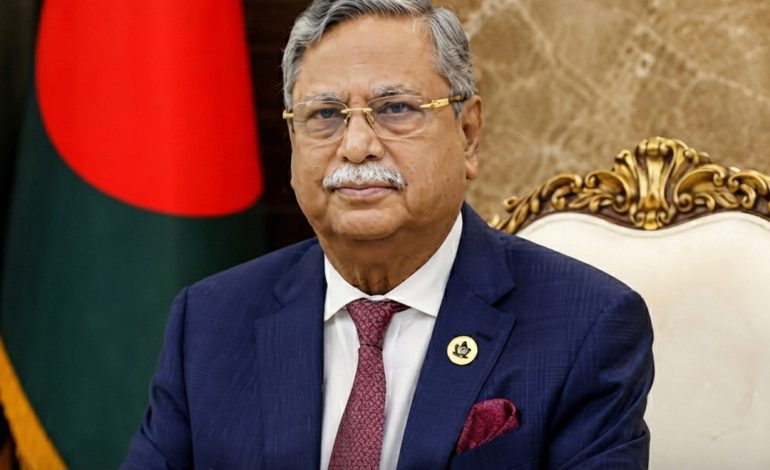
Mohammed Shahabuddin. (Photo via X)

New Delhi: Mohammed Shahabuddin, the president of Bangladesh, resigned on Friday, roughly halfway through a five-year term that was due to run until April 2028. His resignation letter was delivered to parliament and accepted by the speaker, Hafiz Uddin Ahmad, at 5.01pm (4.31pm IST) at the Jatiya Sangsad in Dhaka, according to the president’s press secretary, Sarwar Alam.
Asked by reporters why he was quitting, Shahabuddin gave a brief, health-related answer and said he had nothing further to add. His written resignation, however, set out both a defence of his own record and a detailed account of his medical condition.
His reason for resigning
In the resignation letter, Shahabuddin recorded that he had taken the oath of office as the 22nd president on April 24, 2023, and had since discharged his duties with honesty and full allegiance to the constitution. He then set out his version of the events of August 2024, when mass protests forced Sheikh Hasina out from power and, in his telling, plunged the country into a governance and constitutional crisis.
He wrote that he had sought the opinion of the appellate division of the Bangladeshi supreme court under Article 106 of the country’s constitution, and on that basis had formed an interim government, which in turn arranged the general election to parliament. He noted that the resulting government and opposition were now functioning through parliamentary practice, and credited his own conduct at the time with having spared the country a constitutional vacuum.
Turning to his health, he listed a long history of heart disease, high blood pressure, diabetes and kidney complications, and added that he had recently been diagnosed with autonomic neuropathy – a condition that causes him to occasionally lose consciousness. Citing the resulting physical and mental incapacity, he invoked Article 50(3) of the constitution: “I hereby resign from the office of the president.”
Separately, the president’s press secretary, Sarwar Alam, told reporters that Shahabuddin’s illness meant he could no longer discharge his duties and “he needs treatment and rest.”
Presidency outlasted two governments
Shahabuddin, a nominee of the Awami League, was elected unopposed on February 13, 2023, after no rival candidate filed papers, and was sworn in that April by the-then speaker, Shirin Sharmin Choudhury. A veteran of the 1971 Liberation War of Bangladesh, he had earlier retired as a district and sessions judge in 2006 and served as an anti-corruption commission member of the country from 2011 to 2016. He had also held posts in Awami League-linked student and labour bodies earlier in his career, and sat on the party’s advisory council – the same party whose activities have been banned since 2024.
Remarkably, he remained in Bangabhaban through the entire upheaval that followed. He dissolved parliament the day after Hasina fled to India in August 2024, ordered the release of the opposition leader, Khaleda Zia, from house arrest, and then presided over an 18-month interim administration led by the Nobel peace laureate, Muhammad Yunus. When the Bangladesh Nationalist Party swept the February 2026 election, winning more than 200 of parliament’s 300 directly elected seats, it was Shahabuddin who administered the oath to the incoming prime minister, Tarique Rahman, on February 17 this year.
Shadow of Hasina’s planned return
Shahabuddin’s departure comes at a pointed moment. On July 10, Hasina told Reuters in a rare interview that she and senior Awami League colleagues intended to return to Bangladesh from exile in India around December to surrender in court, despite a death sentence handed down in absentia in November 2025 over a crackdown on the 2024 uprising that a UN report put at nearly 1,400 deaths. “I will go myself,” she said.
Three sources familiar with the matter told Reuters that the Rahman government had pressed Shahabuddin to step aside precisely because of his long-standing ties to Hasina, in the run-up to her planned return. With his exit, Hasina loses her last identifiable ally in high office in Dhaka, five months before she says she will come home.
A reported phone call
Adding to the speculation, Bangladeshi media have reported – citing sources, and not confirmed by the president’s office – that Shahabuddin spoke by telephone with Hasina during a visit to London for medical treatment between May 9 and May 18. Neither side has given an on-record account of that reported conversation.
This is not the first time Shahabuddin’s perceived closeness to the fallen Awami League government has provoked a backlash. In October 2024, protesters tried to storm Bangabhaban after he told a Bangla-language newspaper that he had no documentary proof Hasina had actually signed a resignation letter before fleeing. This statement made the interim government’s law adviser call it “self-contradictory”, given Shahabuddin’s own televised address on the night of August 5, 2024, announcing that her resignation had been accepted.
The interim government stopped short of removing him at the time. Reuters had also reported, in December 2025, that Shahabuddin himself said he was keen to leave the post, citing among other grievances the removal of his official portraits from Bangladeshi missions abroad.
Taken together, the record allows for more than one reading. The letter’s medical detail is specific and, if accurate, would be reason enough on its own for a 76-year-old former judge to step down. Equally, the timing – barely five months before Hasina’s stated return date, and following sustained pressure documented by multiple news organizations – points to a political calculation by the Rahman government to clear the last vestige of the old order from Bangladesh’s highest constitutional office. The two explanations are not mutually exclusive, and neither Shahabuddin nor the government has offered anything beyond the official health rationale on record.
What now?
Under Bangladesh’s constitution, the speaker assumes the role of acting head of state once the presidency falls vacant, pending the election of a successor by parliament. The office is largely ceremonial, with executive authority resting with the prime minister, though the president also holds the nominal title of supreme commander of the armed forces. Given the Bangladesh Nationalist Party’s commanding majority in the current parliament, the choice of the next president is unlikely to be contested.
For New Delhi, which has hosted Hasina since August 2024 and has so far resisted Dhaka’s calls for her extradition, the removal of Bangladesh’s last Hasina-aligned office holder adds another layer to an already delicate bilateral relationship, one likely to come under renewed scrutiny as December approaches.