


India floats stratospheric airship push, opens door to private players
RNA illustration for representation.

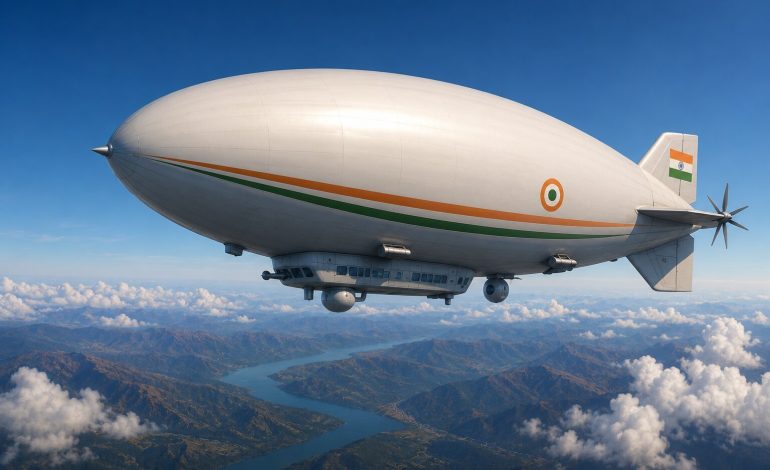
New Delhi: India has begun opening its stratospheric airship programme to private defence manufacturers, as the government pushes to field a fleet of near-space surveillance platforms capable of loitering over the country’s borders for months at a stretch. The push follows two rounds of approvals by the Defence Acquisition Council (DAC) this year.
In February this year, the council, chaired by the defence minister, Rajnath Singh, cleared an airship-based high-altitude pseudo satellite (AS-HAPS) programme worth around ₹15,000 crore, part of a wider ₹3.60 lakh crore acquisition package that also covered Rafale fighters and combat missiles for the Indian Air Force. In July, the DAC returned to the theme, granting acceptance of necessity (AoN) for a fixed-wing-based high-altitude pseudo satellite (FW-HAPS) platform as part of a further ₹52,000 crore package spanning the Army, Navy and Air Force.
Both platforms are meant to operate in the stratosphere, broadly between 18km and 50km altitude, bridging the gap between short-endurance drones and expensive orbital satellites. Solar-powered by day and battery-run overnight, they are designed to remain aloft for weeks or months, providing continuous intelligence, surveillance and reconnaissance, besides communication relay and remote sensing over India’s land and maritime borders.
The programme builds on groundwork laid by the Defence Research and Development Organisation (DRDO), whose Agra-based Aerial Delivery Research and Development Establishment carried out the maiden flight trial of a stratospheric airship platform in May 2025, from Sheopur in Madhya Pradesh. The unmanned airship, carrying an instrumented payload, reached about 17km and stayed airborne for 62 minutes before recovery. Singh had called the trial a step that placed India among a select group of nations with such indigenous capability, while the-then DRDO chairman, Samir V Kamat, described it as a milestone towards long-endurance, lighter-than-air systems.
Private industry is now central to scaling that early success. Bengaluru-based NewSpace Research and Technologies has run trials funded under the ministry’s Innovation for Defence Excellence scheme and drawn Navy interest for maritime roles. VEDA Aeronautics, working with the UAE’s Mira Aerospace, is separately preparing a bid for the Air Force’s wider HAPS requirement. Chennai-based Dashagriv Aerospace trialled a high-altitude airship prototype in open-sea conditions off Nagapattinam in April, one of the earliest such maritime validations by an Indian start-up.
Hindustan Aeronautics Limited is collaborating on prototypes, while a dedicated manufacturing facility set up by the Council of Scientific and Industrial Research’s National Aerospace Laboratories was inaugurated in November 2025.
The broader procurement framework favours this private participation. The draft Defence Acquisition Procedure 2026 raises the indigenous content threshold under the “Buy Indian-Indigenously Designed, Developed and Manufactured” category from 50% to 60%, alongside incentives meant to draw start-ups and private manufacturers deeper into high-technology defence programmes.