
Japan PM Sanae Takaichi arrives in Delhi for 16th India-Japan Annual Summit, economic security and defence high on agenda
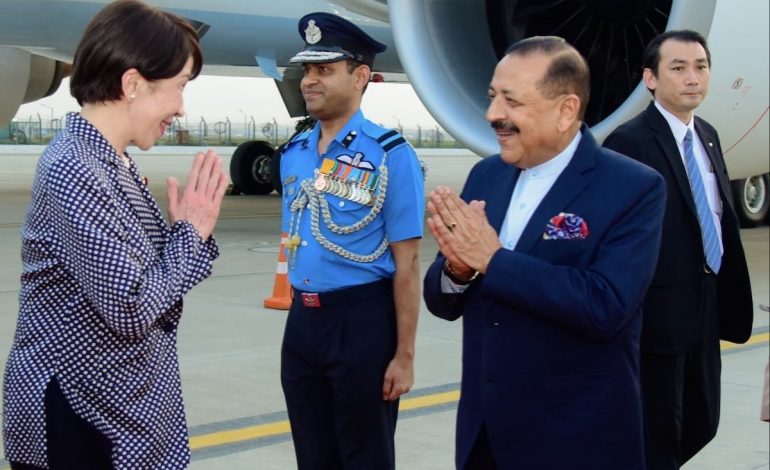
Sanae Takaichi (L) being welcomed by Jitendra Singh at the Delhi airport’s Palam Technical Area. (Photo: MEA)

New Delhi: The Japanese prime minister, Sanae Takaichi, landed in New Delhi on Wednesday evening for a three-day official visit to India, her first since taking charge in Tokyo in October 2025. The visit, at the invitation of the prime minister, Narendra Modi, will see Takaichi attend the 16th India-Japan Annual Summit, a mechanism that has anchored the bilateral relationship since it began nearly two decades ago.
Takaichi was received on arrival by the minister of state for science and technology, Jitendra Singh. The spokesman for the Ministry of External Affairs (MEA), Randhir Jaiswal, welcomed the Japanese leader on X and described the visit as an important step in advancing the “India-Japan Special Strategic and Global Partnership”. According to an earlier MEA statement, the visit that started today will end on Friday, July 3.
Takaichi is scheduled to be accorded a ceremonial reception at Rashtrapati Bhavan on Thursday morning, followed by summit-level talks with Modi and the signing and exchange of several agreements between the two countries. She will also address the India-Japan Business Forum, where, by her own account, more than 150 representatives of the Japanese business community are expected to take part.
A delegation of roughly 50 Japanese business leaders is travelling with her, including the president of Suzuki Motor, Toshihiro Suzuki, alongside senior executives from Itochu and Toyota Tsusho.
The summit was originally proposed to be held in Guwahati, Assam – a venue India had offered and one that would have revived a plan shelved in December 2019 after protests against the Citizenship (Amendment) Act. That plan was dropped this time too, with officials citing the ongoing session of Japan’s parliament, Diet, and the tight window available for Takaichi’s travel, keeping the entire visit confined to New Delhi.
Economic security agenda
The MEA has said the visit is expected to significantly boost investment and innovation opportunities while strengthening economic ties between the two countries, with a major focus on building resilient supply chains in strategic sectors such as semiconductors and critical minerals. Diplomatic sources indicate the discussions will also emphasize maritime security and defence technology cooperation.
Officials suggest a declaration on artificial intelligence cooperation could be announced, alongside proposals for a large-scale green ammonia project in Odisha, expanded biogas collaboration and regional resilience initiatives under the POWERR Asia framework. Expected outcome documents include a Joint Statement on the Annual Summit, an agreement on energy resilience, and memoranda of understanding covering artificial intelligence, pharmaceuticals, batteries and critical minerals. Officials also point to work on developing an “industrial value chain” connecting the Bay of Bengal with northeast India, an idea that dovetails with Japanese-backed infrastructure such as Matarbari port in Bangladesh and the Dhubri-Phulbari bridge in Assam.
One of the more consequential items likely to feature in the joint statement is a proposal, first reported by Nikkei Asia, for a local-currency settlement scheme that would enable direct yen-rupee transactions, bypassing the US dollar. If it goes through, it would mark the first time currency cooperation of this kind has been formally written into a leaders’ joint statement between the two countries, with officials targeting a memorandum of cooperation between Japan’s finance ministry and the Reserve Bank of India within this financial year.
Under the framework, non-resident Japanese entities would be permitted to open accounts with Indian banks, allowing financial institutions on both sides to settle cross-border payments directly in yen and rupees without routing through the dollar. The two countries already maintain a $75 billion bilateral currency swap arrangement extended through 2026, which officials say gives the settlement plan a ready-made foundation.
The economic numbers underpinning the visit are sizeable. Bilateral trade reached $27.5 billion in the 2025-26 financial year, while Japanese investment in India totalled $3.2 billion between April and December 2025. About 1,400 Japanese companies currently operate in India, nearly half of them in manufacturing. The figures build on a commitment made during Modi’s visit to Tokyo in August 2025 for the 15th annual summit, when Japan revised its investment target for India upward, from an initial 5 trillion yen to 10 trillion yen over the coming decade, under what the two sides called the “Japan-India Joint Vision for the Next Decade”.
Defence and security cooperation
Security cooperation builds on the “Joint Declaration on Security Cooperation” signed by Modi and Takaichi’s predecessor, Shigeru Ishiba, in Tokyo on August 29, 2025. That declaration commits both sides to opposing destabilizing or unilateral attempts to change the status quo by force or coercion, supporting freedom of navigation and overflight, and deepening cooperation within the Quad grouping. It also set out enhanced defence research and development cooperation between India’s Defence Research and Development Organisation and Japan’s Acquisition, Technology and Logistics Agency, along with cooperation on critical minerals exploration, processing and refining.
Concrete outcomes from that framework have been modest but real. In November 2025, India and Japan signed their first military co-development and co-production project, for specialized naval radio communication equipment known as the Unified Complex Radio Antenna, or Unicorn, technically designated the NORA-50 antenna and already in service on Japanese warships. Bigger-ticket proposals have moved more slowly. India first approached Japan in 2015 over its plans for six diesel-electric submarines, eyeing the Soryu-class boat with lithium-ion batteries, but talks stalled over Tokyo’s traditional reluctance to share submarine technology.
A separate proposal for Mahindra Defence Systems to manufacture ShinMaywa’s US-2 amphibious aircraft in India, agreed in principle in 2018, also did not progress. Whether either project resurfaces during this visit remains to be seen; officials have given no indication that either is on the table this week.
The China factor
The backdrop to the visit is a sharply deteriorated Tokyo-Beijing relationship. Takaichi’s remarks in Diet last year suggesting Japan could intervene militarily were China to attack Taiwan have drawn a hard Chinese response. Beijing blacklisted a further 20 Japanese defence and technology firms from accessing Chinese raw materials on June 29, 2026, and over the weekend of June 27-28, a combined formation of roughly 15 Chinese and Russian bombers and fighter jets carried out joint air patrols over the Sea of Japan, the East China Sea and the western Pacific, forcing both Japan and South Korea to scramble aircraft.
Rare earths have become a particular pressure point for both countries. Japan is currently facing a Beijing-imposed restriction on rare earth elements used in high-performance magnets, a curb similar to the one India encountered when China suddenly tightened export controls on rare earths and finished magnets in April last year. To reduce that dependence, India has committed ₹7,280 crore to build 6,000 million tonnes per annum of integrated rare earth permanent magnet manufacturing capacity, with both countries working together through the “Mineral Security Partnership” and the “Quad Critical Minerals Initiative”.
Speaking before her departure from Tokyo, Takaichi framed the visit around three broad priorities – deepening the strategic partnership, advancing economic security, and expanding business-to-business collaboration – and linked her government’s Free and Open Indo-Pacific vision explicitly to Modi’s MAHASAGAR initiative. She described India as an indispensable partner for Japan in jointly realizing the Free and Open Indo-Pacific, arguing that a genuinely free and open region is one where every nation can chart its own course free of external coercion.
Writing ahead of her arrival, she summed up her government’s view of the relationship in a single line: a strong India is good for Japan, and a strong Japan is good for India.
The substantive engagement begins Thursday, when Modi and Takaichi hold summit-level talks followed by the ceremony to sign and exchange agreements, and the two leaders address the business forum. This report will be updated once the joint statement and the list of signed agreements are formally released.