


India Slams China-Pakistan Over CPEC Projects In Occupied Territories, For Raking Up Kashmir Issue
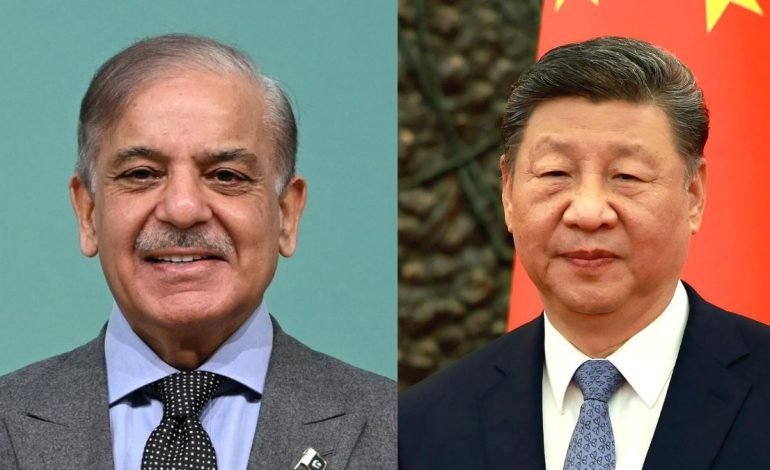
Chinese President Xi Jinping and Pakistani Prime Minister Shehbaz Sharif during talks in Beijing as India sharply rejected China and Pakistan’s remarks on Kashmir and opposed CPEC projects passing through Pakistan-occupied territories. Image courtesy: Wikimedia Commons.

India, on Tuesday (May 26, 2026), slammed China and Pakistan for raising the Kashmir issue under the United Nations framework, and reminded the two nuclear-armed neighbours that any CPEC-related Pakistan-occupied territories were illegal.
India’s reaction came after China supported Pakistan on the Kashmir issue, with Beijing reiterating its call for a “peaceful solution” in a joint statement issued during an official visit by Pakistani Prime Minister Shehbaz Sharif and Army chief Asim Munir.
The joint statement, issued in Beijing, said both China and Pakistan supported a “peaceful settlement of disputes” in accordance with the UN Charter and relevant Security Council resolutions.
China reiterated its support for Pakistan’s position on Kashmir, while the joint statement underlined the deepening strategic alignment between the two countries across security, diplomacy, Artificial Intelligence, regional connectivity, and counter-terror cooperation.
India has consistently rejected Pakistan’s stand on Kashmir, including the occupied territories of Gilgit-Baltistan, through which the China-Pakistan Economic Corridor is being constructed.
In its reaction to the joint statement, India’s Ministry of External Affairs (MEA) “categorically” rejected the “unwarranted” references to the Union Territory of Jammu and Kashmir.
“India’s position is consistent and well known to the concerned parties. The Union Territories of Jammu & Kashmir and Ladakh have been, are, and will always remain integral and inalienable parts of India. No other country has the locus standi to comment on the same,” MEA spokesperson Randhir Jaiswal said.
“As regards the so-called China-Pakistan Economic Corridor (CPEC) projects, some of which are in India’s sovereign territory, we resolutely oppose and reject any moves by other countries to reinforce or legitimise Pakistan’s illegal and forcible occupation of these territories, impinging on India’s sovereignty and territorial integrity. This has been clearly conveyed to Pakistani and Chinese authorities several times,” Jaiswal said.
“We have also seen references to the so-called ‘trans-boundary water resources cooperation’ between China and Pakistan. As the two countries do not share any boundary, the question of so-called ‘trans-boundary water resources cooperation’ does not arise. India has never recognised the so-called 1963 boundary agreement between Pakistan and China,” he said.
China and Pakistan also reached a “new broad consensus” on deepening strategic ties to upgrade the development of a joint economic corridor and establish Gwadar port as a regional connectivity hub.
“Both sides welcomed third parties to participate in the development of the China-Pakistan Economic Corridor under the model agreed,” they said in the joint statement.
They agreed to promote “high-quality” development of CPEC, a flagship project of China’s Belt and Road initiative, develop Pakistan’s port of Gwadar, and strengthen road and port links.
The plans included the Khunjerab Pass and an upgrade of the Karakoram Highway, the main overland link between China and Pakistan. Islamabad promised targeted steps to boost security for the Chinese workers and investments, a key concern for Beijing after multiple attacks by military groups such as the TTP.