


‘Innovate at the Speed of Relevance’: Air Chief Marshal A P Singh’s Call to India’s Defence Ecosystem
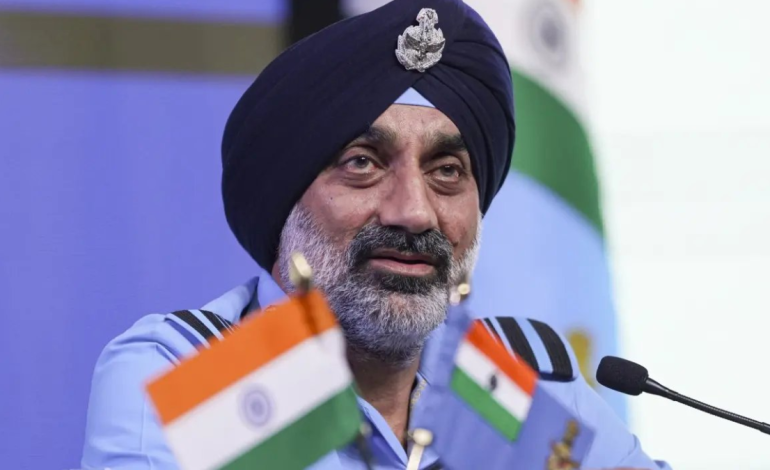

The Chief of Air Staff Air Chief Marshal A P Singh on Friday (May 15) called for a fundamental shift in India’s approach to defence technology, stressing that the country must accelerate its research and development cycle to keep pace with the rapidly evolving nature of modern warfare.
Air Chief Marshal A P Singh was speaking at a seminar organised by the Indian Air Force’s think tank, the Centre for Aerospace Power and Strategic Studies, in New Delhi. He called on India to match the pace of technological change by getting the balance right between manufacturing scale and genuine innovation in defence.
“There is a need to innovate at the speed of relevance,” he said. “We cannot be innovating or doing R&D at a slow pace. We need to increase the speed because the system has to come in before it becomes irrelevant. While we build the systems of today, we must simultaneously be doing Research and Development for the systems of tomorrow.”
ACM Singh spoke at length about the growing role of unmanned and autonomous systems across all domains of warfare, noting that the shift toward robotic combat is no longer a distant possibility but an accelerating reality. He pointed to the proliferation of unmanned aerial vehicles, unmanned vessels at sea, and ground-based robotic systems already being deployed with weapons.
“We are moving towards robotic warfare, where robots will fight wars because the human cost—the cost in human lives—simply cannot be measured in those terms,” he said, adding that India needed to take this transition seriously and invest in its own capabilities across all domains.
The Air Chief also flagged a critical gap that could undermine India’s operational effectiveness—the absence of robust policy and regulatory frameworks to govern the use of AI and autonomous systems in both the civil and military domains.
He warned that without the right regulations in place, distinguishing friend from foe in a complex operational environment, where manned and unmanned platforms fly together, would become increasingly difficult.
ACM Singh emphasised that building a credible unmanned systems capability cannot rest on the military alone. “It has to be a whole-of-nation approach,” he said, calling on uniformed personnel, users, developers, and manufacturers to jointly determine the roadmap, agree on timelines, and commit to meeting them.
He backed collaboration with like-minded nations and foreign companies to build industrial capacity in India but drew a firm line on strategic dependency. Every component of a critical system, he said, must be designed and manufactured domestically so that production can be scaled up rapidly when required.
Further, ACM Singh offered the audience a lesson drawn from personal experience, which challenges the pursuit of perfection at the cost of timeliness. “I have sometimes been guilty of this myself,” he said. “It is better to have a system with 85 to 90 percent capability delivered on time than to wait for 100 percent and have it delayed beyond its relevance.”