India Trains Myanmar Forces on UN Peace-Keeping, Shares Best Practices
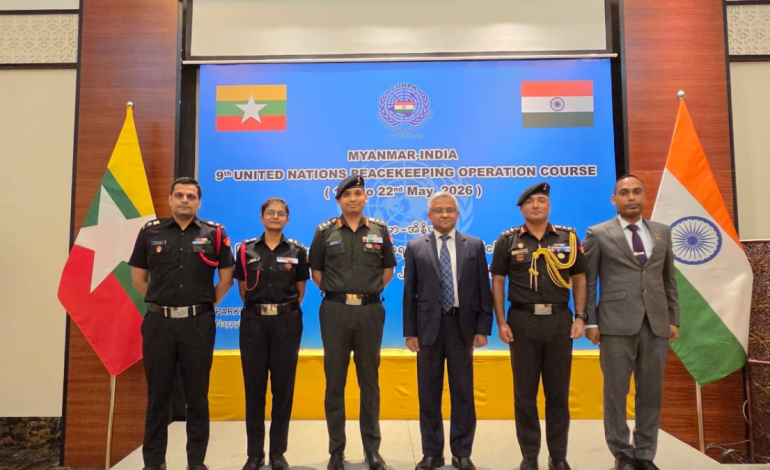
India UN peacekeeping training. Image courtesy: @IndiainMyanmar

India, as the largest troop-contributing nation in UN peacekeeping, is training Myanmar forces in best practices, drawing on its vast experience in successful blue beret operations.
New Delhi-based Centre for United Nations Peacekeeping (CUNPK), on Monday (May 11, 2026), has begun a two-week training course on blue beret operations for 30 Myanmar military officers at the neighbouring nation’s capital, Naypyitaw.
The Indian Embassy in Myanmar said this was the ninth UN peacekeeping course being organised by India for Myanmar forces, and a three-member CUNPK trainers’ team was conducting the course in Naypyitaw.
At the inaugural function, Indian Ambassador to Myanmar, Abhay Thakur, covered India’s role in humanitarian missions, contributing to global stability.
India-based CUNPK hosted the eighth training capsule in July 2025, building on the seven previous successful courses held between 2016 and 2019, according to a statement from the Indian Embassy in Naypyitaw.
The CUNPK is a joint effort of the Indian Ministries of External Affairs and Defence, along with the Indian armed forces.
“Myanmar and India share a unique and profound bond, one that is deeply rooted in centuries of shared history, vibrant cultural exchanges, and an unbreakable geographical proximity,” the statement said.
Abhay Thakur, in his remarks, said Myanmar stood at the confluence of three of India’s most important foreign policy priorities: Neighbourhood First, Act East, and Indo-Pacific.
“This relationship is not merely strategic; it is a testament to our shared destiny and common future,” the Ambassador said.
He referred to the CUNPK’s meticulously designed curriculum, which would focus on strengthening Myanmar officers’ readiness and understanding of the critical areas of blue beret operations.
The curriculum, he said, included graduated escalation and conflict management, which would equip the peacekeepers with the nuanced skills to de-escalate tensions and manage conflicts effectively in volatile environments.
The training capsule also taught rules of engagement and protection of civilians, which reinforced the paramount importance of adhering to international humanitarian law and ensuring the safety and well-being of civilian populations, which was the very essence of peacekeeping.
It also included operational planning within the complex peacekeeping environments, which provided practical insights and methodologies for effective planning and execution of missions in diverse and challenging operational theatres.
India has been a key contributor to global peace and security since 1950, providing over 2,90,000 peacekeepers for over 50 UN missions, the Ambassador noted.
“India is committed to and deeply honoured to share its extensive and invaluable peacekeeping experience,” he added.
According to the Indian Ministry of External Affairs’ fact-sheet on UN peacekeeping missions, India has been an energetic and influential participant in the UN debates on peacekeeping and has helped in shaping current thoughts on many conceptual issues.