


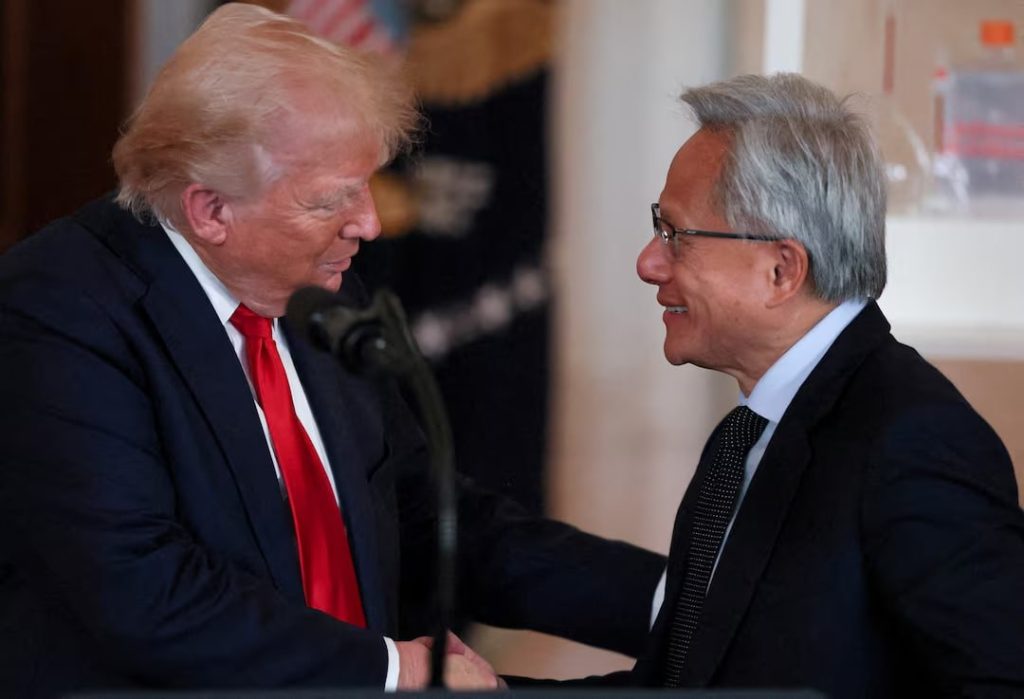
New Delhi: The US president, Donald Trump, has welcomed Jensen Huang’s return as Nvidia’s chief executive officer, describing the technology billionaire as a “great patriot and national treasure” whose leadership is vital to America’s global technological dominance. Trump’s endorsement came shortly after Nvidia’s board reversed its earlier decision and reinstated Huang, bringing an extraordinary 11-day leadership crisis at the world’s leading artificial intelligence chipmaker to an end.
The president’s intervention has added a significant political dimension to the controversy, which involved allegations concerning Huang’s personal relationships and possible links to Chinese intelligence operations. Trump maintained that American authorities had found no evidence of unlawful conduct by Huang and expressed confidence that his reinstatement would not compromise US national security.
Trump’s remarks reflected Washington’s growing recognition of Nvidia’s importance to American economic and strategic interests, particularly as the US intensifies its competition with China over artificial intelligence and advanced semiconductors. However, the president also emphasized that the company must continue complying with restrictions on exports of sensitive computing technology, underlining the delicate balance between commercial leadership and national security requirements.
Trump explicitly endorsed the board’s decision, calling it the “correct and proper decision” and arguing that Huang’s continued leadership would benefit both Nvidia and the American economy. He also said the US attorney general, Todd Blanche, had confirmed that federal authorities possessed no evidence of Huang having engaged in unlawful activities, although that assurance did not amount to a conclusion that all related investigations were over.
Trump’s support preceded the board’s reversal
Trump had publicly supported Huang even before Nvidia announced his reinstatement, repeatedly suggesting that the company should give its co-founder another opportunity to lead. On November 16, he said he would not object to Huang’s return, and by November 21, he was openly urging the company’s directors to reconsider their position despite their earlier declaration that reinstatement was not under consideration.
As RNA Media reported on Saturday, Trump had argued that Huang should be allowed to apologize and resume his responsibilities rather than be permanently excluded from the company he helped establish. His position was supported by several prominent Silicon Valley executives and Nvidia employees, although others questioned whether reinstatement would undermine corporate governance and accountability.
The controversy began when Huang resigned on November 12 following revelations about extramarital relationships, including one allegedly involving Alice Huang, a Chinese businesswoman suspected by American authorities of having connections to Chinese intelligence. The two are not related, and the espionage allegations remain under investigation, with no publicly established finding that Jensen Huang knowingly participated in intelligence activities.
A subsequent report by the New York Times alleged that Alice Huang had maintained contact with an official associated with China’s principal intelligence agency for more than a year during her relationship with the Nvidia executive. Those allegations intensified scrutiny of possible foreign intelligence efforts targeting senior figures at companies possessing strategically sensitive American technologies.
Washington’s assurances and the national security question
In its official statement, Nvidia said its directors had unanimously approved Huang’s reinstatement after discussions with him and consultations involving senior levels of the US government. The board said those exchanges had satisfied it that Huang could return to leadership without creating an unacceptable national security risk.
However, the company emphasized that an independent directors’ committee would continue investigating reports that Huang may have been targeted by a foreign intelligence operation. Nvidia has also established a separate national security and export-control committee and initiated a search for a chief compliance officer, demonstrating that the broader security concerns remain unresolved.
Trump’s insistence on continued scrutiny of export controls is particularly significant because Nvidia dominates the market for advanced processors used to train and operate artificial intelligence systems. Washington has restricted the transfer of certain high-performance computing technologies to China, fearing that they could strengthen Beijing’s military modernization, surveillance capabilities and intelligence operations.
The tensions surrounding these restrictions have already complicated Nvidia’s commercial relationship with China, historically an important market for American semiconductor companies. RNA Media’s earlier examination of Washington’s efforts to tighten AI chip export controls highlighted how the controversy surrounding Huang had become entangled with the wider technological confrontation between the two powers.
Political endorsement, corporate consequences
Trump’s enthusiastic backing has also raised questions about the extent to which political considerations should influence the governance decisions of major American corporations. Although Nvidia maintains that its board reached a unanimous decision after independent deliberations, the timing of its reversal underscores the considerable influence exercised by both Washington and Silicon Valley’s most powerful figures.
Huang’s return nevertheless provides reassurance to investors concerned about the future of a company whose technological ambitions have remained closely associated with his leadership since its founding in 1993. Nvidia’s extraordinary growth has made its processors indispensable to the global AI industry, giving its chief executive an influence extending well beyond the company’s shareholders.
The board had previously appointed the chief financial officer, Colette Kress, as interim chief executive following Huang’s resignation, placing her in charge during a particularly difficult period. Nvidia has thanked Kress for maintaining operational continuity and confirmed that she will continue in her financial leadership role.
For Trump, Huang’s reinstatement represents a victory for his argument that retaining exceptional technological talent is essential to preserving American leadership in artificial intelligence. For Nvidia, however, the greater challenge will be to reconcile the return of its influential founder with credible corporate oversight, regulatory compliance and the continuing investigation into potential foreign intelligence threats.
The immediate leadership crisis may have ended, but the issues that triggered it have not disappeared. Whether Huang’s return ultimately strengthens Nvidia will depend not only on the company’s commercial performance but also on its ability to demonstrate that national security concerns and corporate accountability are being addressed independently of political influence.