


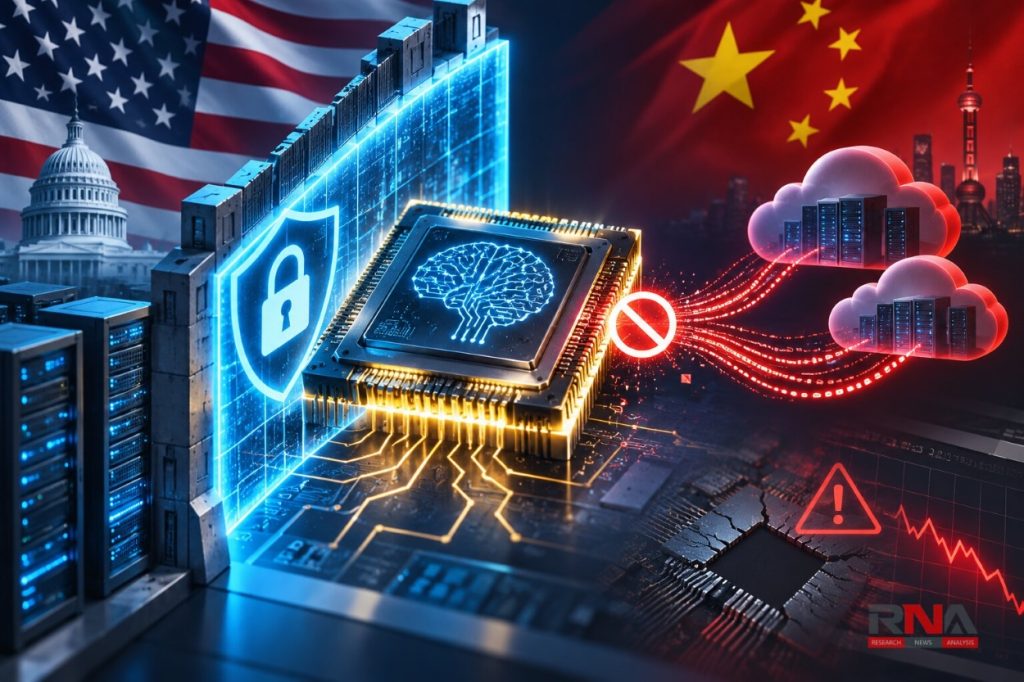
New Delhi: The administration of the US president, Donald Trump, has introduced sweeping restrictions aimed at preventing Chinese technology companies from accessing advanced American artificial intelligence chips through overseas data centres, closing a regulatory loophole that Washington believes has undermined its semiconductor export controls. The measures, announced on Tuesday, extend US oversight beyond the physical shipment of sophisticated processors to the computing services they provide, potentially disrupting China’s AI ambitions and the rapidly expanding global cloud-computing industry.
The new regulations issued by the US commerce department identify Singapore, Malaysia, Thailand, Indonesia and Brazil as countries presenting heightened risks of advanced American chips being diverted to unauthorized users. Exporters seeking to supply covered processors to these destinations must obtain licences, although the rules provide exemptions for certain American-operated facilities and commercial activities.
The restrictions also require overseas data centres supplying substantial computing capacity to Chinese companies to secure American authorization within 90 days if they wish to continue providing those services. Washington argues that preventing the physical export of sensitive technology is insufficient when companies can rent equivalent computing power through servers located outside China.
Beijing warns of countermeasures
China reacted sharply on Wednesday, accusing Washington of using national security concerns to obstruct legitimate technological and commercial cooperation. The Chinese foreign ministry spokesman, Guo Jiakun, described the restrictions as economic coercion and extraterritorial interference, warning that Beijing would take necessary measures to protect its legitimate interests.
China’s commerce ministry separately expressed strong dissatisfaction and firm opposition, arguing that the measures threatened international supply chains and contradicted understandings reached between the two governments. The statements came as Trump travelled to Asia for discussions with the Chinese president, Xi Jinping, raising questions about whether the latest semiconductor dispute could complicate their fragile trade understanding.
How Chinese companies exploited loophole
For several years, Washington has restricted China’s access to advanced graphics processing units, particularly those manufactured by Nvidia, because of their importance in training sophisticated AI systems. However, Chinese developers could still acquire computing capacity from overseas data centres equipped with restricted American processors, effectively accessing the technology without importing the chips themselves.
Such arrangements allowed Chinese companies to train large AI models on powerful foreign-based hardware, creating a distinction between ownership of restricted processors and remote access to their computational capabilities. The new regulations seek to narrow that distinction by bringing certain cloud-computing arrangements under the same national security scrutiny as physical semiconductor exports.
The implications extend to military technology because advanced AI computing can support intelligence analysis, surveillance, autonomous systems, cyber operations and complex defence simulations. Washington’s concern is that unrestricted access to American processing capabilities could accelerate Chinese military modernization, although the commercial use of such computing infrastructure does not itself establish military involvement.
Nvidia scandal intensifies Washington’s scrutiny
The restrictions follow a major controversy involving Nvidia’s co-founder and former chief executive, Jensen Huang, who resigned on November 12 following allegations concerning his relationship with Alice Huang, a former executive associated with Singapore-based Megaspeed International. US authorities suspect Megaspeed of involvement in arrangements that may have diverted restricted AI technology towards China, although the allegations have not been established in court.
As previously reported by RNA Media, Huang’s departure triggered a leadership crisis at the semiconductor company, with its chief financial officer, Colette Kress, assuming the role of interim chief executive. Beijing has rejected allegations connecting the controversy to Chinese intelligence activities, describing the accusations as groundless attempts to discredit China.
In a joint statement on Tuesday, the US commerce and justice departments confirmed that Megaspeed had been under investigation for potential export-control violations since 2024. Nvidia subsequently placed the company on its internal sales-restriction list in June 2025, while American investigators pursued allegations concerning the possible diversion of advanced computing equipment.
Megaspeed has maintained that it complies with applicable laws, including American export regulations, and Singaporean and Malaysian authorities have separately examined possible irregularities involving semiconductor shipments. Singapore has also indicated that it is assessing the new American restrictions and consulting affected businesses to understand their potential consequences.
New restrictions begin disrupting AI investments
The commercial impact is already emerging, with banks reportedly suspending work on a $480 million financing arrangement intended to purchase advanced Nvidia processors for use by the Chinese technology company ByteDance. According to a Bloomberg report, lenders are reassessing their participation because of concerns that the transaction could breach the new American restrictions.
The episode illustrates how semiconductor controls can influence not only chip sales but also financing, data-centre construction and cross-border technology partnerships. Nvidia, meanwhile, faces heightened regulatory scrutiny and investor uncertainty as its leadership transition coincides with an increasingly restrictive policy environment.
What restrictions mean for India and global AI race
For India, which is expanding indigenous AI capabilities and investing in semiconductor manufacturing, the developments underline the strategic importance of reliable access to advanced computing infrastructure. Although India is not among the five countries facing the additional country-specific licensing requirements, Indian businesses developing AI infrastructure must still consider American export regulations, technology dependencies and the risks arising from international cloud-service arrangements.
The wider confrontation also exposes a fundamental challenge facing Washington: restricting China’s access to American technology without undermining the global commercial ecosystem that supports US semiconductor leadership. Whether the latest measures successfully constrain Chinese AI development will depend on enforcement, cooperation from third-country governments and Beijing’s ability to develop alternatives to American computing technology.
The immediate test will be whether Washington can prevent restricted computing capabilities from reaching unauthorized users without imposing excessive costs on legitimate international AI businesses. With Beijing threatening countermeasures and both governments preparing for another round of high-level negotiations, advanced semiconductors are becoming an increasingly consequential instrument of economic and strategic competition.