


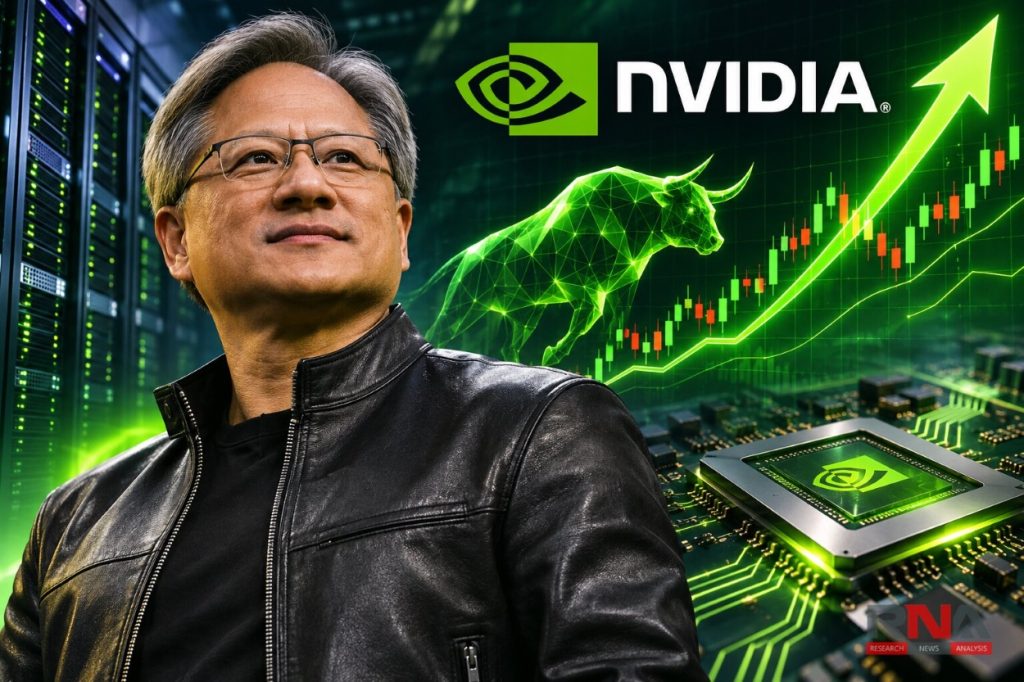
New Delhi: Nvidia has reinstated its co-founder, Jensen Huang, as chief executive just 11 days after his abrupt departure following revelations about his personal relationships and allegations involving a suspected Chinese intelligence operative. The decision, announced on Monday, represents an extraordinary reversal by the American semiconductor giant’s board, which had previously ruled out his return, and comes amid mounting concerns over corporate governance, US national security and the future of the global artificial intelligence industry.
The decision restores Huang to the positions of president, chief executive officer and board director with immediate effect, ending the short tenure of Colette Kress as interim chief executive. Kress, who has served as Nvidia’s chief financial officer since 2013, will return to that position as the company seeks to restore confidence among investors, customers and employees following nearly two weeks of leadership uncertainty.
In its announcement confirming Huang’s reinstatement, Nvidia said its directors had unanimously concluded that his return served the interests of the company and its stakeholders. The board’s chairman, Harvey C Jones, defended the decision, saying Huang remained the appropriate person to lead the chipmaker through a period of exceptional growth and increasing geopolitical scrutiny.
Huang welcomed his reinstatement and expressed gratitude to the board, Kress, Nvidia employees and industry partners for supporting the company during the upheaval. He also acknowledged his family’s support and pledged to resume his responsibilities with renewed commitment, although his return does not remove the questions surrounding the circumstances of his resignation.
The announcement triggered an immediate rally in Nvidia shares, which jumped more than 25 per cent in premarket trading, according to the Guardian. The sharp reaction reflected investor expectations that Huang’s return could stabilize Nvidia’s leadership and preserve relationships with major customers at a time when the company occupies a central position in the global AI infrastructure business.
From resignation to reinstatement
The controversy began after reports emerged concerning Huang’s extramarital relationships, including an alleged relationship with a woman whom American authorities suspect of having connections to Chinese intelligence. Huang resigned on November 11, with Nvidia formally announcing his departure the following day, although neither the suspected intelligence connection nor any compromise of company information has been publicly established.
On November 8, before Huang stepped down, Nvidia’s board had ordered an independent investigation into reports that its chief executive had been targeted by a foreign intelligence operation. The company maintained that it had no reason at that stage to believe its proprietary information or American national security had been compromised, although the allegations raised concerns about possible vulnerabilities involving one of Washington’s most strategically important technology companies.
The board initially adopted a firm position against bringing Huang back, with Jones publicly stating on November 17 that Nvidia did not intend to reinstate him. Kress reinforced that position during the company’s earnings discussions, suggesting the semiconductor manufacturer was prepared to move forward under new leadership despite Huang’s importance to its development.
That position changed dramatically following renewed calls for Huang’s return, including an intervention by the US president, Donald Trump, who publicly urged Nvidia to rehire him. Trump argued that Huang’s leadership was important not only for the company but also for the wider American economy, underscoring how closely Nvidia’s fortunes have become connected with Washington’s technological and industrial priorities.
The board subsequently said it had received input from senior American government officials and was satisfied that Huang’s reinstatement did not pose a national security risk. However, the decision does not necessarily amount to a complete resolution of the underlying investigation or of broader questions concerning Nvidia’s export-control safeguards.
National security concerns remain unresolved
Nvidia has confirmed that its independent investigation will continue despite Huang’s return, with external legal advisers assisting the inquiry into the suspected foreign intelligence operation. The board has also established a national security and export-control committee and announced plans to appoint a chief compliance officer, signalling that stronger oversight will accompany the leadership change.
The controversy has acquired wider significance because Nvidia’s advanced processors are central to the technological competition between the United States and China, particularly in artificial intelligence and high-performance computing. Washington has imposed restrictions on exports of sophisticated chips to China over concerns that the technology could strengthen Beijing’s military and intelligence capabilities, making Nvidia’s compliance procedures a matter of strategic importance.
The allegations have also prompted scrutiny of Nvidia’s overseas commercial relationships, including those involving intermediaries suspected of facilitating unauthorized shipments of restricted processors. As RNA Media reported on November 16, the controversy generated a campaign within Silicon Valley to restore Huang even as investigations into China-related security concerns continued.
Why Huang’s return matters for Nvidia
Huang co-founded Nvidia in 1993 and transformed it from a graphics-chip manufacturer serving computer gamers into a dominant supplier of processors powering modern AI systems. That transformation has made the company indispensable to major cloud-computing providers and AI developers, giving its leadership decisions consequences extending well beyond the semiconductor industry.
The company’s latest financial performance illustrates the scale of its importance, with third-quarter revenue reaching $115.8 billion, an increase of 103 per cent from a year earlier. Its data-centre business alone generated $107.6 billion, demonstrating how rapidly demand for AI infrastructure has expanded despite uncertainty surrounding Huang’s departure.
However, reinstating Huang presents Nvidia with a delicate corporate governance challenge, particularly after directors publicly rejected the possibility of his return. The company must now demonstrate that its decision was based on a credible assessment of commercial interests and security risks rather than pressure from influential investors, technology executives or political leaders.
For Washington, the immediate question is whether Nvidia can retain its technological leadership without weakening safeguards intended to prevent sensitive American technology from reaching strategic competitors. Huang’s return may restore stability at the company’s highest level, but the outcome of the continuing investigations will determine whether Nvidia can put the controversy behind it.