


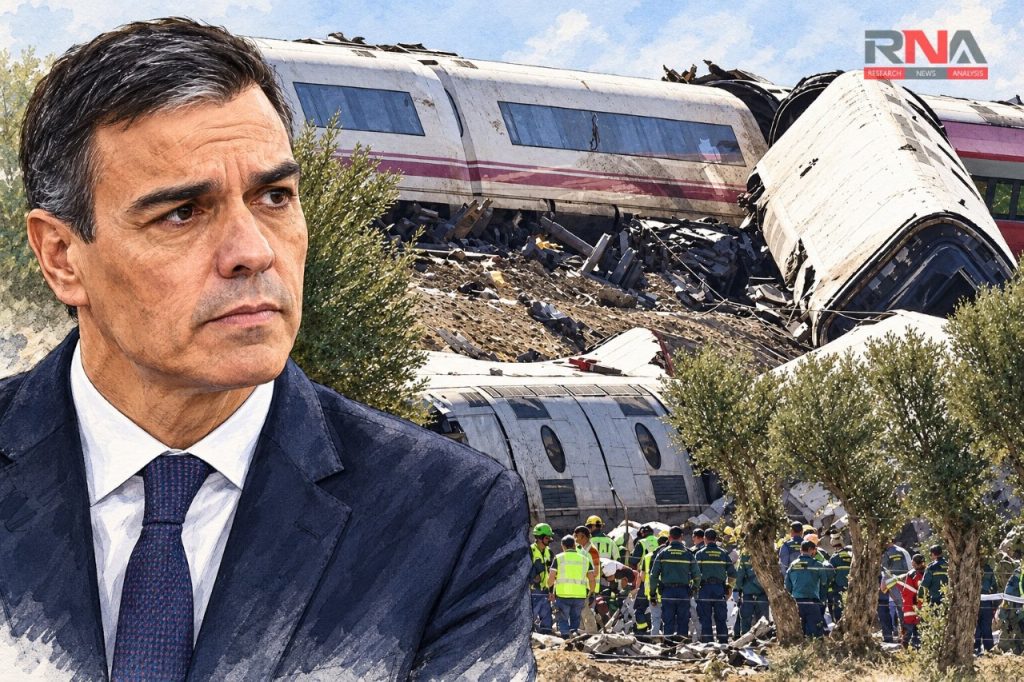
New Delhi: The death toll from Spain’s high-speed train collision rose to 69 on Thursday as emergency workers searched damaged carriages and investigators examined why a train was allowed to proceed towards another standing on the same track. The country’s second fatal high-speed rail disaster in nine months has interrupted election campaigning and placed the prime minister, Pedro Sanchez, under renewed pressure over public safety and government accountability.
Cranes worked overnight to move wreckage near Urda in Toledo province, where a Renfe AVE train struck the rear of an Iryo service on Wednesday. Both trains were travelling from Madrid towards Seville, and the collision derailed several carriages, some of which fell down an embankment.
The head of the Castilla-La Mancha regional government, Emiliano Garcia-Page, announced the revised death toll after human remains were recovered during the overnight operation. Authorities said 57 injured people remained in hospital, while rescue teams continued examining an overturned carriage.
Spain has declared three days of official mourning, from Thursday to Saturday, with national flags lowered at public buildings and overseas missions. After visiting the crash site, Sanchez promised assistance for victims and their families and said any negligence or deficiencies in the safety system would be investigated and addressed.
The preliminary reconstruction centres on a communications failure that disabled the LZB train-control system at about 8.30am, forcing several trains to stop. According to the transport minister, Oscar Puente, the control centre subsequently authorized the Renfe service to resume normal running even though the Iryo train remained ahead on the same track.
A reconstruction published by Euronews, drawing on official information and recorded communications, places that authorization at 8.36am and the collision at 8.53am local time. It reported that the Iryo driver had informed controllers that her train remained stationary, making the failure to stop or slow the approaching service a central question for investigators.
Puente described the authorization as inexplicable, but the precise sequence of failures and individual responsibilities remains under investigation. The distinction matters: a technical malfunction may explain why normal operations were interrupted, while investigators must separately establish why the procedures governing movements during that interruption failed to prevent a collision.
The infrastructure manager, Adif, suspended high-speed services between Madrid and Andalusia and established assistance points at major stations, including Madrid, Seville, Cordoba and Málaga. Its notice said the Madrid–Toledo and Malaga–Seville high-speed sections continued operating normally.
The disaster follows the January 18 collision near Adamuz in Cordoba province, where an Iryo train derailed and struck an oncoming Renfe service, killing 46 people. Preliminary findings in that investigation pointed to a possible rail fracture before the derailment, underlining that the two disasters should not be assumed to share an identical technical cause.
Sanchez has acknowledged that two high-speed rail disasters in one year are unacceptable, while cautioning that investigators must determine their origins. His government now faces the simultaneous demands of supporting bereaved families, restoring services and demonstrating that the safety review will produce credible answers.
Disaster turns poll campaign into test of governing credibility
Politically, the collision changes the question confronting Sanchez before the November 29 snap election. A campaign in which he sought to mobilize support around social protection now risks becoming a judgement on whether his government can ensure the dependable functioning of essential public services.
Reuters’ examination of the electoral implications describes a campaign that had recently gained momentum following nationwide anger over the eviction and subsequent death of an elderly woman, Maricarmen Abascal. Housing had become a central political issue, while an October survey by the state-run pollster CIS offered Sanchez encouragement despite his weaker position in many other polls.
The political difficulty is that a government campaigning on protection must also defend its delivery of that protection. Voters concerned about housing insecurity can simultaneously demand reliable transport, and the opposition will seek to connect those concerns through a broader argument about administrative competence.
The conservative People’s Party leader, Alberto Nunez Feijoo, has demanded accountability and promised a review of the network if elected, while the Vox leader, Santiago Abascal, has called for Sánchez’s resignation. These responses reveal different political approaches: Feijoo can present himself as an alternative administrator, while Vox can channel anger into a more sweeping rejection of the government.
Neither approach guarantees electoral gains, because public grief does not translate mechanically into support for an opposition party. An excessive rush to assign blame could also alienate voters who expect political leaders to prioritize victims and allow investigators to establish the facts.
For Sanchez, however, the repetition of disaster creates a particular vulnerability even if the two crashes prove technically unrelated. The public may judge whether the authorities learned enough from January, acted on warnings and subjected the system to sufficiently rigorous scrutiny.
That is a question of political accountability distinct from criminal responsibility. Investigators must establish who did what and whether laws or operating rules were breached, while ministers must explain whether oversight, staffing, maintenance and emergency procedures were adequate.
The government also faces an uncomfortable dispute over investment priorities, with unions alleging that safety improvements have been neglected. Those allegations require examination against expenditure, maintenance and implementation records rather than acceptance as a settled explanation of the collision.
Spain’s railway expansion has made the country a European leader in high-speed infrastructure, but network size alone cannot demonstrate operational resilience. The European Commission’s assessment of the rail network explicitly identifies adequate funding and effective infrastructure management as essential to reliable services.
The immediate policy test therefore extends beyond promises of additional spending or new equipment. Authorities must show that existing safeguards work when technology fails, that controllers and drivers receive unambiguous instructions, and that warnings trigger timely intervention.
There is also a wider European dimension, because Spain’s railways form part of the continent’s ambitions for closer economic integration and lower-emission transport. The European Commission’s high-speed rail plan envisages stronger cross-border links, including journeys connecting Paris and Lisbon through Madrid, supported by more coordinated investment and common technical systems.
The implication for that agenda is practical: investment in faster connections must be accompanied by confidence in everyday operations and emergency arrangements. Spain’s disaster does not establish that the European rail model is failing, but it strengthens the case for measuring success through safe, reliable service as well as infrastructure expansion.
The election’s proximity makes the government’s response especially consequential, because a final technical investigation may take longer than the remaining campaign. Sanchez will therefore be judged partly on decisions visible now – disclosure of verified information, cooperation with investigators, support for victims and demonstrable action on identified risks.
His political prospects cannot responsibly be declared settled before voters respond and further evidence emerges. What the disaster has already done is narrow his room for error: restoring confidence will require a credible account of what failed and evidence that the authorities can prevent those failures from recurring.