


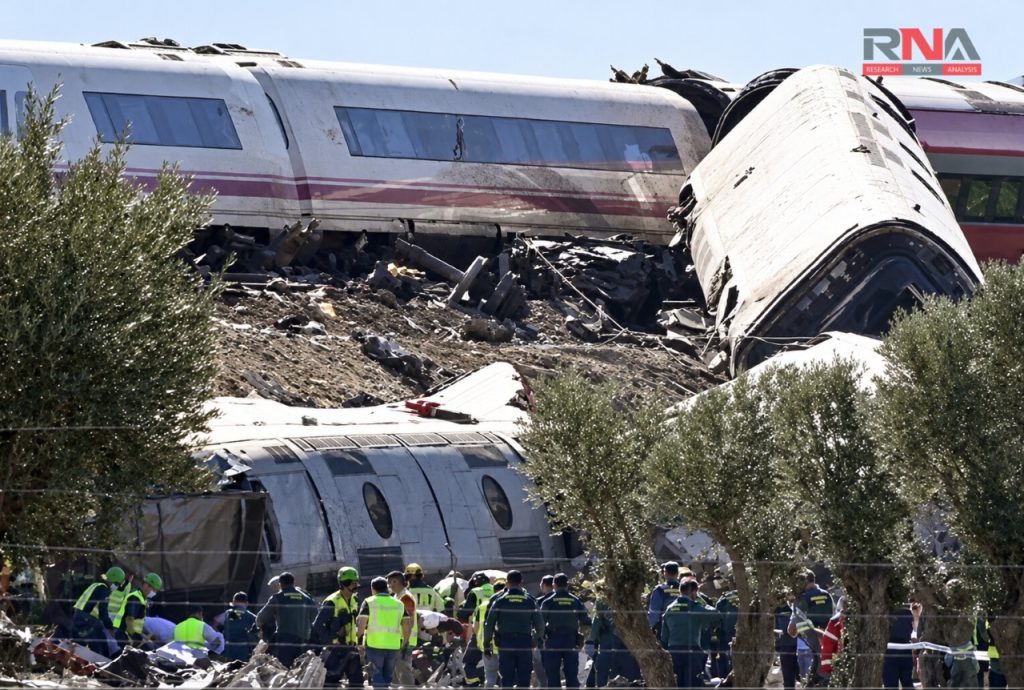
New Delhi: At least 68 people were killed when a high-speed passenger train struck another from behind near Urda in Spain’s Toledo province on Wednesday, with the government’s preliminary account focusing on an instruction allowing the approaching train to resume its journey despite a red signal. Rescue teams continued searching the wreckage as Spain announced three days of national mourning following its second major railway disaster this year.
The latest official death toll, announced by the president of Castilla-La Mancha, Emiliano Garcia-Page, marked a substantial increase from the 39 deaths reported earlier by RNA Media in the day. He said 24 of those killed had been aboard the Renfe AVE service and 44 on the Iryo train, while warning that further victims could be found beneath the damaged carriages.
Garcia-Page also reported 15 injured people classified under the most urgent red triage category and another 53 under the less urgent yellow category, alongside others with minor injuries. These figures were an emergency assessment rather than a final injury count, with the search and identification process still under way.
The collision occurred shortly before 9am near kilometre 118 of the Madrid–Seville high-speed corridor, where both trains were travelling south towards Seville. Spain’s railway infrastructure manager, Adif, confirmed a rear-end collision between services operated by the state-owned Renfe and the private operator Iryo, bringing traffic on the Madrid–Andalusia high-speed line to a halt.
The AVE struck the Iryo service while the latter was stationary, sending several carriages off the tracks and down the railway embankment. Aerial images showed three Iryo carriages below the line, while the AVE’s leading power car had fallen down the opposite slope and its first passenger carriage had broken apart.
More than 500 passengers were travelling on the two services, although initial reports differed over the precise number aboard. In its official statement on the accident, Renfe identified its train as the service scheduled to leave Madrid-Puerta de Atocha at 8am and reach Sevilla-Santa Justa at 10.39am.
The transport minister, Oscar Puente, outlined a preliminary sequence in which a computer-related failure affecting the LZB train protection system at about 8.30am automatically stopped several trains. Controllers at Adif’s Atocha centre then assumed responsibility for directing movements through the affected section, according to his account carried by Spain’s public broadcaster, RTVE.
At about 8.36am, the AVE was authorized to resume normal running even though the Iryo remained ahead and a red signal was active, Puente said. He described that authorization as “inexplicable” and said the control centre had time to recognize and correct the error before the collision at approximately 8.53am local time (1.23 IST).
The distinction between normal running and restricted movement is central to the emerging investigation: Puente said the applicable procedure required the train to proceed on sight, at no more than 40 kilometres per hour, so the driver could respond to an obstruction. The AVE instead travelled approximately 25 kilometres before the impact, although its exact speed and the full chain of responsibility had yet to be conclusively established.
The minister’s account places the instructions issued after the protection-system failure at the centre of the inquiry, but it remains a preliminary reconstruction rather than a completed investigative finding. The reasons for the initial technical failure, the authorization to proceed and the absence of an effective subsequent intervention remain questions for investigators.
Visiting Urda, the prime minister, Pedro Sanchez, promised a thorough investigation and said any negligence would be exposed. He announced national mourning from October 29 to October 31 and said measures would be taken to restore confidence in the railway system after two high-speed rail disasters in the same year.
Firefighters, medical teams, the Guardia Civil, civil protection personnel and Spain’s military emergency unit were deployed to the scene, with cranes and specialist search teams supporting operations around the wreckage. García-Page said canine units would assist the search, while further access beneath damaged carriages would be coordinated with the judicial authorities.
The regional government activated its territorial emergency plan at 9.15am, establishing an advanced command post and medical facilities for assessing and treating casualties before hospital transfers. Urda opened local sports facilities for those affected, while psychological and social support teams were mobilized to assist passengers and families.
The closure disrupted high-speed connections between Madrid, Ciudad Real and Andalusia, leaving trains held at stations along the corridor. Renfe enabled free ticket changes and cancellations for affected services, while passengers were advised to check with their operators before travelling to stations.
Adif established assistance points at Madrid-Puerta de Atocha, Sevilla-Santa Justa, Cordoba-Julio Anguita and Malaga-María Zambrano stations. It also published dedicated family assistance numbers: 900 10 10 20 for Renfe and 900 001 403 for Iryo.
The disaster follows the January 18 crash near Adamuz, in Cordoba province, which killed 46 people and injured more than 120. In that accident, an Iryo train derailed before colliding with a Renfe Alvia service travelling in the opposite direction, a different sequence from the rear-end impact at Urda.
The Adamuz investigation remains open, with investigators examining a fractured rail and the possibility of a failure at a welded joint; no final cause has been established. The latest collision raises a separate set of questions about train protection, the handling of technical failures and the safeguards governing instructions from railway control centres.