


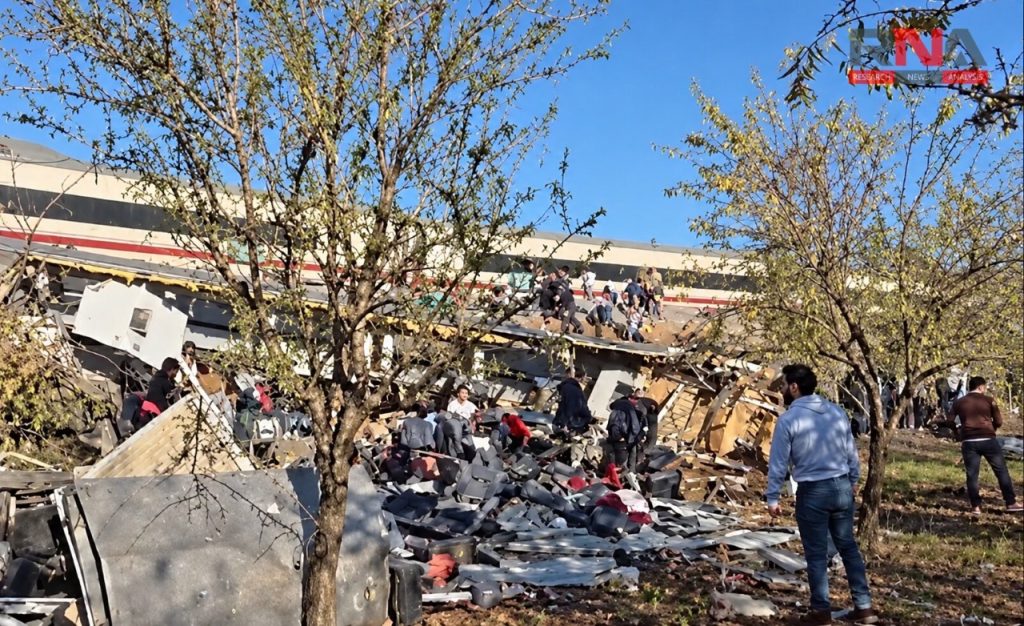
New Delhi: Two high-speed passenger trains collided near Urda in Spain’s Toledo province on Tuesday, sending carriages down an embankment and forcing the suspension of services between Madrid and Andalusia. The death toll was reported to have reached at least 39, although casualty figures remained uneven across news outlets as emergency teams assessed the scale of the disaster.
The Spanish regional newspaper Tribuna de Avila reported 39 deaths, attributing the figure to Castilla-La Mancha’s emergency service, while earlier coverage had put the toll at at least 10. The number of injured and the severity of their injuries had not been established in the public broadcaster RTVE’s latest available account.
Spain’s railway infrastructure administrator, Adif, described the accident as a rear-end collision involving a Renfe train and a service operated by Iryo. According to RTVE’s account citing Adif, both trains were travelling south towards Andalusia when one struck the other from behind.
The collision occurred near Urda station, on the stretch between Mora and Orgaz and Urda, at kilometre 118 of the Madrid–Seville corridor. Regional emergency service sources placed the incident at about 8.54am local time (1.24pm IST), although some initial railway accounts gave an earlier time.
At least two carriages left the tracks and fell down an embankment, according to emergency service information carried by Spanish news agencies. The circumstances leading to the impact remained unexplained, with no established finding on its cause in the available reporting.
Firefighters from Alcazar de San Juan and Orgaz were deployed alongside civil protection teams from surrounding towns. Three medical helicopters and two mobile intensive care units were also sent to the site, according to Europa Press, citing the regional 112 emergency service.
The regional government activated its territorial emergency plan, known as Platecam, at 9.15am, placing Toledo under its operational emergency level 1. In nearby Urda, the mayor, Manuel Galan, said emergency officials had asked the town hall to prepare a sports pavilion to receive passengers requiring assistance.
The suspension of the Madrid-Andalusia high-speed line affected travel in both directions, interrupting connections between the capital, Ciudad Real and southern Spain. Because the collision occurred on a corridor serving several Andalusian destinations, the disruption extended beyond the two trains directly involved.
Renfe confirmed the accident and enabled ticket changes and cancellations for passengers affected by the closure, while sending personnel to the scene. No confirmed timetable for restoring services was available in the reports reviewed, leaving passengers dependent on further announcements from the operators and Adif.
The prime minister of Spain, Pedro Sanchez, cancelled a scheduled appearance at the health ministry to monitor the emergency. According to an EFE report, he had been due to address the closing session of the World Obesity Summit 2026 in Madrid.
The Toledo collision follows another major railway disaster in southern Spain earlier this year, when a high-speed train derailed near Adamuz in Córdoba province on January 18, 2026, and collided with an approaching service. That accident killed 46 people and temporarily severed the rail connection between Madrid and southern Spain, prompting wider debate about the network’s safety and reliability.
The available accounts describe different collision sequences: the Adamuz disaster involved a derailment into the path of an oncoming train, whereas Adif described the Urda crash as an impact between trains travelling in the same direction. The cause of the latest collision remained undetermined, while a consolidated casualty count was still awaited.