


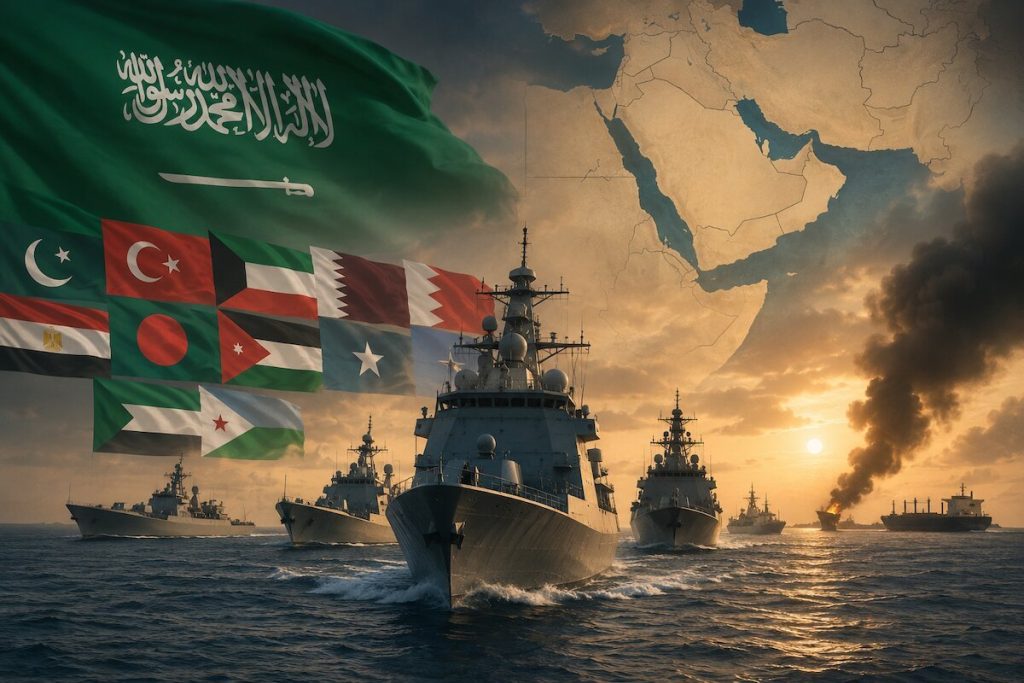
New Delhi: Saudi Arabia has unveiled a new multinational naval coalition to protect Red Sea and Gulf of Aden shipping lanes after weeks of Houthi attacks disrupted one of the world’s busiest trade corridors. Representatives from 43 countries and the European Union gathered in Riyadh on Thursday, to discuss the proposal, though only 14 states have so far signed on as founding members.
The kingdom’s defence ministry said the new body, described as a “purely defensive” grouping, will be called the Multinational Maritime Defence Alliance. Riyadh will host its headquarters and serve as the coalition’s founding and leading state.
Two conspicuous absentees
The initial signatories include Saudi Arabia, Kuwait, Bahrain, Qatar, Turkey, Pakistan, Egypt, Jordan, Yemen, Bangladesh, Sudan, Djibouti and Somalia. Reports differ on the 14th member, with some naming Nigeria and others the Comoros, though the Saudi ministry has not clarified the discrepancy.
Notably absent are the United Arab Emirates and Oman, two of the six Gulf Arab states that share Saudi Arabia’s stated security concerns. Neither government has explained its decision to stay out for now, and the Saudi ministry has stressed that the coalition’s charter remains open to any country willing to complete its domestic accession procedures.
The alliance is to be built around a joint command structure, an operations control centre and a general secretariat, intended to coordinate intelligence-sharing, naval patrols and joint exercises among members. Saudi officials have taken care to frame the initiative as protective rather than confrontational.
The ministry said the coalition is not directed against any particular state or organization and would operate strictly within international law while respecting the sovereignty of participating nations. It is a formulation clearly aimed at Tehran, without naming it.
Blockade, airstrikes, widening front
The trigger for the coalition was a July 20 announcement by Yemen’s Iran-aligned Houthi movement that it would impose a naval blockade on Saudi Arabia, a move the Houthis justified as retaliation for what they called Riyadh’s siege of Yemen. Saudi Arabia has rejected that characterisation outright.
Since then, the Houthis have claimed a series of attacks on Saudi-linked shipping, and at least one Saudi-owned tanker has reportedly been struck. Saudi Arabia has responded with airstrikes on Houthi military installations in the Yemeni port city of Hodeidah, which Riyadh says were being used to threaten commercial vessels.
The confrontation is unfolding against the backdrop of the wider war involving Iran, which has already disrupted shipping through the Strait of Hormuz. Analysts have noted that Yanbu, Saudi Arabia’s Red Sea export terminal, has become an increasingly vital outlet for the kingdom’s crude since Hormuz traffic was curtailed, giving Riyadh little room to tolerate a prolonged blockade.
The disruption has rattled energy markets. Brent crude broke through $100 a barrel last week for the first time since May, even as other market assessments put prices nearer $90, underlining just how volatile trading has become.
Shipping companies have increasingly rerouted vessels around Africa’s Cape of Good Hope to avoid the danger zone, a diversion that can add up to two weeks to a voyage. Industry analysts warn that the resulting rise in freight and fuel costs could eventually feed through to consumer prices well beyond the region.
Echo of 2019 but bigger
The Riyadh-led initiative is not the first of its kind. In 2019, after drone attacks on Saudi Aramco facilities widely blamed on Iran, Saudi Arabia joined the American-led International Maritime Security Construct alongside the UAE, Britain, Australia and Bahrain to safeguard Gulf shipping lanes.
This time, Saudi Arabia itself is in the driving seat, and the scale of participation – 43 countries at the table, against a handful in 2019 – reflects how far the threat to Red Sea trade has spread. The European Union already runs its own naval protection mission in the Red Sea, known as Operation Aspides, and it remains unclear how the new Saudi-led alliance will interact with it.
For India, which draws heavily on the Persian Gulf and Red Sea corridor for both crude imports and container trade with Europe, prolonged instability along this route carries direct economic consequences, even though New Delhi is not currently listed among the coalition’s members. With oil prices already elevated and shipping costs rising, the coming weeks are likely to test how quickly the new alliance can move from statements of intent to operations on the water.