


New Delhi: Tensions around the Middle East’s key maritime routes have intensified after Yemen’s Houthi rebels claimed missile and drone attacks on Saudi Arabia following Saudi strikes in Yemen’s Hodeida province. The latest escalation comes alongside a US naval blockade of Iran and fresh confrontations involving commercial vessels in the Strait of Hormuz, Gulf of Oman and Arabian Sea.
Houthi-Saudi tensions spill into Red Sea
The Houthi military spokesman, Brig Gen Yahya Saree, said the group launched missiles and drones towards facilities linked to Saudi Aramco in Yanbu and Jizan. The Houthis said the action was retaliation for Saudi strikes on Hodeida. Saudi civil defence reported multiple alerts in Yanbu and Jizan early Saturday but Riyadh did not provide further details about the alleged attack.
The Saudi-led coalition said its aircraft had struck military targets in Hodeida province that were connected to threats against commercial shipping. It denied targeting the port. The confrontation has renewed concerns over the security of the Red Sea, particularly the Bab el-Mandeb strait, which links the Red Sea with the Gulf of Aden and serves as a major route for international trade.
Shipping faces fresh uncertainty
The Houthis have threatened to restrict Saudi-linked shipping through Bab el-Mandeb unless Saudi Arabia ends its military campaign and lifts its blockade on Yemen. The group has also targeted several oil tankers in recent days. While commercial vessels continue to use the waterway, the growing threat has prompted some ships to change routes or turn around, adding to uncertainty for global maritime trade.
US intensifies maritime pressure on Iran
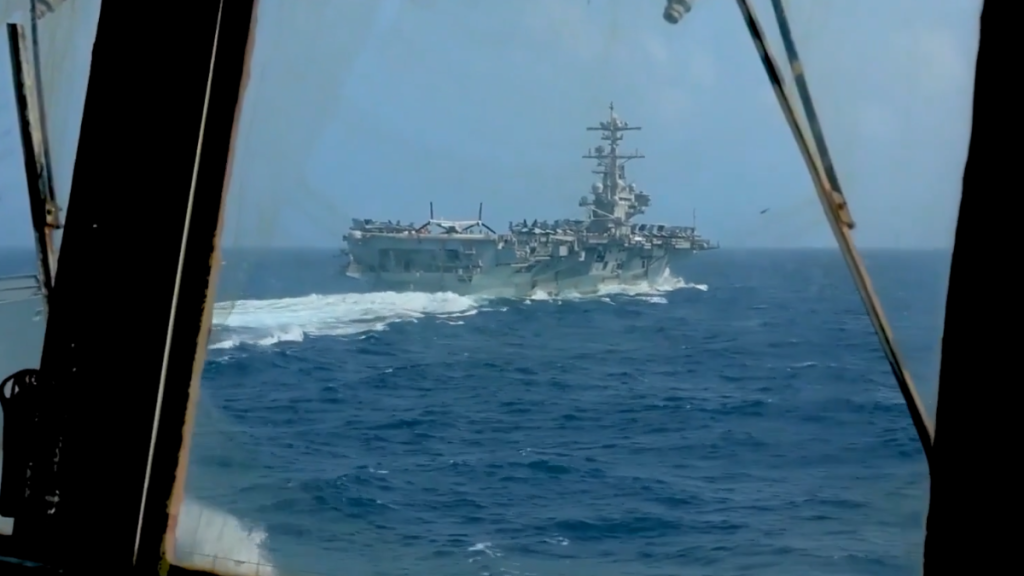
At the same time, the US is enforcing a naval blockade aimed at restricting maritime traffic heading towards Iranian ports. US Central Command (Centcom) said coalition forces have redirected 12 commercial vessels attempting to cross the blockade. It said American forces also carried out a verification boarding of the Comoros-flagged tanker M/T Charminar in the Arabian Sea before allowing it to continue its voyage.
A separate confrontation took place in the Gulf of Oman involving the Mozambique-flagged M/T Lavine. Centcom said the vessel was disabled on July 24 after its crew allegedly ignored repeated warnings and attempted several times to breach the blockade. The US command said its forces would continue monitoring and intercepting vessels across regional waterways.
Iran steps up action in Hormuz
Iran’s Islamic Revolutionary Guard Corps has also increased pressure on maritime traffic. Four commercial vessels were targeted in the southern Strait of Hormuz within a 24-hour period, according to Iranian state broadcaster IRIB. Tehran said the ships were travelling along a route it considered illegal and unsafe, although the identities of the vessels were not released.
Indians safe after tanker incident
An incident involving the Mozambique-flagged LPG tanker “Disha” has also drawn attention in India. The vessel was involved in an incident in Iranian territorial waters while carrying 28 Indian crew members. The Indian embassy in Tehran said it was coordinating with local authorities and confirmed that all the crew members were safe.
No new US strikes reported overnight
The maritime developments followed an apparent pause in US strikes on Iran. No fresh US attacks were reported overnight, breaking a pattern of nearly two weeks of consecutive strikes. Iranian health ministry spokesperson Hossein Kermanpour described the night as peaceful, while Centcom did not announce new strikes.
The Iranian foreign minister, Abbas Araghchi has meanwhile called for diplomacy and dialogue to resolve the Yemen crisis and prevent further military confrontation.
Iran, Ukraine trade accusations
Tehran also accused Ukraine of attacking an Iranian commercial vessel in the Caspian Sea, saying one person was killed and another injured, as reported earlier by RNA Media. Araghchi raised the issue with EU foreign policy chief Kaja Kallas, while Iranian state media said Ukraine’s diplomatic representative was summoned.
Ukraine, however, said its long-range strikes in the Caspian Sea had achieved significant results, including against vessels it alleged were involved in military cargo shipments connected to Iran.