


New Delhi: Iran has warned that it could launch pre-emptive military strikes against the United States if it concludes that Washington is preparing another attack, signalling a potentially dangerous shift in Tehran’s response to mounting American military pressure. The warning comes as a third US aircraft carrier arrives in the Middle East, Iranian drones target American military installations in Bahrain, and renewed incidents in the Strait of Hormuz threaten to deepen an already prolonged regional conflict.
The warning was issued by Iran’s deputy foreign minister for legal and international affairs, Kazem Gharibabadi, during an interview with Iranian state television on Sunday. According to Iranian media, Gharibabadi accused Washington of potentially exploiting diplomatic negotiations to prepare another military offensive, making it clear that Tehran would not necessarily wait for American forces to strike first.
Gharibabadi said Iran was preparing for three possible developments – a negotiated settlement, continued economic and maritime restrictions, or another round of military confrontation. He rejected suggestions that mounting American pressure could compel Tehran to surrender its strategic interests, arguing that the country possessed sufficient military capabilities to withstand further coercion.
The Iranian official also questioned whether the present confrontation could reasonably be described as a period between war and peace. He maintained that Iran remained legally in a state of war and asserted that its Islamic Revolutionary Guard Corps (IRGC) was developing missiles with new ranges, although the claimed advances could not be independently verified.
Third US aircraft carrier enters the region
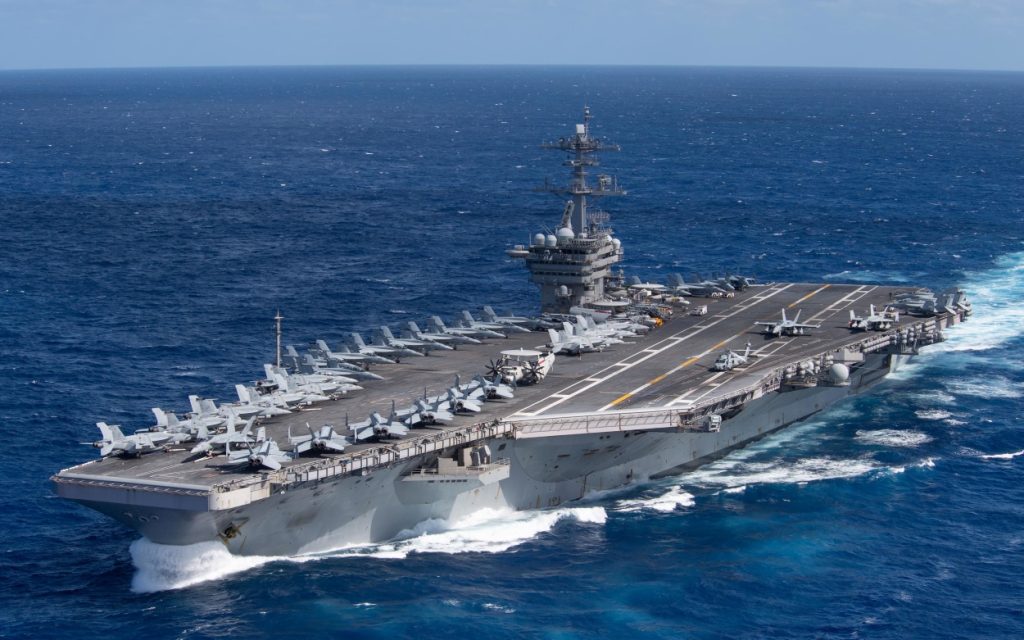
The warning coincided with the arrival of the USS Theodore Roosevelt in the Middle East, reinforcing an already substantial American naval deployment in the region. A US official confirmed the carrier’s arrival to Al Jazeera on Monday, saying the warship had joined two other aircraft carriers operating within the US Central Command’s area of responsibility.
The deployment provides Washington with additional options for sustained air operations, maritime surveillance and possible strikes against Iranian military infrastructure. However, the concentration of American naval power also creates the possibility of a wider confrontation if Iran interprets military movements as preparations for an imminent attack.
The latest development follows a Reuters report on Saturday that the US president, Donald Trump, had privately indicated he might refrain from ordering further strikes unless Iran or the Iran-backed Houthis in Yemen carried out fresh provocations. The report said Saudi Arabia and Turkey had urged Washington to avoid another major military offensive, although Trump had made no firm commitment to either government.
American officials reportedly believe that sanctions and the naval blockade are weakening Iran economically without requiring an immediate return to large-scale combat operations. The US secretary of state, Marco Rubio, reinforced that position on November 13, arguing that further military action was unnecessary because Washington’s economic pressure had already substantially weakened Tehran.
Iranian drones target US radar in Bahrain
The military confrontation has nevertheless intensified around Bahrain, where the IRGC claimed to have launched six drones against a US air-defence radar installation at Al-Riffa Air Base on November 15. Bahrain said its air-defence systems intercepted Iranian aerial attacks before they reached their targets, contradicting Tehran’s suggestion that the operation had successfully damaged American military infrastructure.
The attack followed another Iranian claim on November 13 that its forces had struck a US early-warning radar installation in the kingdom. American military authorities rejected that account, saying two Iranian drones had been intercepted without causing casualties or damage, as previously reported by RNA Media.
Bahrain is particularly sensitive to the confrontation because it hosts the headquarters of the US Navy’s Fifth Fleet, which plays a central role in American maritime operations across the Gulf. The kingdom condemned the renewed attacks, saying it would not accept its territory being turned into a battleground for settling disputes between other countries.
The latest drone operations also raise questions about Iran’s ability to continue threatening American military installations despite months of US-Israeli attacks against its defence infrastructure. Although the extent of Iran’s remaining missile and drone capabilities remains uncertain, its willingness to resume attacks on Gulf-based facilities complicates Washington’s efforts to contain the conflict geographically.
Hormuz emerges as another flashpoint
Tensions have also intensified in the Strait of Hormuz, where Iran’s Revolutionary Guards claimed on Monday that two oil tankers had struck naval mines after attempting to transit waters without Iranian authorization. Iranian authorities said explosions and fires followed the incidents, with earlier reports also claiming that a supertanker carrying more than two million barrels of crude oil had sunk, although the vessel’s identity and the reported sinking had not been independently established.
The developments threaten commercial shipping through one of the world’s most strategically important energy corridors, which ordinarily carries roughly one-fifth of global petroleum consumption. Maritime disruptions have already raised shipping costs and complicated energy supplies, creating particular concerns for major importing economies such as India, China, Japan and South Korea.
The latest incidents further undermine prospects of an early agreement to reopen the waterway, despite earlier diplomatic efforts involving Qatar. As RNA Media reported on November 1, Tehran had proposed a conditional mechanism to restore navigation within 48 hours if Washington first accepted demands concerning sanctions, frozen Iranian assets and American military deployments.
Nuclear inspections remain another obstacle
Iran has simultaneously ruled out renewed international inspections of its damaged nuclear installations until the conflict ends and Washington meets its conditions. Gharibabadi said the International Atomic Energy Agency (IAEA) would not be allowed into the affected facilities, including sites previously targeted by American and Israeli aircraft.
IAEA inspectors visited the Bushehr nuclear power plant in September but have not regained access to damaged facilities at Natanz, Fordow and Isfahan. Tehran argues that inspections cannot proceed under continuing military threats, while the nuclear watchdog maintains that restoring verification is essential to determining the status of Iran’s nuclear material and activities.
The dispute adds another obstacle to negotiations already complicated by disagreements over sanctions, maritime access and security guarantees. For Washington and its allies, unresolved questions about Iran’s nuclear programme remain central to the confrontation, while Tehran insists that meaningful negotiations require credible assurances against further military attacks.
The broader conflict began with US-Israeli strikes against Iran on February 28 and has since expanded into a prolonged confrontation involving maritime restrictions, attacks on regional military installations and economic disruption. Although the most intense fighting subsided following an April ceasefire, the absence of a comprehensive political settlement has left both sides maintaining military pressure alongside intermittent diplomatic contacts.
Iran’s latest warning does not establish that a pre-emptive attack has been ordered or that another American offensive is imminent. Nevertheless, the combination of competing military threats, recent attacks in Bahrain, uncertainty over maritime security and the deployment of additional US naval assets increases the danger that a limited confrontation could trigger a wider conflict before diplomacy produces an agreement.