


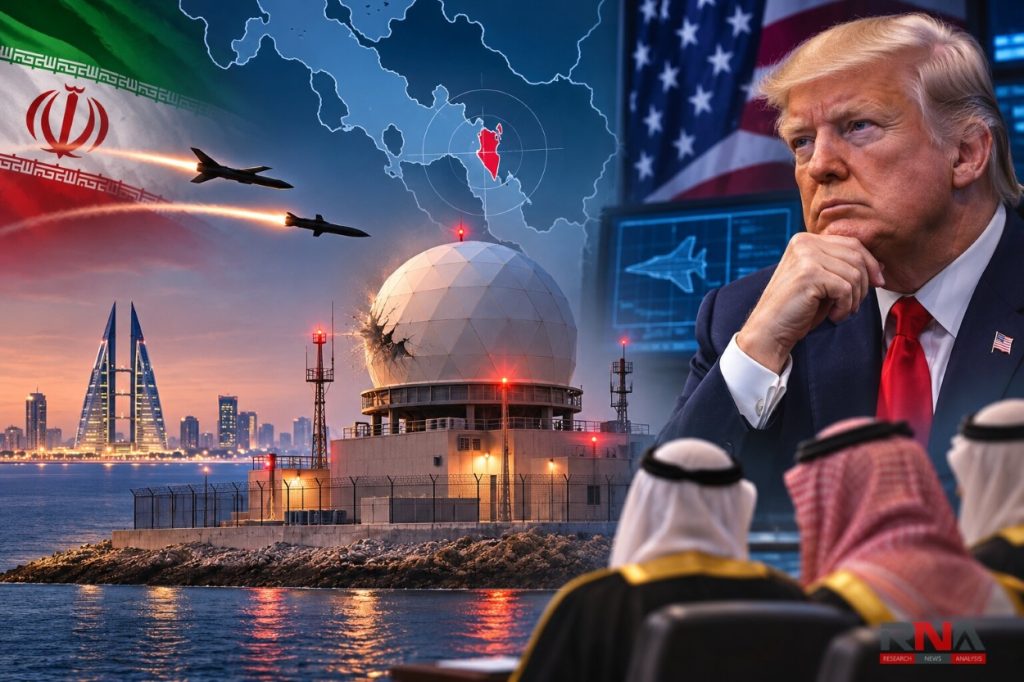
New Delhi: Iran has claimed to have attacked and destroyed an American early-warning radar installation in Bahrain, raising the possibility of renewed military confrontation in the Gulf just as Washington and regional powers attempt to prevent another major escalation. The announcement by Iran’s Islamic Revolutionary Guard Corps on Friday came hours after the US president, Donald Trump, said he had restrained further attacks on Iran at the request of Gulf allies despite having the military capability to inflict extensive damage on the country.
The IRGC said its operation was retaliation for an air attack on a telecommunications tower in Sirik, a coastal district of Iran’s southern Hormozgan province, on Thursdayg, according to IRGC-linked news agency Tasnim. Iranian state media described the incident as an enemy attack, although neither the identity of the attacking force nor the circumstances surrounding the strike had been independently established.
The IRGC-affiliated Fars news agency reported that the force’s aerospace units had destroyed the American radar facility but provided no independently verifiable evidence of the damage. Neither the US military nor the Bahraini authorities had immediately confirmed the attack, leaving uncertainty over whether the installation was hit, the extent of any damage and whether American personnel were affected.
In a statement reported by Tasnim, the IRGC characterized the operation as a warning against further aerial attacks and what Tehran alleges is the unauthorized movement of oil through the Strait of Hormuz. The IRGC also threatened a broader military response if similar incidents continued, signalling that Iran remains prepared to target American assets beyond its borders.
Bahrain is particularly sensitive to such an attack because it hosts the headquarters of the US Navy’s Fifth Fleet, which oversees American naval operations across strategically important waters in West Asia. An early-warning radar supports the detection and tracking of potential aerial threats, meaning that damage to such a system could affect surveillance and defensive readiness, depending on its function within the wider American military network.
The reported operation represents Iran’s first claimed attack on American military facilities in a Gulf country since early September, according to Reuters. Its significance extends beyond the possible loss of equipment because it demonstrates Tehran’s willingness to threaten American military infrastructure on the territory of neighbouring states even during periods of reduced hostilities.
Trump says Gulf countries sought restraint
The development coincided with Trump’s disclosure that Saudi Arabia, Qatar, Kuwait, the United Arab Emirates and Bahrain had urged him not to resume large-scale strikes against Iran. Speaking in an interview with Stephen A Smith, Trump claimed that American forces could cripple Iran’s energy infrastructure, bridges and manufacturing facilities within three days, but acknowledged that regional governments preferred the existing military and economic pressure campaign.
Asked whether he would have ordered further strikes without their intervention, Trump answered in the affirmative, indicating that the suspension reflected diplomatic considerations rather than any abandonment of military options. His remarks also highlighted the competing calculations confronting Washington and its Gulf partners, with the former maintaining the threat of overwhelming force and the latter seeking to avoid renewed attacks on their own territories.
The disagreement comes as Qatar continues efforts to mediate between Washington and Tehran, although the two sides remain divided over the conditions for ending the conflict. Iran wants the American naval blockade lifted, sanctions eased and frozen assets released, whereas Washington insists that any settlement must address restrictions on Iran’s nuclear programme.
In an Al Jazeera interview, Iran’s parliament speaker and chief negotiator, Mohammad Bagher Ghalibaf, said Tehran was awaiting an American response to its seven conditions for peace talks. He also argued that the Strait of Hormuz could not return to its pre-war arrangements, indicating that control over maritime passage remains central to Iran’s negotiating position.
Hormuz blockade complicates peace prospects
The latest confrontation follows nearly nine months of conflict that began with American and Israeli attacks on Iran on February 28, targeting nuclear facilities, military installations and political leaders. Iran subsequently launched missile and drone attacks against American military assets and other targets across the Gulf, while Washington imposed a naval blockade on Iranian ports and sought to maintain commercial shipping through the Strait of Hormuz.
A United Nations security council briefing note warned of deteriorating maritime security and continued military tensions despite the reduction in large-scale hostilities. Citing British maritime security reporting, it said shipping through the Strait of Hormuz remained approximately 65 per cent below pre-conflict levels, demonstrating the continuing disruption to international trade.
The maritime crisis has particular implications for India, whose energy security and commercial interests depend heavily on stable shipping routes connecting the Gulf with Asian markets. Prolonged restrictions on tanker movements could increase freight charges, insurance premiums and imported energy costs, adding pressure on economies already exposed to disruptions in global oil supplies.
The diplomatic stakes are also rising, with the UNSC scheduled to discuss Gulf security on Friday at Bahrain’s request. The meeting offers another forum for addressing attacks on regional infrastructure and maritime security, although the immediate question remains whether Washington and Tehran can prevent their latest exchange from developing into a wider confrontation.