


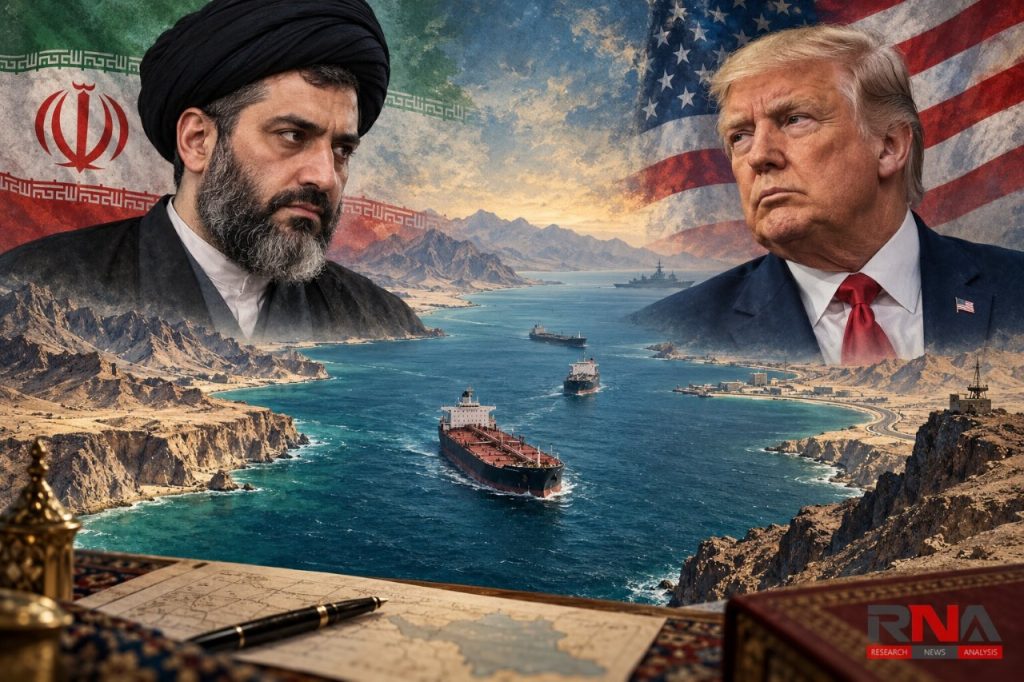
New Delhi: Iran says negotiations with Qatar have produced a proposal to reopen the Strait of Hormuz within two days if Washington first meets Tehran’s conditions, raising the prospect of movement in efforts to resolve the West Asia conflict. The diplomatic opening comes alongside a warning from Iran’s supreme leader, Mojtaba Khamenei, that renewed American or Israeli attacks would trigger retaliation without geographical limits.
The Iranian foreign minister, Abbas Araghchi, said discussions with Qatari mediators had shortened the proposed implementation period, while the country’s security chief reported a significant change in Washington’s language. Neither development amounted to an announced agreement: Tehran continued to insist that American concessions must precede the restoration of shipping access and substantive negotiations.
Washington, meanwhile, kept both diplomacy and military action in play as the United States approached its November 3 midterm elections. The US secretary of state, Marco Rubio, said no decision had been made on renewed strikes, although the president, Donald Trump, continued to identify Iranian sites that could be attacked.
A shorter timetable, with conditions attached
In an interview with Al Jazeera, Araghchi said Qatar had initially sought to reduce the implementation period for Iran’s proposal to five days, before discussions brought it down to two. His account described an accelerated diplomatic mechanism, rather than a commitment to reopen the waterway within 48 hours regardless of Washington’s response.
The conditions he outlined included reversing sanctions imposed after the Islamabad memorandum, reducing American forces in the region, restoring oil waivers and releasing frozen Iranian funds, including money held in Qatar. He said reopening Hormuz on agreed terms could then create the conditions for negotiations over outstanding disputes.
Tehran also wants recognition of shipping routes through Hormuz that it says it has discussed with Oman, alongside the closure of other routes. That demand makes the negotiations about more than restoring access: they also concern the arrangements under which commercial vessels would be allowed to transit the strait.
The secretary of Iran’s supreme national security council, Mohsen Rezaei, has maintained that the waterway will remain closed until Tehran’s conditions are met. He has separately ruled out negotiations over the nuclear programme before Washington accepts Iran’s demands, underscoring the distance between continued mediation and a substantive negotiating breakthrough.
The broader Iranian framework includes an end to hostilities, relief from restrictions on Iranian ports and access to frozen assets abroad. Qatari mediation has continued in Doha, with Pakistan also involved in efforts to narrow the differences between Tehran and Washington.
Vance letter draws a guarded welcome
Rezaei’s comments about a letter from the US vice-president, JD Vance, provided another indication that communication channels remain open despite the threats of renewed fighting. Speaking on Iranian television on October 31, he said he had read the message but had not yet replied or disclosed its detailed contents.
“Their tone has completely changed,” Rezaei said, describing the shift as “a good sign”. His assessment of the American approach was nevertheless accompanied by an insistence that Iran’s conditions remained in place, rather than an announcement that direct talks had been scheduled.
The purpose of the letter has been described differently by the two sides and in American media reports. While reports characterized it as an effort to revive negotiations, Trump said the outreach concerned medical supplies and humanitarian assistance, denying that he had instructed Vance to restart peace talks.
Rubio nevertheless said Washington remained open to a diplomatic settlement and that Trump had not decided whether to resume military operations. His remarks left the possibility of negotiations alive without withdrawing the threat of force.
Tehran warns of wider retaliation
Alongside the diplomatic exchanges, a statement issued in Khamenei’s name on October 31 instructed Iran’s military leadership to prepare an immediate and effective response to potential enemy threats, without geographical restrictions. It also said Iran would determine the timing and conditions for ending any confrontation triggered by renewed attacks.
Khamenei ordered commanders to revise their targeting plans to bring American and Israeli assets within the armed forces’ reach, according to the statement carried by Iranian state media. The warning against fresh strikes was accompanied by separate Iranian military statements that another round of fighting could spread across a wider area.
Iranian media described the statement as following a meeting with senior military commanders, although Khamenei has not appeared publicly since succeeding his father earlier this year. His father, Ali Khamenei, was killed in the US-Israeli strikes at the beginning of the war, which started earlier this year on February 28.
Trump, speaking in Florida late on October 31, renewed the threat of military action and singled out the underground facility known as Pickaxe Mountain. He said the United States still had “one or two sites” to address, while declining to remove the possibility of further attacks.
The Israeli prime minister, Benjamin Netanyahu, has also advocated removing Iran’s government, while facing uncertainty over the formation of Israel’s next administration after his political camp fell short of a parliamentary majority. The competing military warnings and diplomatic exchanges therefore come at a politically consequential moment for both Washington and Israel.
Why Hormuz talks matter to India
The strait, between Iran and Oman, connects the Persian Gulf with the Gulf of Oman and the Arabian Sea, making it a critical outlet for regional energy exports. Iran’s restrictions on shipping and the American blockade of Iranian ports have made maritime access a central issue in the conflict and the negotiations surrounding it.
According to the US Energy Information Administration, Hormuz carried an average of 20.9 million barrels of oil a day in the first half of 2025, equivalent to about one-fifth of global petroleum liquids consumption. More than one-fifth of global liquefied natural gas trade also passed through the strait during that period, primarily from Qatar.
India, China, Japan and South Korea together accounted for 74 per cent of the crude oil and condensate moving through Hormuz in that period. These figures underline India’s exposure to disruptions in the waterway, while the limited capacity of alternative pipelines means that diverted supplies cannot fully replace normal maritime flows.
For now, the shorter timetable represents a proposal to accelerate implementation, rather than evidence that the central disagreements have been settled. The immediate question is whether Washington and Tehran can agree on the concessions and shipping arrangements required to turn continuing indirect contacts into an operational reopening of Hormuz.