


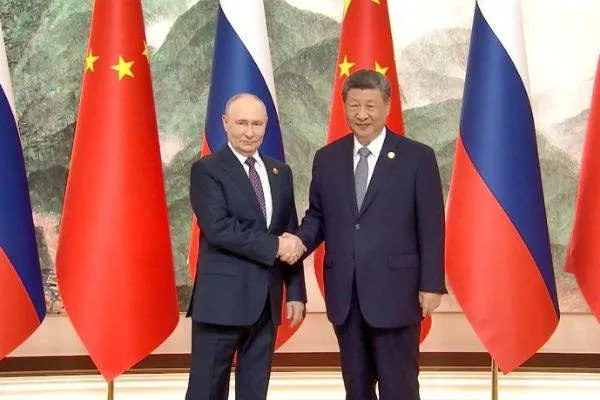
New Delhi: The Chinese president, Xi Jinping, has called on China and Russia to assume a leading role in reshaping the international order towards a multipolar system, signalling Beijing’s determination to challenge the concentration of global power in Western hands. His remarks came during talks with the Russian president, Vladimir Putin, on Wednesday, as the two leaders sought to reinforce their strategic partnership ahead of a crucial three-way summit with the US president, Donald Trump.
Meeting on the sidelines of the Asia-Pacific Economic Cooperation (Apec) summit in Shenzhen, Xi urged Beijing and Moscow to strengthen their coordination and translate their political understanding into practical cooperation. The Chinese leader said both countries should take concrete steps to deepen their comprehensive partnership and help accelerate the emergence of a world with multiple centres of power.
Putin endorsed that position, describing cooperation between Moscow and Beijing as an important stabilizing factor in an increasingly uncertain geopolitical environment. He argued that their foreign-policy coordination was progressing steadily and that both countries were pursuing a more equitable international system, reflecting their shared opposition to what they regard as excessive western influence over global institutions.
The Russian leader sharpened his criticism of the west during an address to business leaders at the Apec gathering, portraying established western powers as declining centres of influence. He also dismissed the long-term effectiveness of sanctions, tariffs and export restrictions, arguing that economic pressure could disrupt competitors but could not permanently prevent their development.
China presents its alternative to western leadership
Xi’s remarks were consistent with Beijing’s increasingly assertive diplomatic approach, which combines calls for international cooperation with demands for changes in the distribution of global influence. China maintains that emerging economies and developing countries should exercise greater influence over international decision-making, rather than accept arrangements dominated by the United States and its traditional allies.
In his official address to Apec, Xi advocated an international system based on equality among countries, greater economic openness and stronger multilateral institutions. He also emphasized the importance of preserving the postwar international order, indicating that Beijing wants to reform the existing framework rather than explicitly dismantle it.
China’s position nevertheless contains a strategic contradiction: Beijing supports open markets and international economic integration while maintaining extensive state involvement in its own economy. Its growing industrial capacity, substantial export surplus and dominance in several critical supply chains have also generated resistance among trading partners concerned about market access and competition.
The Chinese leadership has linked its vision of multipolarity to institutional reform, technological cooperation and the increasing economic weight of Asia and the Global South. Its partnership with Russia gives Beijing an influential diplomatic and military counterpart, although the relationship is shaped by different economic strengths, security priorities and international constraints.
Russia attacks sanctions
For Moscow, closer relations with Beijing have become particularly important since Russia launched its full-scale invasion of Ukraine in February 2022, triggering extensive western sanctions and restrictions on financial and technological transactions. China has provided Russia with an important commercial partner and market for energy, although Beijing has avoided formally joining Moscow’s military campaign.
Putin used the Shenzhen gathering to argue that economic coercion had failed to achieve its intended strategic results, despite the continuing restrictions imposed on Russia. He emphasized the growing importance of Asia-Pacific markets to Moscow and said the region accounted for more than half of Russia’s international trade.
The China-Russia partnership, however, should not be mistaken for a formal military alliance with identical interests on every international issue. China remains substantially more integrated into global trade and western markets, whereas Russia’s confrontation with Europe and the United States has increased its dependence on alternative commercial relationships.
Trump summit tests global power equations
The Xi-Putin meeting has acquired additional significance because Trump is scheduled to join both leaders in Shenzhen on Thursday for an unusual trilateral engagement involving three nuclear powers. As RNA Media reported, Washington intends to raise nuclear arms reduction, particularly after the expiry of the last major US-Russia strategic arms control treaty in February this year.
The discussions could also provide an opportunity to address trade tensions, technological restrictions and wider strategic disagreements, although major breakthroughs remain uncertain. Putin expressed optimism about the potential benefits of the meeting, but differences over nuclear weapons, sanctions and regional security are unlikely to disappear through a single diplomatic encounter.
The broader Apec summit, bringing together 21 economies representing roughly 60 per cent of global economic activity, has meanwhile become a platform for competing visions of international economic governance. Xi has promoted freer trade and more resilient supply chains, while Washington continues to pursue policies intended to protect American industries and restrict China’s access to certain advanced technologies.
What emerging China-Russia axis means for India
For India, the growing strategic convergence between Beijing and Moscow presents both opportunities and complications, particularly because New Delhi maintains close relations with Russia while facing unresolved territorial and security disputes with China. A more genuinely multipolar international system could strengthen India’s influence, but a framework increasingly shaped by Chinese priorities would not necessarily advance Indian strategic interests.
India has therefore continued to pursue strategic autonomy, balancing partnerships with Russia, the United States and other major powers without formally aligning itself with competing geopolitical blocs. As RNA Media reported in October, the external affairs minister, S Jaishankar, has emphasized that India’s relationship with Moscow remains important even as China’s rise and shifting American policies transform the international balance of power.
The central question emerging from Shenzhen is whether the proposed multipolar order will genuinely distribute influence among a larger number of countries or produce a new concentration of power around a few dominant states. The answer will depend less on diplomatic declarations than on how China, Russia and the United States accommodate the security and economic interests of countries outside their immediate strategic circles.