


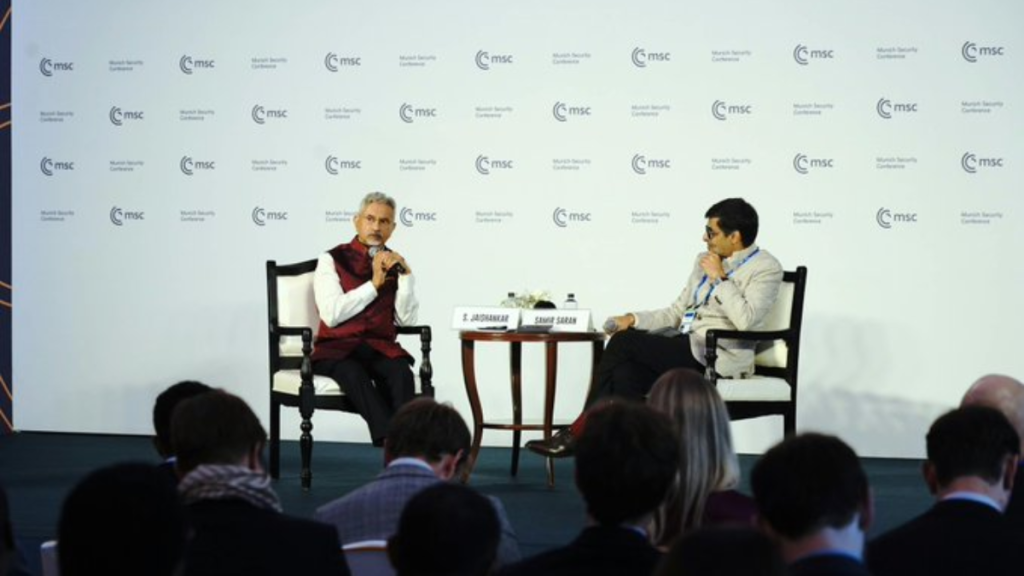
New Delhi: India’s old friendship with Russia continues to shape the relationship between the two countries, the external affairs minister, S Jaishankar, said on Sunday while addressing the Munich leaders meeting in New Delhi. He recalled Moscow’s support for New Delhi during difficult periods and also spoke about the changing global order, the rise of China, the shifting US position, BRICS and the growing role of middle powers.
Jaishankar said India and Russia have enjoyed good relations for decades, with Moscow and the Soviet Union supporting India at times when its security and territorial integrity faced challenges. He recalled the relationship since the 1950s and said India’s experience with Russia has remained “positive and consistently positive”.
He also referred to Soviet support during the 1971 war with Pakistan and said the relationship has expanded since the 1970s and 1980s, with trade, energy and resources now complementing military and nuclear cooperation.
The remarks came amid criticism from the US and Europe over India’s continued engagement with Russia, particularly its purchases of Russian oil. Jaishankar said India’s priority is to protect consumer interests and maintain multiple sources of supply.
On the Ukraine war, he signalled India’s call for dialogue, diplomacy and negotiations. He said India has engaged with both Russia and Ukraine on issues including Black Sea shipping, grain imports, energy exports and attacks on critical infrastructure.
Jaishankar on US shift and China’s rise
Turning to the wider global landscape, Jaishankar said the international system is being shaped by a “radical repositioning” of the United States and the rise of China. He described the competition between Washington and Beijing as a defining feature of the current landscape and said it has led to the weaponization of leverage, with countries using their strengths in production, markets, purchasing power and supply chains to gain influence.
Jaishankar said the rivalry should not become too intense, advocating what he called a “Goldilocks scenario” in global power dynamics. He said the objective should be to keep the competition “somewhere in between at the right temperature” rather than allowing it to become destabilising.
BRICS and India’s growing role
Jaishankar said the growing interest in BRICS shows that countries want wider platforms and more players in global discussions. He said the grouping’s membership has doubled and that its challenge now is to develop a deeper agenda matching its expanding role.
He also highlighted India-led initiatives including the International Solar Alliance and the Coalition for Disaster Resilient Infrastructure as examples of countries developing cooperation around common interests.
On India’s future, Jaishankar said the country has decades of high economic growth ahead, supported by its demography. He said India does not necessarily have to follow the traditional industrialization path and can explore newer possibilities suited to a changing world.
AI, peace and India’s global footprint
Jaishankar said India’s approach to artificial intelligence is focused on making the technology accessible and affordable and using it for social and economic needs. He also stressed that AI-related safety and security concerns are too important to be left entirely to market forces.
He highlighted India’s growing trade, development and humanitarian assistance partnerships, along with the rising mobility of skilled professionals and the need to ensure the welfare of Indians abroad, including seafarers.
Jaishankar also pointed to India’s efforts to promote peace through peacekeeping and advocacy of dialogue and diplomacy, while noting the challenges of conducting foreign policy in the social media era.