


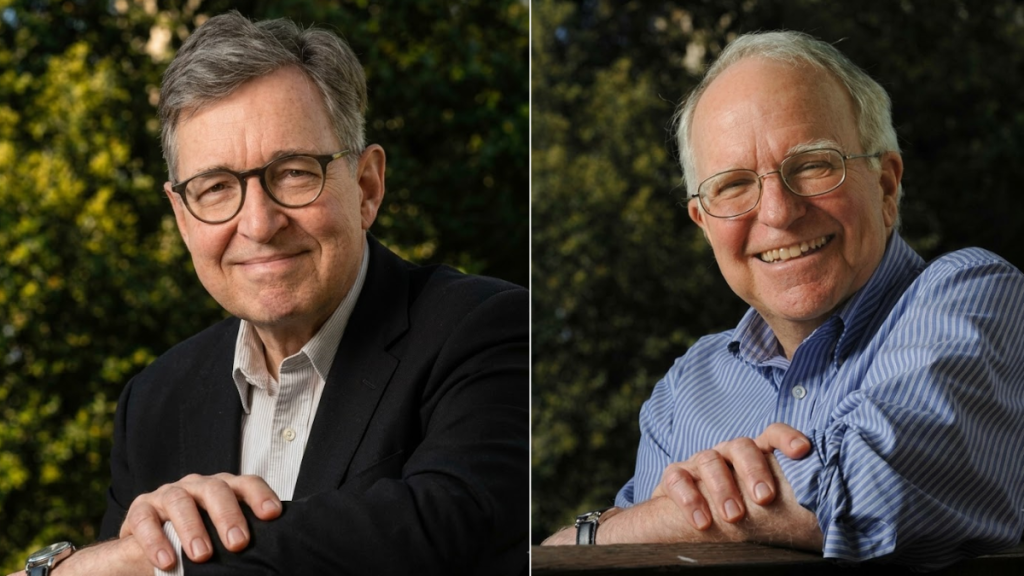
New Delhi: The 2026 Nobel prize in economic sciences has been awarded to American economists Robert E Hall and Michael Woodford for their work on economic models that help governments and central banks manage inflation, recessions and other economic shocks. The Royal Swedish Academy of sciences announced the winners in Stockholm on Monday, marking the final Nobel prize announcement of the year.
Hall, of Stanford University in California, and Woodford, of Columbia University in New York, will share the prize money of 12 million Swedish kronor, approximately $1.2 million. They were recognized for developing models that explain how the spending decisions of households and businesses affect the wider economy.
The Nobel prize awarded the economists for laying down the micro-foundations for macroeconomic stabilization. The contributions made by the economists have played a crucial role in the formulation of New Keynesian economics, which are now employed by central banks and finance ministries to make decisions about economic fluctuations.
Why did Hall and Woodford win the Nobel prize?
Hall’s research focused on the process by which individuals make choices regarding spending and saving money based on their anticipated income in the future. Those who feel that their financial conditions are improving in the future will be more willing to spend, whereas those with fears of the future will be thrifty.
Woodford used this model to explain price setting by firms according to their anticipation of future cost and interest rate levels. He emphasized that clarity in communication by central banks was crucial, since expectations regarding future interest rate levels could have an impact on spending and investment decisions.
The work of these two men enhanced the economic models that were created by British economist John Maynard Keynes. These models were unable to provide an explanation for the state of the economy in the 1970s, whereby many nations were facing high levels of inflation and increased rates of unemployment.
Their findings have guided the policies in dealing with disruptive events in the economy like the global financial crisis in 2008 and energy crises. Their findings were also influential in forward guidance whereby central banks guide the public on the future policies to be adopted by the bank.
The Nobel committee said their work provided a stronger theoretical foundation for understanding how stabilisation policies affect economic cycles. The models help policymakers assess how economies might respond to disruptions such as energy crises and sudden changes in household spending.
Woodford described the award as a tremendous honour and said he was surprised by the announcement, according to the Associated Press.
2026 Nobel prize winners
As RNA Media earlier reported, the Nobel announcements began with the Medicine prize on October 5 and concluded with the Economics prize on October 12.
The Medicine prize went to Karl Deisseroth, Peter Hegemann and Georg Nagel for discoveries that laid the foundations for optogenetics, a technique that allows scientists to control selected nerve cells using light. Belgian-American physicist Francis Halzen won the Physics prize for his contributions to the IceCube Neutrino Observatory and the discovery of high-energy neutrinos from space.
The Chemistry prize was awarded to Henri Kagan and Kenso Soai for their work on asymmetric organic synthesis, while Canadian writer Anne Carson received the Literature prize for her work connecting classical literature with contemporary life. South African jurist Navi Pillay won the peace prize for her contributions to human rights and international justice.
The laureates will formally receive their awards on December 10, the anniversary of Alfred Nobel’s death. The Economics award is formally known as the Sveriges Riksbank prize in economic sciences in Memory of Alfred Nobel. Established by Sweden’s central bank in 1968, it is presented alongside the other Nobel prizes.