


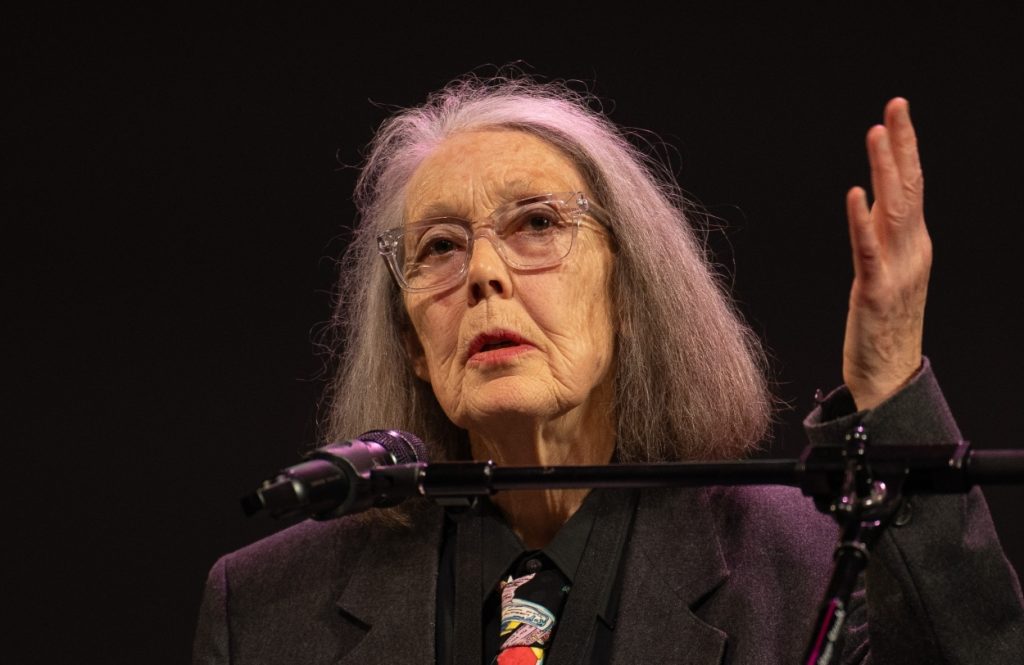
New Delhi: The Canadian poet, essayist and translator, Anne Carson, has won the 2026 Nobel prize in literature for a body of work that brings classical mythology into contemporary life while crossing the boundaries between poetry, fiction and scholarship. Announced by the Swedish Academy on Thursday, the award recognizes a writer whose experiments with language and form have produced new ways of exploring desire, grief and identity.
The academy’s prize citation praised Carson’s “bold and inventive oeuvre”, highlighting how her engagement with the classical tradition has created fresh forms for contemporary literature. The 76-year-old will receive 12 million Swedish kronor, approximately $1.2 million, with the award formally presented in Stockholm on December 10.
Carson was in Iceland when the academy’s permanent secretary, Ingrid Carlberg, telephoned her shortly before the announcement. Carlberg said the writer was surprised and happy and had explained that she was spending her time there listening to the wind.
Her response to the honour was characteristically dry. Speaking to the Icelandic broadcaster RUV, Carson called the decision “crazy” and joked that it would mean a sticker on the front of her book, Reuters reported.
Born in Toronto in 1950, Carson developed an interest in ancient Greek while still at secondary school, where a Latin teacher gave her lessons during lunch breaks. She subsequently combined teaching and translation with original writing, building a career in which scholarly inquiry and personal experience frequently occupy the same page.
That relationship between the ancient and the contemporary is central to understanding the award. Carson draws on Greek and Roman literature to examine recognizable human experiences, allowing old stories to take on new settings, voices and meanings rather than treating them solely as subjects of historical study.
Her best-known book, “Autobiography of Red”, published in 1998, illustrates that approach through a novel written in verse. It reworks the Greek myth of Geryon as a contemporary coming-of-age story, combining an ancient narrative with questions of sexuality and self-discovery.
An earlier work, “Eros the Bittersweet”, published in 1986, examines the pleasure and pain of desire through ancient Greek literature. In “Norma Jeane Baker of Troy”, published in 2019, Carson brings Marilyn Monroe into conversation with Helen of Troy, connecting figures separated by centuries through an unexpected dramatic framework.
Her experiments extend to the physical form of a book. “Nox”, published in 2010, is an elegy for her estranged brother presented as an accordion-folded work inside a box, bringing together text, images and fragments of memory.
Carson’s earlier honours include the TS Eliot prize for “The Beauty of the Husband: A Fictional Essay in 29 Tangos” and Canada’s Griffin poetry prize for “Men in the Off Hours”. Her translations include “If Not, Winter: Fragments of Sappho”, while collaborations with musicians and other artists have carried her work beyond conventional literary publishing.
The Nobel recognizes this wider body of work rather than an individual title. Carson is the first Canadian literature laureate since Alice Munro in 2013, and succeeds the Hungarian novelist, Laszlo Krasznahorkai, who received the prize in 2025.
The literature announcement follows three science awards earlier this week: Karl Deisseroth, Peter Hegemann and Georg Nagel won the medicine prize for discoveries underlying optogenetics, which allows researchers to control selected nerve cells with light, while Francis Halzen received the physics prize for his role in IceCube and the detection of high-energy cosmic neutrinos. The chemistry prize went to Henri Kagan and Kenso Soai for discoveries explaining how one mirror-image form of a molecule can become dominant in chemical reactions.
The Nobel announcement programme continues with the peace prize on October 9, followed by the economic sciences prize on October 12. Carson’s selection places literature’s recognition this year with a writer whose work repeatedly tests how ancient texts can illuminate contemporary experience.