


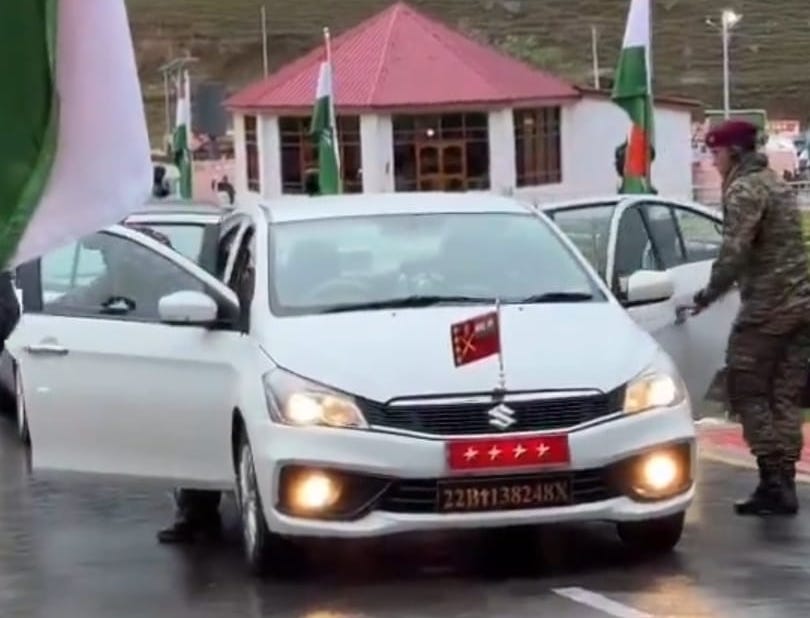
New Delhi: A short video of the Indian Army chief, General Dhiraj Seth, stepping out of an ordinary Maruti Suzuki Ciaz at the Kargil war memorial has triggered an unusual round of introspection on Pakistani social media, with users there turning their anger not on India but on their own military leadership.The footage shows Gen Seth arriving at Dras in Ladakh to pay tribute to soldiers killed in the 1999 war.
There was no motorcade of imported sports utility vehicles, no visible security bubble of gleaming sedans – just a modest Maruti Suzuki Ciaz, which is a compact sedan that retails for roughly ₹10–14 lakh in the Indian market, depending on the model. That plainness, rather than anything said or done by the Army, is what set off the reaction across the border.
Pakistanis compare their own generals
Within hours of the clip surfacing, a string of Pakistani X accounts began contrasting Seth’s Suzuki with the fleets of Mercedes-Benz saloons, BMWs, Toyota Prados and Land Cruisers that typically ferry Pakistan’s senior military brass. One widely shared post, from a user identifying as Sameena Sultana, drew a direct line between the two militaries, framing the Indian chief’s low-key travel as a sign of a professional force focused on its mission rather than its optics, and contrasting this with what the post described as the lavish convoys and heavy security protocols surrounding routine engagements by Pakistan’s army leadership.
Another account, run by a user named Arslan Akbar, suggested that the viral clip had exposed how ordinary Pakistanis actually regard their ruling elite, arguing that no amount of public relations effort could shift that sentiment unless the country’s leadership changed its own conduct.
A further post, by a user posting as Burhan Uddin, placed clips of the two chiefs’ vehicles side by side, captioning the Indian general’s car as representative of the world’s fifth-largest economy and the Pakistani chief’s as symptomatic of a nation weighed down by debt, poverty and economic distress.
Several other users joined in with sharper barbs, one suggesting – evidently in jest – that people should try to imagine Pakistan’s own army chief stepping out of an entry-level Suzuki Liana, while others posted images contrasting the 70cc motorcycles used by ordinary Pakistanis with the imported luxury vehicles associated with the country’s generals.
Chief known for his low profile
General Seth took charge as the 31st chief of the Army staff on June 30, succeeding General Upendra Dwivedi. He is the first officer from the Armoured Corps to lead the Army since General Shankar Roychowdhury, who held the post between 1994 and 1997, and is the son of Lieutenant General Krishna Mohan Seth, a former adjutant general of the Indian Army who later served as governor of Tripura and Chhattisgarh. Before his elevation, he had commanded both the South Western Command and the Southern Command along India’s western front, and had been serving as vice chief of the army staff since April 2026.
At Dras, alongside the defence minister, Rajnath Singh, Seth laid a wreath at the Kargil war memorial and paid tribute to the soldiers of Operation Vijay, calling their sacrifice an inexhaustible source of inspiration for the force. None of that formal messaging, however, is what caught fire online – it was the unremarkable hatchback he arrived in.
Pakistan’s ‘Military Inc’ resurfaces
The episode has revived a longstanding critique of Pakistan’s military establishment made by the scholar Ayesha Siddiqa in her book Military Inc. Siddiqa has argued for years that Pakistan’s armed forces function less like a conventional defence force and more like a sprawling business conglomerate, with interests spanning banking, insurance, manufacturing, petrol retail, shopping malls, large landholdings and even film and television production. This informal commercial network, often referred to as “milbus”, channels benefits to senior officers in ways that do not show up in the defence budget, according to her research.
It is this entrenched corporate culture, Siddiqa has contended, that has normalized a culture of luxury among the senior ranks even as ordinary Pakistanis grapple with inflation and economic hardship – a disparity that many of the viral posts this week appeared to be drawing on, whether or not the users cited her work by name.
Pakistan’s army chief, Field Marshal Asim Munir, was elevated to that rank last year following the brief military confrontation with India (Operation Sindoor) in 2025. The promotion drew scrutiny over the ceremonial trappings afforded to the country’s top brass at a time when Pakistan continues to negotiate with international lenders over its debt obligations.
Pattern of exchanges
The reaction is also consistent with a broader trend of Pakistani social media users increasingly using Indian military conduct as a mirror to criticize their own establishment, particularly during Operation Sindoor in May 2025 that followed the killing of tourists in Indian-administered Kashmir the previous month. India has continued to attribute that attack to Pakistan-backed militants, a charge Islamabad denies.
Neither the Indian Army nor Pakistan’s military media wing has issued any formal comment on the viral video, and none is likely, given that the story here is less about any statement than about the optics of a fairly ordinary car.