


Dras/New Delhi: The success of Operation Sindoor demonstrates India’s capacity to respond to any Pakistani provocation “with a severity far beyond its imagination”, the defence minister, Rajnath Singh, said on Sunday, ruling out talks with Islamabad except on the return of Pakistan-occupied Kashmir (POK). Addressing the 27th Kargil Vijay Diwas commemorations at Dras in Ladakh, Singh said any act against India’s sovereignty would draw the same response the armed forces delivered to terrorists and their backers during Operation Sindoor.
‘Pakistan’s military and militants same’
The defence minister said the line between Pakistan’s armed forces and militant groups had effectively disappeared, with terrorism now embedded in state policy. He said Pakistan’s military both sheltered and worked alongside terrorist organizations, and that India, through Operation Sindoor, had stopped treating terrorists and the governments sponsoring them as separate entities.
Operation Sindoor was India’s military response to the April 22, 2025, terrorist attack in Pahalgam, Jammu & Kashmir, in which 26 civilians were killed. Indian forces struck nine sites in Pakistan and POK on May 7, 2025, in a campaign that continued for several days before a ceasefire was announced on May 10, 2025.
‘India building, Pakistan infiltrating’
Singh contrasted India’s economic and technological trajectory with Pakistan’s, arguing that 27 years after the Kargil war the two countries’ paths had diverged sharply. He said India was advancing in chip design, start-ups, semiconductors, space missions and digital payments through UPI, while Pakistan was investing in terror infrastructure, radicalization and cross-border infiltration. He added that the armed forces stood ready to respond firmly should Pakistan attempt to obstruct India’s progress.
Singh said the government had given the defence forces full political backing to act decisively against threats, and expressed confidence that no adversary would challenge India while its soldiers guarded the borders.

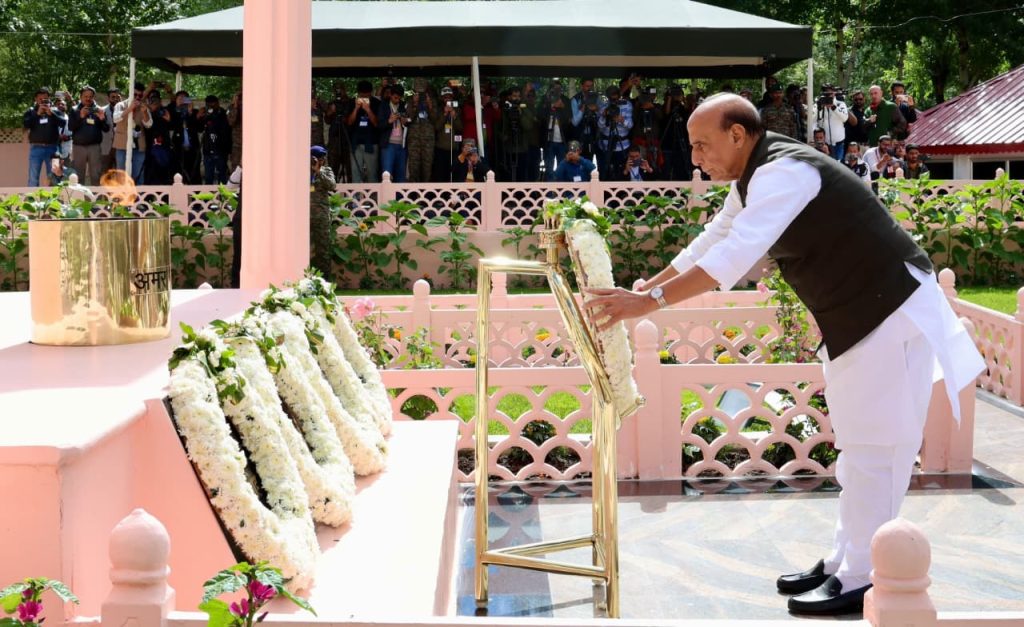
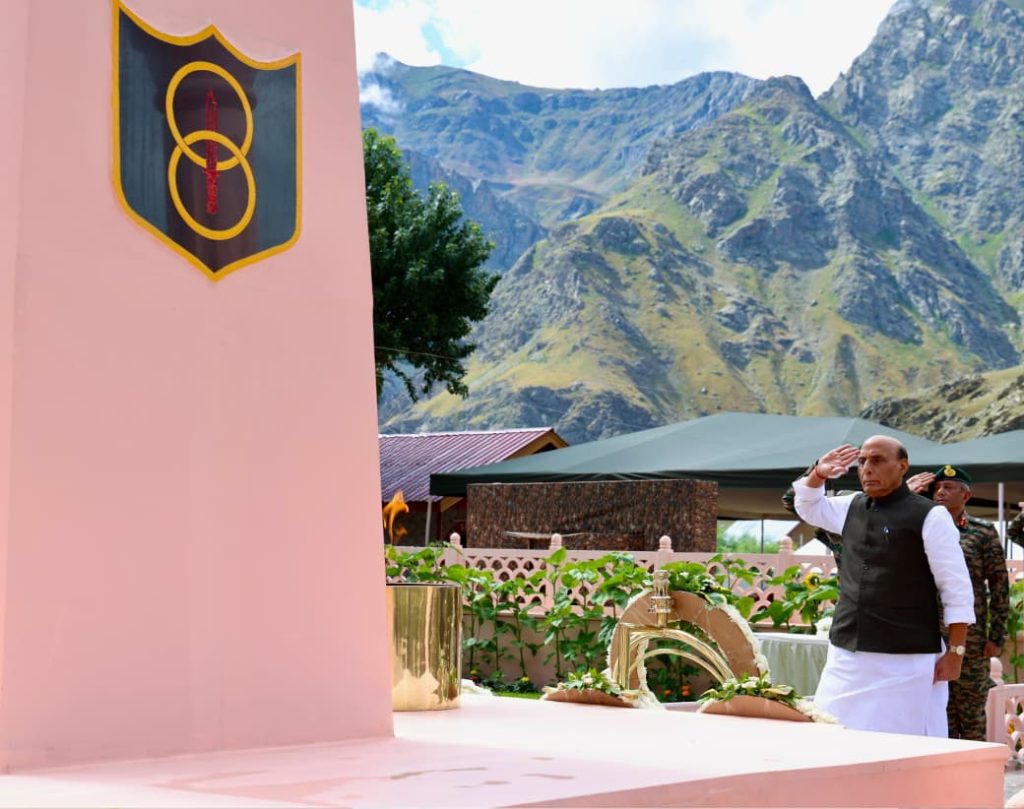
Tributes paid to Kargil war heroes
Earlier in the day, as RNA Media reported, Singh paid tribute to the soldiers who died defending Indian territory during the 1999 Kargil War, singling out the Param Vir Chakra awardees Captain Vikram Batra and Captain Manoj Kumar Pandey. He described Kargil Vijay Diwas as a reminder of the distinction between personal ambition and national duty, and said sacrifice and service formed the foundation of any nation.
He also noted that the Kargil War Memorial carried the names of fallen soldiers from every part of the country, calling it a symbol of unity that stood firm despite India’s diversity.
Referring to ongoing conflicts in West Asia and between Russia and Ukraine, Singh said such wars tested not only military capability but also a nation’s patience and resolve. Security, he added, was a shared responsibility, and while he was not calling on every citizen to become a soldier, Indians should be prepared to support the country if the need arose.

Push for self-reliance in defence production
Singh said the government, led by the prime minister, Narendra Modi, had prioritized national security and the welfare of soldiers since taking office, with sustained investment in border infrastructure and military modernization.
Invoking Captain Batra’s wartime catchphrase “yeh dil maange more”, Singh said India had cut its dependence on imported defence equipment from 65–70 per cent to roughly 35 per cent over the past decade, with the remainder now manufactured domestically. He cited the indigenously developed Akash-Teer air defence control system, the next-generation Akash missile, the aircraft carrier INS Vikrant, the Tejas light combat aircraft, the Prachand light combat helicopter, the Dhruv advanced light helicopter, the Arjun main battle tank, the Pinaka multi-barrel rocket launcher and the Astra air-to-air missile as evidence of progress, alongside indigenous drone and counterdrone systems.
He said work would continue on next-generation fighter aircraft, submarines and missiles built in India. The Tejas programme, which Singh referenced, currently comprises the Tejas-Mk1 and Tejas-Mk1A variants in service or production, with the more advanced Tejas-Mk2 under development.

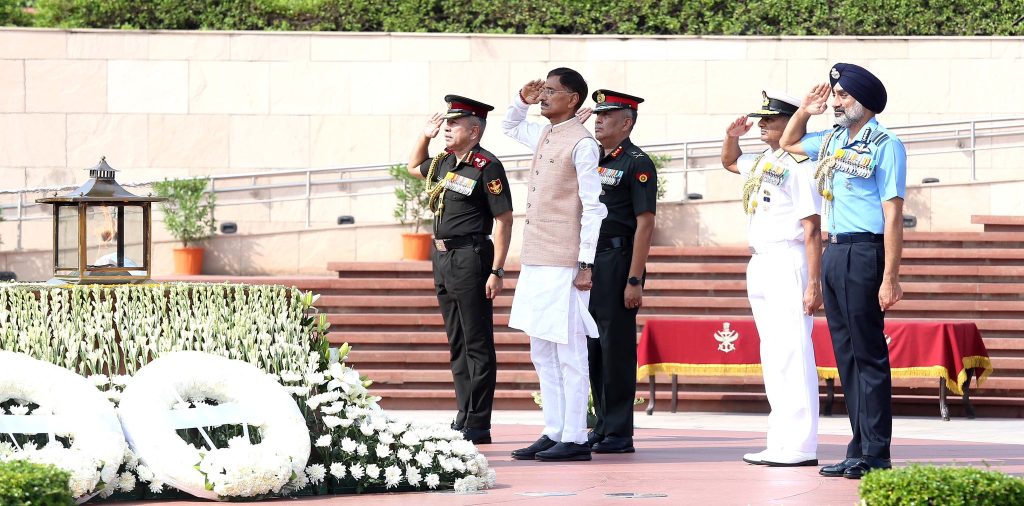
Wreaths laid in New Delhi
In Delhi, the minister of state for defence, Sanjay Seth, laid a wreath at the National War Memorial. He was joined by the chief of defence staff, General NS Raja Subramani; the chief of the air staff, Air Chief Marshal Amar Preet Singh; the chief of the naval staff, Admiral Krishna Swaminathan; the defence secretary, Rajesh Kumar Singh; and the vice-chief of the Army staff, Lieutenant General Sandeep Jain.
The Kargil War was fought between May and July 1999 after Pakistani troops and militants occupied high-altitude posts on the Indian side of the line of control (LoC) in Ladakh’s Kargil sector. India’s recapture of the posts, codenamed Operation Vijay, concluded on July 26, 1999 – the date now marked annually as Kargil Vijay Diwas.
(With inputs from Anjali Manhas in Dras and Prakhya Singh Rajput in New Delhi.)