


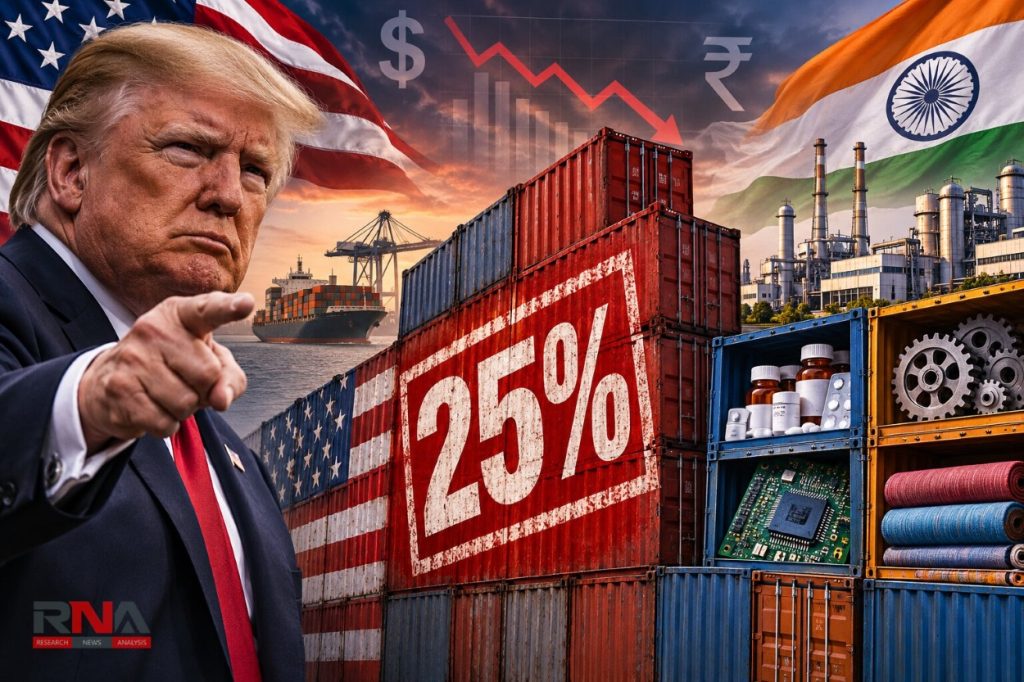
New Delhi: The United States on Wednesday proposed tariffs of up to 25% on Indian goods as the administration of the US president, Donald Trump, launched a fresh trade offensive against 14 major economies over their alleged unfair manufacturing practices. However, Washington has offered to lower the proposed rate to 17% if New Delhi concludes a bilateral trade agreement that addresses American concerns.
The move introduces fresh uncertainty into the protracted India-US trade negotiations and threatens to raise costs for Indian exporters seeking greater access to the world’s largest economy. It also marks a significant shift in Washington’s tariff strategy, with the Trump administration invoking an established American trade law after the US Supreme Court struck down its earlier sweeping duties imposed under emergency powers.
The office of the United States trade representative (USTR) announced the proposed measures on Wednesday, following an eight-month investigation into the industrial policies and manufacturing practices of 16 economies. Washington concluded that the practices of 14 of them adversely affected American commercial interests, manufacturing activity and employment.
The proposed duties are not immediately enforceable and will undergo public consultation before Washington takes a final decision. Nevertheless, the announcement substantially raises the stakes for New Delhi, which has been negotiating with Washington to secure a predictable and preferential tariff regime for Indian merchandise exports.
India faces steeper tariffs than many competitors
The proposed measures broadly confirm what RNA Media reported on Tuesday about Washington preparing to impose higher duties on Indian merchandise than on goods originating in several other major economies. The differentiated tariff structure could have significant implications for India’s export competitiveness and its ambitions to become an alternative global manufacturing hub to China.
Vietnam faces the highest proposed rate of 35%, which could come down to 20% under a negotiated settlement, while Bangladesh, Cambodia, Indonesia, Malaysia and Thailand face duties of up to 18%. Japan, South Korea, Taiwan, Switzerland and the European Union face rates of 15%, while Singapore faces a proposed 20% levy that could be reduced to 10% following a satisfactory agreement.
China faces fresh duties of up to 20%, although its effective tariff burden would remain considerably higher because of levies introduced during Trump’s first presidential term. According to Reuters, the combined duties on certain Chinese products could reach around 45%.
Mexico and Norway, which were also covered by the original American investigation, have been left out of the latest proposed tariff measures.
Why Washington is targeting India manufacturing
At the centre of the latest dispute is what Washington describes as structural excess industrial capacity – a situation in which manufacturing capabilities expand beyond what market demand would ordinarily justify, often with government support.
The American argument is that subsidies, preferential financing, market-access restrictions and other forms of state intervention allow foreign manufacturers to sustain production at levels that would otherwise be commercially unviable. Washington contends that the resulting supply of relatively inexpensive goods undermines American manufacturers and discourages investment in domestic industrial capacity.
In India’s case, the USTR has raised concerns over government-backed industrial expansion, restrictions on market access, weaknesses in labour protections and policies governing the allocation of capital. It has also questioned India’s approach towards imports and investments originating in economies where state intervention plays a substantial role in determining commercial activity.
The American authorities have identified pharmaceuticals, medical devices, steel, solar equipment and information and communications technology as industries of particular concern. Washington argues that dependence on foreign supplies in these sectors could have consequences extending beyond commerce to American economic and national security.
For India, however, the investigation raises a more fundamental policy question. New Delhi’s manufacturing incentives are intended to expand domestic industrial capabilities, generate employment, reduce import dependence and integrate Indian companies into global supply chains – objectives that Washington itself has pursued through industrial subsidies and incentives.
India’s production-linked incentive (PLI) schemes, for instance, seek to attract investments in industries ranging from electronics and pharmaceuticals to advanced batteries and solar equipment. Any American demand for changes to India’s industrial support mechanisms could complicate New Delhi’s long-term manufacturing strategy.
How Trump’s new tariff differs from earlier one
The latest measures are being pursued under Section 301 of the US Trade Act of 1974, which empowers Washington to investigate and respond to foreign commercial practices considered discriminatory or harmful to American economic interests. The provision was also used extensively against China during Trump’s first presidential term.
The shift follows the US supreme court’s ruling this February, which invalidated the administration’s use of the International Emergency Economic Powers Act (IEEPA) to impose sweeping import duties. Trump subsequently turned towards other statutory mechanisms to reconstruct his tariff regime.
India has already faced American trade action under Section 301 this year over Washington’s assessment of measures against imports of goods produced using forced labour. In July, the USTR finalized a 10% additional duty on eligible Indian merchandise, down from an initially proposed 12.5%.
According to the Union commerce and industry ministry, exemptions under that particular measure covered approximately 45% of Indian exports to the US, including generic medicines, smartphones and products already subject to certain sector-specific duties. The latest proposal would account for existing Section 301 levies, while its interaction with other duties and exemptions would determine the actual tariff burden on individual products.
Therefore, the proposed 25% rate should not be interpreted as an automatic additional levy of 25 percentage points on top of every existing American import duty.
What proposed tariffs mean for Indian exporters
The immediate concern for Indian exporters is the potential erosion of their price competitiveness in the American market, particularly in labour-intensive industries operating on narrow profit margins. Textiles, garments, leather goods, footwear, engineering products, chemicals and handicrafts could face considerable commercial pressure, depending on the final tariff schedule and product-specific exemptions.
Although American importers formally pay customs duties, the financial burden is often distributed across the supply chain. Indian manufacturers could consequently face demands from American buyers to lower prices, absorb part of the additional costs or risk losing orders to suppliers in countries enjoying more favourable tariff treatment.
The potential disruption is particularly significant given the scale of bilateral commerce. According to official USTR data, India-US goods and services trade reached $239.6 billion in 2025, registering an annual increase of 12.1%.
American merchandise imports from India stood at $103.8 billion, against exports worth $45.4 billion, leaving Washington with a goods trade deficit of $58.4 billion. Bilateral services trade accounted for approximately $90.4 billion.
While the proposed duties directly concern merchandise rather than services, prolonged trade friction could also influence investment decisions and corporate expansion plans. International manufacturers considering India as an export-oriented production base may reassess the relative advantages of operating in the country if tariff disparities persist.
Will new tariff threat accelerate India-US trade deal?
Washington’s willingness to accept a 17% rate under a negotiated settlement suggests that the proposed tariffs are also intended to provide leverage in bilateral trade negotiations. However, New Delhi’s considerations extend beyond securing a reduction in the headline tariff rate.
As RNA Media reported in September, the commerce and industry minister, Piyush Goyal, had made it clear that India wanted tariff concessions that would give its exporters a competitive advantage over rival manufacturing economies. A favourable agreement would, therefore, need to be evaluated against the terms Washington extends to India’s competitors.
In February, India and the US announced a framework for an interim trade agreement, under which Washington agreed to lower its reciprocal tariff on Indian goods from 25% to 18%. However, subsequent legal developments in the US and the restructuring of American tariffs complicated negotiations.
On November 14, the external affairs minister, S Jaishankar, indicated that negotiations were approaching their conclusion, with most outstanding matters having been resolved. The latest American announcement could either accelerate the remaining negotiations or introduce fresh differences over India’s industrial policies and market-access commitments.
Wider economic and geopolitical implications
The renewed tariff offensive comes despite the electoral setbacks suffered by Trump’s Republican Party in this month’s US midterm elections, in which affordability and the cost of living emerged as major issues. A subsequent Reuters-Ipsos opinion poll found that 62% of respondents supported efforts to repeal the tariffs.
The announcement also comes ahead of December’s G20 summit in Miami, where trade disputes could feature prominently in discussions among the world’s major economies. Washington’s simultaneous targeting of strategic partners and economic competitors illustrates the extent to which trade policy has become an independent instrument of American economic diplomacy.
For India, the challenge is to prevent commercial differences from undermining its broader strategic partnership with the US, particularly in defence, critical technologies, semiconductor manufacturing and Indo-Pacific security. At the same time, New Delhi will have to safeguard its domestic industrial priorities without compromising Indian manufacturers’ access to the American market.
The USTR has set January 5, 2027, as the deadline for written submissions, with public hearings scheduled to begin on January 25, 2027. The intervening period provides India with an opportunity to challenge Washington’s findings and negotiate more favourable terms before the proposed duties are finalized.
Ultimately, the success of an India-US trade agreement will depend not merely on bringing the threatened 25% tariff down to 17%, but on securing a durable and commercially competitive arrangement that allows businesses on both sides to make long-term investment decisions without the recurring uncertainty of fresh tariff announcements.