


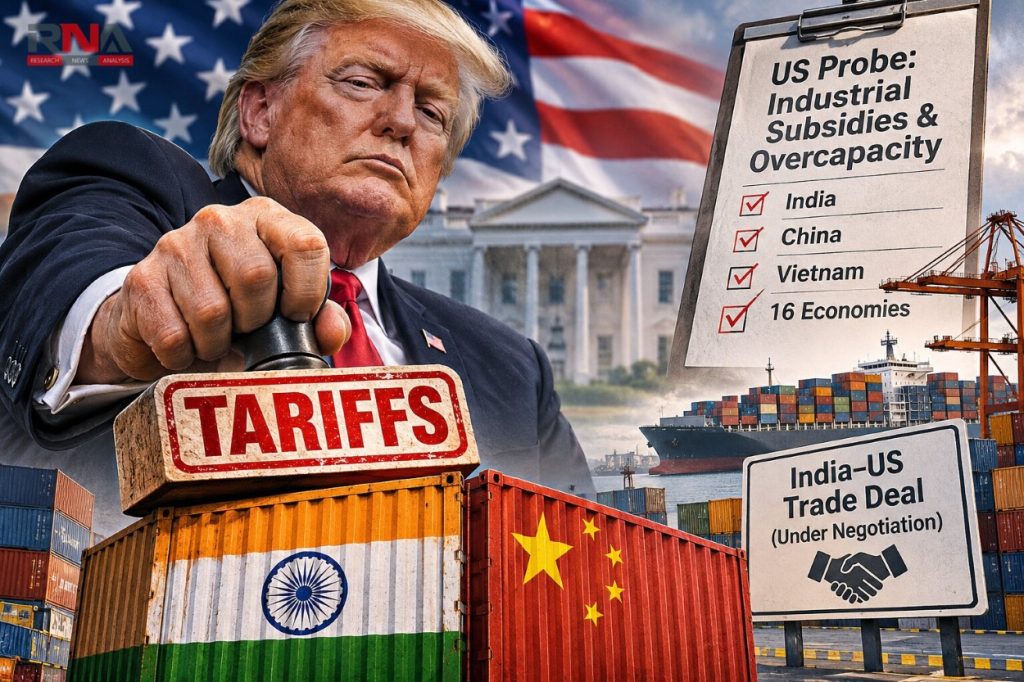
New Delhi: India faces the prospect of another increase in US import duties as the Donald Trump administration prepares to unveil a fresh round of tariffs targeting economies accused of unfairly subsidizing their domestic industries. The move, which could also hit China and several major US trading partners, threatens to complicate New Delhi’s ongoing negotiations with Washington for a bilateral trade agreement.
The US trade representative, Jamieson Greer, is expected to announce the findings of a months-long investigation into industrial subsidies and excess manufacturing capacity as early as this week, according to the Wall Street Journal. While the precise tariff rates remain unclear, India and Vietnam could face higher duties than the European Union (EU), Japan and South Korea, which are expected to attract overall levies of 15 per cent or less.
The development marks a renewed push by the White House to reconstruct the protectionist trade regime that suffered a major legal setback in February this year, when the US supreme court struck down Trump’s earlier tariffs imposed under emergency economic powers. The administration is now seeking to achieve similar objectives through alternative provisions of American trade law.
Why Washington is targeting industrial subsidies
The investigation, launched on March 11, covers 16 economies, including India, China, Japan, South Korea, Mexico, Vietnam, Taiwan, Bangladesh, Singapore, Switzerland, Norway, Thailand, Malaysia, Indonesia, Cambodia and the EU. It was initiated under Section 301 of the US Trade Act of 1974, which empowers Washington to respond to foreign trade practices considered detrimental to American commerce.
The Trump administration argues that government subsidies, preferential financing and other forms of state assistance have enabled manufacturers in several countries to produce goods far beyond domestic demand. Washington maintains that the resulting surplus production finds its way into international markets at artificially competitive prices, undermining American manufacturers and employment.
However, industrial incentives are hardly unique to the countries under investigation, with the US itself providing substantial government support to strategically important sectors, including semiconductors and advanced manufacturing. Determining whether such incentives constitute unfair trade practices remains a contentious issue in international commerce.
According to Reuters, the proposed duties could be added to tariffs introduced in July against economies accused of inadequately enforcing restrictions on goods manufactured using forced labour. Those measures, which imposed duties of 10–12.5 per cent on 60 trading partners, are themselves facing a legal challenge.
Products such as steel, aluminium and automobiles could be excluded from the latest measures because they are already subject to separate tariffs imposed on national-security grounds. Washington is also reportedly considering mechanisms to increase duties further if countries fail to address American concerns over industrial overcapacity.
What the new tariffs could mean for India
The timing is particularly significant for New Delhi, which has been attempting to conclude a trade agreement with Washington following months of difficult negotiations. The two countries announced a framework for an interim trade agreement in February, under which the US agreed to bring its reciprocal tariff on Indian goods down to 18 per cent.
The arrangement had offered considerable relief after Indian exports were subjected to combined duties of up to 50 per cent in 2025, partly because of New Delhi’s purchases of Russian crude oil. However, the subsequent supreme court ruling disrupted the legal framework underpinning those tariffs.
On November 18, the commerce secretary, Rajesh Agrawal, indicated that negotiations on the first tranche of the bilateral trade agreement were virtually complete, but its signing depended on greater clarity regarding Washington’s emerging tariff structure. The latest development could therefore prove decisive in determining the commercial value of the negotiated agreement.
The US remains India’s largest export market, with New Delhi recording a bilateral merchandise trade surplus of nearly $34 billion during the 2025–26 financial year. Higher duties could particularly affect labour-intensive Indian industries, including textiles, garments, footwear, leather goods and engineering products, where even relatively small differences in tariffs can influence sourcing decisions by American importers.
Much will also depend on the rates imposed on India’s competitors, particularly Vietnam and Bangladesh. If these countries face comparable or higher duties, Indian manufacturers could retain their relative competitiveness despite increased costs.
China likely to face heavier tariffs
China is expected to remain the principal target of Washington’s latest trade measures, given its dominance in several manufacturing sectors. Beijing has consistently rejected American allegations of unfair industrial overcapacity, arguing that its export performance reflects technological progress, manufacturing efficiency and competitive advantages.
The proposed measures could also affect Chinese investments in Southeast Asian manufacturing hubs, which Washington suspects are being used to circumvent existing American tariffs. However, the extent of any immediate increase in duties on Chinese goods could depend on the bilateral trade truce currently scheduled to expire on January 10, 2027.
The announcement also comes amid intensifying congressional scrutiny of the Trump administration’s technology policy towards Beijing. As RNA Media reported, Trump personally intervened to facilitate Jensen Huang’s reinstatement as Nvidia’s chief executive despite continuing concerns surrounding alleged Chinese espionage and the diversion of advanced American artificial intelligence chips.
Trump presses ahead despite domestic opposition
The renewed tariff offensive comes barely three weeks after the Republicans suffered setbacks in the US midterm elections, in which the rising cost of living emerged as a major concern. A post-election Reuters/Ipsos survey found that 62 per cent of respondents supported efforts to roll back Trump’s tariffs.
Although tariffs are intended to protect domestic manufacturers, the duties are initially paid by American importers rather than foreign governments. Depending on market conditions, businesses may absorb the additional costs, seek concessions from overseas suppliers or pass them on to American consumers.
The administration nevertheless appears determined to restore much of its earlier tariff regime despite having been compelled to refund billions of dollars in duties following its supreme court defeat.
For India, the immediate challenge is to secure predictable access to the American market without compromising its domestic industrial policies or broader economic interests. The eventual tariff schedule could determine not only the future of the bilateral trade agreement but also India’s ability to position itself as an alternative manufacturing destination to China.