


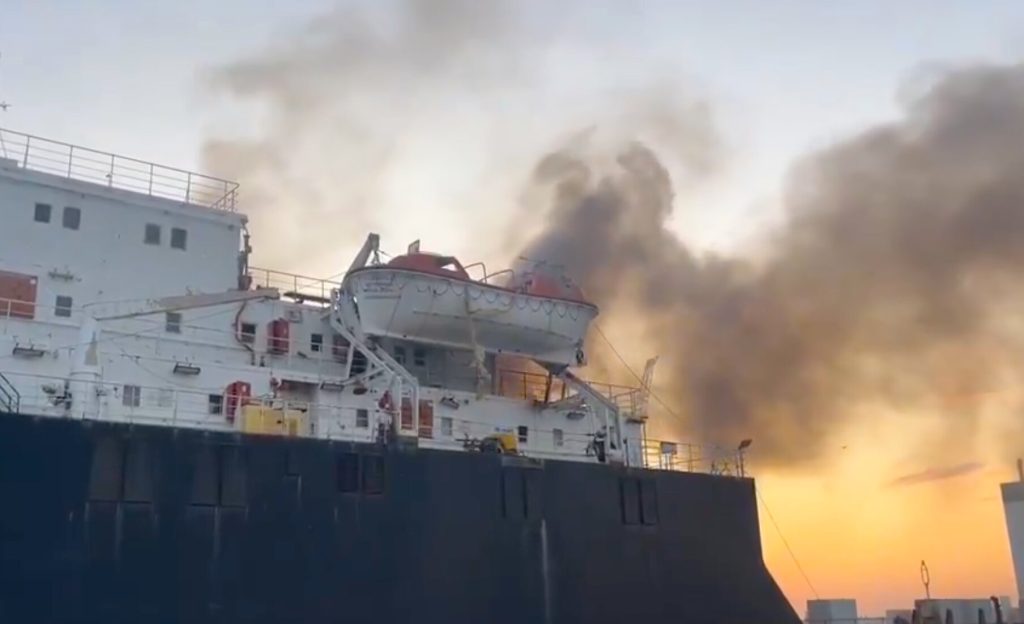
New Delhi: At least 13 Indian seafarers are among the 15 crew members stuck aboard a cargo vessel berthed at Ukraine’s Chornomorsk port, caught in the path of intensifying Russian drone and missile strikes along the Black Sea coastline. The Forward Seamen’s Union of India (FSUI) said on Tuesday that the Tanzania-flagged general cargo ship MV Amir1 was facing a “terrible and life-threatening situation”, with repeated attacks reported in the immediate vicinity of the vessel.
In a post on X, the union said the crew was living under constant fear of a direct hit, and released a video, purportedly filmed from on board, showing thick columns of smoke rising near the port.
The union has appealed to the Indian government, the ship’s owners, its flag state and other concerned authorities to move swiftly to secure the crew’s safety and arrange their evacuation and repatriation, warning that the danger grows with each day the vessel remains in the conflict zone. The account sits uneasily alongside an earlier assessment from India’s own maritime regulator.
The Directorate General of Maritime Administration said on Tuesday that all crew aboard MV Amir1 were safe, despite missile strikes reported in the area – a discrepancy that has yet to be reconciled publicly. Neither the Ministry of External Affairs nor the company operating the vessel had issued a formal statement by the time of writing.
Deadly fortnight for Indian mariners
The Amir1 episode is the latest in a run of attacks on merchant shipping around Ukraine’s southern coast that has turned the Black Sea into one of the most hazardous stretches of water for civilian crews anywhere in the world.
On July 18, the MV Omorfi came under fire while transiting Russian territorial waters in the Black Sea. Of its 10 crew, three were Indian; one was killed. The Indian embassy in Moscow has since remained in contact with the relevant authorities over the case. As reported by RNA Media, the MEA summoned the Ukrainian ambassador to India, Oleksandr Polishchuk, to register serious concern over the attack, on July 27.
The following day brought a heavier toll. The Guinea-Bissau-flagged bulk carrier MV Golden Leo, carrying roughly 22,000 tonnes of wheat out of Odesa bound for Türkiye, was struck by Russian missiles shortly after departure. Ten people died, including a Ukrainian harbour pilot, and four of the five Indian nationals on board were among the dead; a fifth remains critically injured.
New Delhi summoned the Russian chargé d’affaires, Vladimir Ladonov, to lodge a formal protest, calling the targeting of commercial shipping and civilian crews unacceptable and a threat to the safety and stability of international maritime trade. The Golden Leo later capsized and sank off Odesa after burning for close to a week.
Two Indian seafarers aboard the Palau-flagged MV AGN Ragnar, hit near Odesa a few days later, remain unaccounted for. Taken together, the toll of Indian mariners killed in Black Sea attacks over the past fortnight stands at no fewer than five, with more unaccounted for or, as with the Amir1 crew, stranded.
Why Chornomorsk matters
Chornomorsk, roughly 20 kilometres southwest of Odesa, is one of the ports that has kept Ukraine’s seaborne grain and cargo exports moving since Russia’s 2022 invasion, operating under an informal corridor that both sides have periodically threatened to disrupt. Its continued use by foreign-flagged merchant vessels – and by the Indian seafarers who form a disproportionately large share of the world’s commercial crewing workforce – means any escalation there carries consequences well beyond the immediate conflict.
With Moscow and Kyiv both accused in recent weeks of striking vessels flying third-country flags, India has summoned diplomats from both capitals to register its concern. Whether that diplomatic pressure translates into safe passage for the Amir1’s crew remains, for now, an open question.
Two Indian seafarers stranded in Iran
Two Indian seafarers remain stranded for 12 months on vessel PSD-1 at Port Bushehr in Iran. The FSUI in a post on X said these seafarers are trapped in an active conflict zone, with shelling and attacks striking within just 100 metres of their location. On 5 March, desperate to survive, they leapt overboard and swam toward the port – but the vessel’s owner forced them back onto the ship.
They have gone unpaid for a full year, and the ship has no electricity, no working generator, and dwindling supplies of food and water. With no repatriation arranged, they are effectively marooned – cut off from the outside world as though stranded on an uninhabited island.
Given that the Indian Embassy has already advised Indian nationals to evacuate Iran, “we strongly request that these two seafarers also be accommodated under the same advisory for their immediate repatriation,” the FSUI said.