


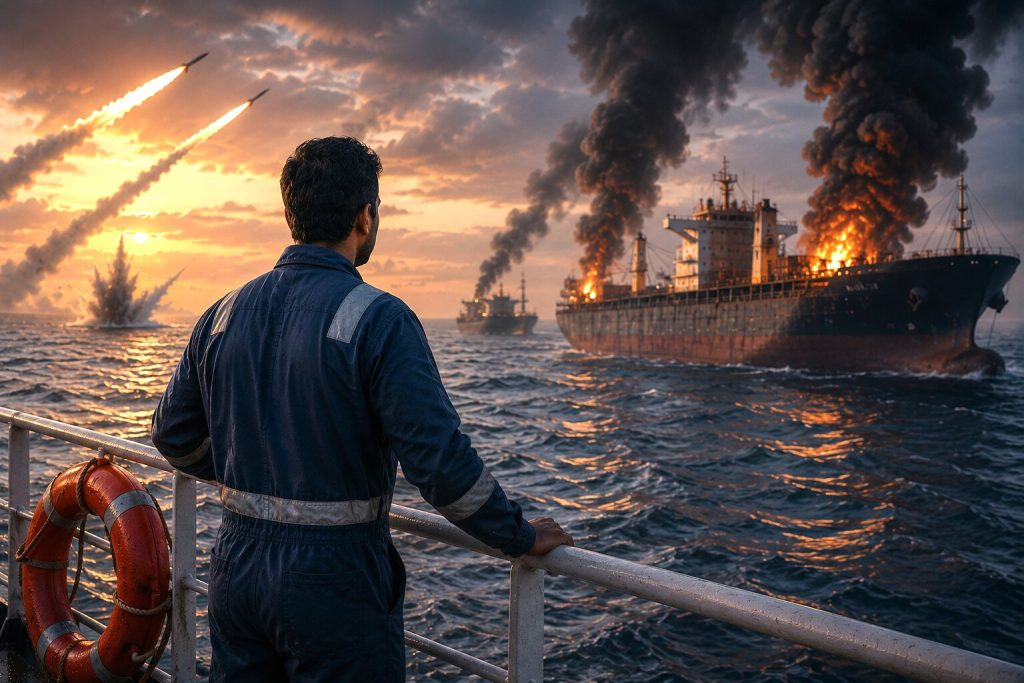
Within the space of a single week this month, five Indian sailors died on two different merchant ships in the Black Sea. They had no stake in Russia’s war with Ukraine. They were doing what Indian seafarers have quietly done for generations – moving cargo so that the world’s refineries, granaries and factories never run dry.
On July 19, the bulk carrier MV Golden Leo was hit by missiles while leaving Ukraine’s Odesa port carrying grain, killing four of the five Indian nationals on board and critically injuring the fifth. A day earlier, on July 18, the vessel MV Omorfi came under attack elsewhere in the Black Sea, killing one of the three Indians among its 10-member crew. New Delhi summoned Russia’s charge d’affaires in protest and condemned both strikes as attacks on innocent civilian crew.
Two fronts, one workforce in crossfire
These two ships are only the latest entries in a grim ledger that Indian seafarers have been filling since February 28, when the United States and Israel went to war with Iran and the Strait of Hormuz – the narrow chokepoint carrying roughly a fifth of the world’s oil and gas – effectively shut down. At least 14 Indians have died in attacks linked to that conflict since it began, at least eight of them merchant seafarers, according to government and industry estimates.
About 20,000 seafarers were left stranded on nearly 2,000 ships in and around the Gulf at the height of the closure, the International Maritime Organization has said.
The Red Sea has added a third layer of risk. The Iran-aligned Houthi militia in Yemen has targeted commercial shipping there intermittently since late 2023, sinking vessels, killing crew and, in July 2025 alone, killing four seafarers in two separate attacks, two of them Indian nationals working as security guards on the bulk carrier Eternity C. The threat has ebbed and flared with the wider West Asia conflict rather than disappeared.
Some of these deaths have names and families attached to them. Aditya Sharma, Shivanand Chaurashiya and Patnala Suresh were three Indian crew members killed on June 10 when a US strike hit the tanker MT Settebello in the Gulf of Oman, close to the strait. In Visakhapatnam, Suresh’s widow, Bhargavi, has since struggled to accept that a man with no uniform and no weapon could be killed the way a combatant might be.
Weeks later, another Indian seafarer, Rohan Kumar, was killed when Emirati oil tankers came under missile fire in the same strait, a death that finally pushed New Delhi to launch a dedicated protection programme for its seafarers. Each of these men had signed on for a wage, not a war.
Indians among world’s seafarers
The scale of India’s exposure comes down to a simple fact: almost no country sends more people to sea than India, barring the Philippines. India now supplies just over 12% of the world’s seafaring workforce, according to the 2026 Seafarer Workforce Report, with close to 3.2 lakh active Indian seafarers as of June 2025, nearly three times the number a decade ago. Among ratings and junior crew specifically, where India’s growth has been sharpest, some industry estimates place the country’s share closer to one in every five seafarers worldwide.
That workforce has roughly doubled in the last 10 years even as the officer-to-rating ratio has flipped, from 60:40 in 2010 to 35:65 in 2024. India is no longer just supplying captains and chief engineers to the world’s fleets. It is supplying the bulk of the hands that keep ships running from the engine room to the deck.
That scale is precisely why Indian seafarers matter well beyond India’s own borders. Close to 80% of world trade by volume still moves by sea, and someone has to crew the tankers carrying crude oil and LNG, the bulk carriers hauling grain and coal, and the container ships stacked with everything from medicines to smartphones. Roughly nine in 10 Indian seafarers work not on Indian-flagged ships but on vessels owned, managed and insured by other countries.
That means an Indian engineer or able seaman today is as likely to be keeping a Greek tanker, a Turkish bulk carrier or a Japanese container ship running as an Indian one. Pull Indian crews off the world’s merchant fleet tomorrow, and oil majors, grain traders and container lines from Rotterdam to Yokohama would feel the shortage within weeks. For India itself, the stakes are just as real, if less visible: seafarer remittances bring in an estimated $4 billion to $6.5 billion a year in foreign exchange, sustaining families across Kerala, Andhra Pradesh, Maharashtra and Odisha long before any ship ever runs into trouble.
What could actually keep them safe
None of this is inevitable. Since March 2026, the International Maritime Organization has been pushing for a safe corridor to evacuate stranded crew from the Gulf, an idea modelled loosely on the Black Sea grain corridor that Russia, Ukraine and Turkey once ran out of Istanbul, and it deserves far more diplomatic muscle than it has received. The International Transport Workers’ Federation and shipowners already classify the Strait of Hormuz and parts of the Black Sea as warlike operations areas, entitling covered seafarers to a full wage bonus, doubled death and disability compensation, and the right to refuse a voyage and be repatriated.
Those protections need to be widened and enforced, not treated as a bargaining chip.
India has its own part to play, and has begun to play it. The shipping ministry’s Seafarer First programme, launched this month by the Union minister of ports, shipping and waterways, Sarbananda Sonowal, tracks every Indian seafarer in West Asia regardless of which flag their ship flies, and assigns a liaison officer to each affected family. The renamed Directorate General of Maritime Administration has barred fresh deployment of Indian crew to the Strait of Hormuz and ordered voyage-specific risk assessments before ships enter the Black Sea, while the Navy continues to run escort and rescue patrols in the Gulf of Aden and the western Indian Ocean.
These are useful first steps, but they still leave hundreds of thousands of Indians on foreign-flagged ships outside New Delhi’s direct writ. The deeper fix has to be diplomatic and legal. India, almost alone among major powers, still talks comfortably to Moscow and Kyiv, and to Washington and Tehran, and it should use that position to press all four capitals on one narrow, specific demand – that unarmed merchant crews are not legitimate targets, whatever flag their ship happens to fly.
Alongside that, the world needs faster war-risk insurance payouts, real penalties for shipowners who abandon crew mid-conflict (Indian seafarers topped the global list of abandoned crew in 2025, with 1,125 cases recorded by the International Transport Workers’ Federation), and a standing international mechanism to open safe corridors the moment a conflict threatens commercial shipping, rather than negotiating one from scratch every time.
The ships keep moving because the men and women on them keep showing up, even to waters that have become genuine war zones, because a family back home needs the wages that only a foreign voyage can bring. They are owed more than a condolence statement after they die. They are owed the basic guarantee that doing their job should not cost them their lives.